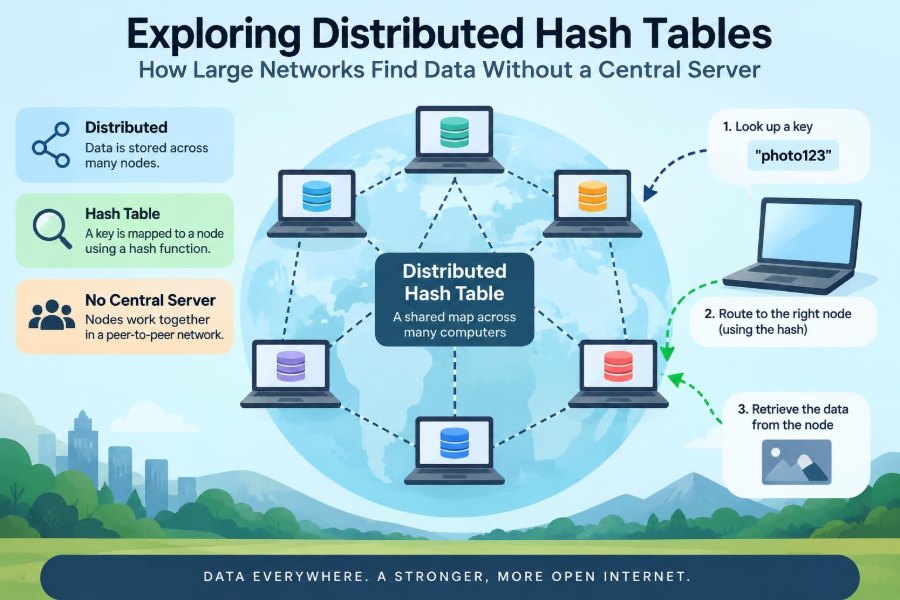

You type a filename into a shared application, request a file from a peer-to-peer network, or ask a decentralized service where a piece of data lives. Somewhere, a system has to answer a basic question: which machine has it?
A traditional service sends that question to a central database or directory. That design is often convenient, but it also makes the directory a potential bottleneck, outage point, or target for attack.
Large decentralized networks need another approach. They must locate data even as computers join, leave, fail, and sit behind changing internet connections.
A distributed hash table, usually shortened to DHT, is a clever answer. It spreads the job of indexing and finding data across participating machines, without requiring any one machine to know the entire network.
🧭 The Core Problem: Finding Data at Scale
Imagine a network with millions of participating computers, called nodes. A node may store a file, a message, a record, or simply information about where a file can be found.
If every node asked every other node whether it had a requested item, each lookup would create enormous unnecessary traffic. A DHT gives the network a repeatable route toward the responsible node instead.
The key idea is simple: data is assigned an identifier, and nodes cooperatively maintain a way to find the node responsible for that identifier.
🏛️ What a Central Directory Does
Centralized systems commonly use an index: a server maps names or identifiers to locations. For example, a service might map a username to an account record, or a document ID to storage servers.
This approach can be fast and straightforward to manage. Administrators can apply policy, make backups, and monitor one well-defined system.
But centralization concentrates responsibility. If the directory is unavailable, overloaded, censored, or compromised, users may be unable to locate data even when copies of that data still exist elsewhere.
🧩 What Makes a Table “Distributed”
A hash table normally stores key-value pairs. A key identifies an item, and a value is the associated information. For instance, a key might be a document identifier and the value might be the addresses of nodes holding that document.
In a DHT, no single computer holds the full table. The table is logically one structure, but its entries and routing knowledge are divided among many nodes.
Each participant keeps only a small portion of the information needed to route requests. Together, those partial views allow the network to answer lookups.
🔐 Hashing Turns Names into Keys
A hash function takes input of arbitrary length and produces a fixed-length output. A filename, public key, or block of data can therefore become a compact-looking identifier, often represented as a long sequence of bits or hexadecimal characters.
For a DHT, the hash output is the key. The same input passed through the same hash function produces the same key, allowing independent nodes to calculate it consistently.
Hashing does not tell us whether content is trustworthy or readable. It mainly provides a predictable way to place and locate identifiers across a large key space.
🗺️ The Shared Identifier Space
DHT designs treat node IDs and data keys as points in the same large numerical space. A node might choose or derive an ID, while a file or record receives its own hashed key.
The protocol defines which node is responsible for which part of that space. A common rule is that a key belongs to the node with the numerically closest appropriate ID.
This shared map is conceptual rather than physically drawn. Nodes do not need a global map; they need enough carefully selected contacts to move a request closer to its destination.
📮 Keys Point to Values, Not Always Files
A DHT value can be many things. It may be a small metadata record, a public-key-related record, a list of peer addresses, or a pointer to content stored elsewhere.
That distinction matters. Many DHT-based systems do not store large files directly in the routing layer. Sending large objects through every routing participant would be inefficient and would complicate storage management.
A common pattern is to store a compact record that says, in effect, “these peers currently claim to have content associated with this key.”
🛣️ Routing Replaces Broadcasting
When a node wants a key, it sends the query to another node that appears closer to that key according to the DHT’s distance rule. That node either has a useful answer or suggests still-closer contacts.
The requester repeats this process until it reaches the responsible node or gathers the best available result. This is called a lookup.
Rather than contacting everyone, the request travels through a short sequence of increasingly relevant nodes. The quality of that routing process determines whether a DHT remains practical at scale.
📏 Distance Is a Mathematical Rule
In DHTs, “near” rarely means physically nearby on the internet. It usually means numerically near in the identifier space.
One influential approach uses XOR distance. XOR compares the bits of two identifiers; the resulting number expresses how different they are. A smaller XOR result means a closer identifier under that protocol.
This may seem abstract, but it creates a consistent rule every node can calculate locally. It also avoids requiring geographic knowledge or a central authority to assign routes.
🔄 A Simple Lookup Example
Suppose a hypothetical DHT uses identifiers from 0 to 999. Your node seeks key 730 but only knows nodes near 100, 500, and 680. It asks node 680 because that is currently the closest known option.
Node 680 replies with contacts near 710 and 745. Your node queries those, discovers node 728, and eventually reaches the node responsible for key 730.
Real DHTs use much larger identifier spaces and more careful rules, but the pattern is the same: each hop should provide better guidance than the last.
🌳 Structured Overlays Create Order
A DHT is a type of structured overlay network. “Overlay” means the logical connections used by the protocol sit on top of the ordinary internet.
Your computer may be physically connected through home routers, providers, and backbone networks, while its DHT neighbors are chosen because their identifiers help with routing. The logical topology serves the lookup algorithm, not necessarily network geography.
This structured arrangement distinguishes DHTs from unstructured peer-to-peer systems, where searches may rely more heavily on flooding, random walks, or ad hoc neighbor relationships.
🧱 Kademlia and Other DHT Designs
DHT is a family of ideas, not one single protocol. Different designs define distance, neighbor tables, replication, and failure handling in different ways.
| Design family | Basic routing idea | Common teaching point |
|---|---|---|
| Chord | Routes around a circular identifier ring | Shows successor responsibility and shortcut fingers |
| Pastry | Progressively matches identifier prefixes | Illustrates prefix-based routing tables |
| Kademlia | Uses XOR distance and buckets of contacts | Widely used as a practical reference design |
Kademlia is especially well known because its routing approach handles a changing population effectively. Its contact groups, often called k-buckets, retain nodes at different XOR distances.
🪣 Why Routing Tables Stay Small
A node cannot realistically maintain direct contact with every participant. Instead, it keeps a routing table containing a limited set of strategically useful contacts.
In Kademlia-like systems, contacts are grouped by distance ranges. This gives a node some knowledge of nearby IDs and progressively farther portions of the key space.
With good shortcuts, lookup hops tend to grow slowly as the network grows. The usual goal is behavior that is roughly logarithmic in network size, rather than one hop per participant.
🚪 Joining a DHT Network
A new node needs an initial contact, sometimes called a bootstrap node. Bootstrap information does not usually grant central control; it simply gives the newcomer someone to ask first.
The joining node selects or derives an identifier, performs lookups near its own ID, and learns about neighbors relevant to its position in the identifier space. Other nodes gradually learn about it through normal communication.
Bootstrap contacts can still be operationally significant. If users cannot discover a reachable starting point, joining becomes difficult even if the DHT itself has no permanent central directory.
🚶 Nodes Leave, Fail, and Return
On open networks, participants are unstable. Laptops sleep, phones switch networks, servers restart, and home connections disappear without warning. This ongoing membership change is called churn.
A DHT expects churn rather than treating it as an exceptional event. Nodes periodically refresh contacts, check whether peers respond, and replace stale routing entries.
Without maintenance, routing tables slowly point to dead machines. Lookups then become slower or fail, even though suitable live nodes may exist elsewhere in the network.
📚 Replication Keeps Records Available
Storing a key-value record on only one responsible node is risky. If that node goes offline, the record may become temporarily unreachable.
For this reason, DHT applications often replicate records to several nodes near the key or use other redundancy rules. A lookup can then try multiple candidates.
Replication improves availability, but it introduces trade-offs: extra storage, extra network traffic, and questions about which version of a changing value should be treated as current.
⏳ Expiration and Republishing
Many DHT records have a time-to-live, meaning they expire unless refreshed. For peer-discovery records, this is useful: a peer that has left should not remain advertised forever.
Nodes that still provide a value republish it periodically. Receivers may also cache useful records for a limited time to speed up later queries.
Expiration does not guarantee perfect freshness. Networks experience delays, partitions, and clock-related complications, so applications should be designed to handle stale or missing information gracefully.
⚡ Parallel Queries Reduce Delays
A lookup does not always query one node and wait before trying the next. Many DHT implementations query several promising contacts in parallel.
Parallelism helps when one node is slow, unreachable, or malicious. It can also reduce overall lookup time because useful replies arrive concurrently.
Too much parallelism wastes bandwidth and can increase load. Protocols therefore choose a modest concurrency setting rather than contacting every candidate at once.
🧠 Caching Makes Popular Lookups Cheaper
If many users request the same key, repeatedly tracing the entire route can be wasteful. Caching lets nodes retain recently discovered values or routing information for later use.
This can improve responsiveness and reduce repeated traffic. It is particularly useful for data that changes infrequently.
The cost is consistency. A cache may return an older value after the original record has changed, so applications need expiry rules, versioning, signatures, or other ways to assess what they received.
📦 DHTs in Peer Discovery
One common use of a DHT is peer discovery. Instead of storing the content itself, the DHT maps a content-related key to network contacts for peers that may offer it.
A client first performs a DHT lookup, then directly contacts the returned peers to request data. The DHT acts more like a distributed phone book than a distributed hard drive.
This division of labor is practical: the routing layer handles small discovery messages, while direct connections carry the larger transfers.
🌐 Other Practical Uses
DHTs can support more than file sharing. They are useful whenever participants need to locate information or services without relying on one directory server.
- Finding nodes that offer a named service
- Locating content addressed by a cryptographic identifier
- Building decentralized naming or metadata layers
- Discovering communication peers in distributed applications
- Coordinating small, replicated application records
Whether a DHT is appropriate depends on the data model. It is strongest for key-based retrieval, not for every kind of database query.
🔎 What DHTs Do Not Do Well
A DHT is excellent at “find the value for this key.” It is much less naturally suited to questions such as “find all records matching these five conditions” or “sort every item by date.”
Complex queries normally require additional indexing systems, application-specific structures, or a conventional database. Trying to force rich relational queries into a basic DHT often creates slow, complicated designs.
DHTs also do not automatically provide transactions, global ordering, or strong consistency. Those features require extra protocols and usually additional trade-offs.
🛡️ Security Starts with Trust Boundaries
Decentralization does not make a network automatically trustworthy. Any open DHT must assume that some participants may lie, disappear, send malformed messages, or attempt to steer traffic.
Cryptographic signatures can help verify that a record was created or authorized by the holder of a particular key. Hashes can help verify that downloaded content matches an expected identifier.
These tools answer different questions. A content hash checks integrity; a signature can establish authorship or authorization; neither alone proves that a peer is available, honest about every claim, or safe to connect to.
🎭 Sybil Attacks Challenge Open Membership
A Sybil attack occurs when one actor creates many apparent identities. In a DHT, an attacker may try to place identities near valuable keys and influence routes or stored records.
Open participation makes this hard to eliminate completely because creating a network identity can be inexpensive. Defenses may include rate limits, identity costs, diverse routing choices, reputation mechanisms, or trusted bootstrap arrangements.
Every defense changes the system’s openness or complexity. There is no universal fix that preserves every desirable property at once.
🕳️ Eclipse Attacks Isolate a Node
In an eclipse attack, an adversary tries to fill a target’s neighbor table with attacker-controlled nodes. The target may then receive filtered results, be directed toward bad routes, or become isolated from honest participants.
Maintaining diverse contacts, periodically refreshing routes, and avoiding overreliance on a small set of nearby peers can reduce exposure. Parallel lookups and multiple bootstrap sources also help make isolation harder.
These measures reduce risk rather than guaranteeing safety. Network design must account for hostile behavior from the beginning.
🔒 Privacy Is Not Automatic
A DHT lookup can reveal something about a node’s interests. Nodes along the route may observe requested keys, source addresses, timing patterns, or the fact that a particular record is being advertised.
Even when keys are hashes, they may be guessable if the underlying names are predictable. Hashing a public filename is not the same as encrypting it.
Applications with serious privacy requirements may need encryption, privacy-preserving transport, careful key design, or additional anonymity systems. A DHT alone should not be treated as a privacy guarantee.
📡 Network Reality Affects Performance
The identifier-nearest node may be on the other side of the world, while a physically closer node could have answered more quickly. Pure DHT routing optimizes logical distance, not always latency.
Network address translation, firewalls, intermittent mobile networks, and asymmetric upload capacity also affect who can accept incoming connections. Real deployments often add relay techniques or connection strategies around the DHT.
As a result, a protocol can be mathematically elegant yet still require substantial engineering to work reliably on the public internet.
⚖️ DHTs Versus Centralized Services
Centralized indexes usually offer simpler operations, clear accountability, and easier support for complex queries. They can be highly reliable when well-operated, but they concentrate control and infrastructure responsibility.
DHTs distribute participation and can continue functioning despite the loss of individual nodes. In exchange, they face churn, weaker control over participants, harder security problems, and less straightforward consistency.
The best choice follows the problem. A company inventory system may benefit from a managed database; a broad peer-discovery system may benefit from decentralized lookup.
🧪 Building a Small DHT as a Learning Project
A small simulation is an excellent way to understand DHT behavior. Start with nodes represented by numeric IDs, a simple distance function, and a routing table that stores a few contacts.
- Hash or assign IDs to nodes and sample keys.
- Define which node owns each key.
- Implement a lookup that forwards toward a closer known node.
- Remove nodes and observe how stale routes break lookups.
- Add replication, periodic refreshes, and parallel queries.
Keep security and internet-scale reliability out of the first version. Once routing is clear, the reasons for maintenance and defensive design become much easier to see.
🧯 Common Design Mistakes
A frequent mistake is assuming that distributing a table removes operational responsibility. DHT applications still need monitoring, protocol upgrades, abuse handling, bootstrap plans, and careful limits on resource use.
Another mistake is storing mutable data without defining ownership and conflict behavior. If two peers publish different values for one key, the application must know whether to reject one, merge them, keep versions, or use signed authority.
Finally, do not confuse content discovery with guaranteed delivery. A DHT can return a peer address, but that peer may be offline, slow, behind a firewall, or unwilling to serve the request.
🧰 Practical Questions Before Choosing a DHT
Before adopting a DHT, ask whether your core operation is genuinely key-based lookup. If most requests are “retrieve the object associated with this identifier,” a DHT may fit well.
- Can records tolerate eventual rather than immediate global consistency?
- What happens when nodes disappear for hours or days?
- How will users bootstrap into the network?
- Who is allowed to publish or update records?
- What prevents one actor from creating many identities?
- What metadata might a lookup expose?
Clear answers are more valuable than choosing a decentralized design because it sounds modern or resilient.
🌟 The Core Principle to Remember
A distributed hash table turns a huge membership problem into a routing problem. By giving nodes and data keys positions in a shared identifier space, it lets each node contribute a little knowledge instead of requiring any one node to know everything.
Its strength comes from structured cooperation: hashing creates stable identifiers, routing tables provide shortcuts, replication handles failures, and maintenance adapts to churn. Its limits come from the same openness that makes it decentralized: security, privacy, consistency, and real-world connectivity require deliberate design.
Think of a DHT as a distributed map with constantly changing local guides. No guide sees the whole territory, but the rules for asking the next guide can still lead a request to the right place.
Distributed hash tables show that large networks can find data through shared rules and partial knowledge, not only through a central server. That idea is useful far beyond any one peer-to-peer application—and it remains a powerful lesson in distributed systems design. 💻🗺️🔐