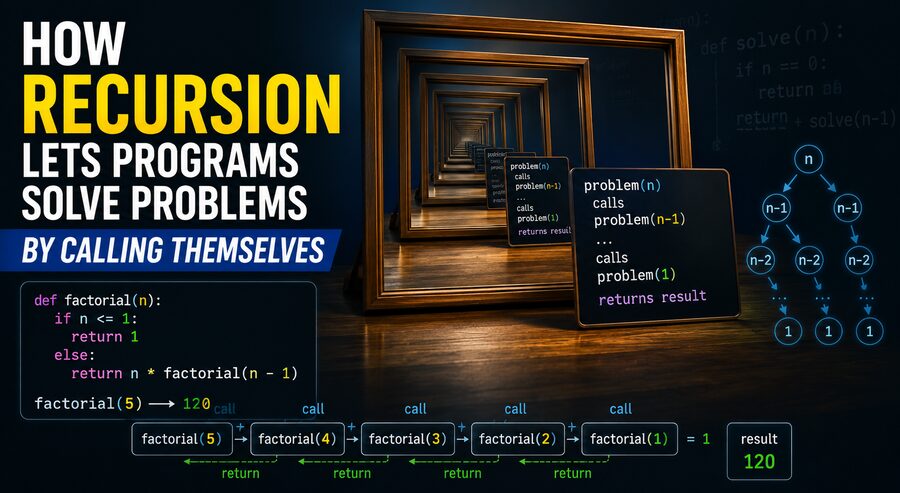

Recursion is one of the most interesting ideas in computer programming. At first, it can sound almost impossible: How can a function solve a problem by calling itself? 🤔
The answer is that recursion does not usually ask a function to solve the entire problem again. Instead, the function calls itself with a smaller or simpler version of the original problem. This process continues until the program reaches a condition simple enough to solve directly.
In other words, recursion works by repeatedly reducing a large problem into smaller versions of the same problem.
A recursive solution usually has two essential parts:
- A base case, which tells the function when to stop.
- A recursive case, which reduces the problem and calls the function again.
Together, these two ideas allow programs to solve tasks ranging from calculating factorials to searching folder structures, processing trees, exploring mazes, and implementing sophisticated algorithms. 🧠⚙️
🔁 What Is Recursion?
In programming, recursion occurs when a function calls itself, either directly or indirectly.
Consider a simple countdown:
countdown(3)A recursive function might behave like this:
countdown(3)
→ print 3
→ countdown(2)

countdown(2)
→ print 2
→ countdown(1)

countdown(1)
→ print 1
→ countdown(0)

countdown(0)
→ stop
The result would be:
3
2
1
Notice that each function call receives a smaller number.
Eventually, the value reaches zero. At that point, the function stops calling itself.
That stopping condition is the base case.
Without it, the function could continue calling itself indefinitely. ⚠️
🛑 Why Every Recursive Function Needs a Base Case
The base case is one of the most important concepts in recursion.
Imagine writing a function like this:
def countdown(n):
    print(n)
    countdown(n - 1)
If you call:
countdown(3)the function produces:
3
2
1
0
-1
-2
-3
...
There is no instruction telling the function when to stop.
Eventually, the program will run out of available call-stack space and produce an error.
A proper version would look like this:
def countdown(n):
    if n == 0:
        return

    print(n)
    countdown(n - 1)
Now the condition:
if n == 0acts as the base case.
Once n reaches zero, the function returns instead of calling itself again. ✅
🧩 The Recursive Case
The other major part of recursion is the recursive case.
This is the part where the function calls itself with a smaller or simpler input.
For example:
countdown(n - 1)Each call reduces n by one.
The important principle is that the recursive call must move the program closer to the base case.
A useful way to think about recursion is:
Solve one small part ➡️ Reduce the problem ➡️ Call the function again ➡️ Eventually stop
If the input does not become simpler, the recursion may never terminate.
🔢 A Classic Example: Factorials
One of the most common examples used to explain recursion is the factorial operation.
The factorial of a positive integer is the product of that number and all positive integers below it.
For example:
5! = 5 × 4 × 3 × 2 × 1 = 120
Mathematically, factorial can be written recursively:
n! = n × (n – 1)!
That means:
5! = 5 × 4!
And:
4! = 4 × 3!
Continuing:
3! = 3 × 2!
2! = 2 × 1!
Finally:
1! = 1
That last statement acts as the base case.
A recursive Python function could look like this:
def factorial(n):
    if n <= 1:
        return 1

    return n * factorial(n - 1)
Calling:
factorial(5)causes a chain of recursive calls.
🧠 What Actually Happens During Recursive Calls?
The computer does not immediately calculate the final result.
Instead, each function call is temporarily stored while waiting for the next recursive call to finish.
For factorial(5), the process begins like this:
factorial(5)
= 5 × factorial(4)

factorial(4)
= 4 × factorial(3)

factorial(3)
= 3 × factorial(2)

factorial(2)
= 2 × factorial(1)

factorial(1)
= 1
Once the base case is reached, the calls begin returning their results in reverse order:
factorial(1) = 1

factorial(2) = 2 × 1 = 2

factorial(3) = 3 × 2 = 6

factorial(4) = 4 × 6 = 24

factorial(5) = 5 × 24 = 120
This unwinding process is fundamental to understanding recursion. 🔄
📚 The Call Stack: How the Computer Remembers Everything
Recursive functions rely heavily on a memory structure called the call stack.
Whenever a function is called, the program stores information about that function call in a structure known as a stack frame.
A stack frame may contain information such as:
- Function parameters
- Local variables
- Return address
- Intermediate calculations
Imagine calling:
factorial(5)The stack might gradually look like this:
factorial(5)
factorial(4)
factorial(3)
factorial(2)
factorial(1)
The most recent call sits at the top of the stack.
Once factorial(1) returns, its stack frame is removed.
Then factorial(2) can finish.
Its frame is removed next.
This continues until the original call finishes.
The process follows the principle:
Last In, First Out — LIFO
The most recently created function call is the first one to complete. 📚
⚠️ What Is a Stack Overflow?
Because each recursive call uses some memory, recursion cannot continue forever.
If a function makes too many nested calls, the call stack may run out of available space.
This produces what is commonly called a stack overflow.
For example, a badly designed recursive function might look like this:
def repeat():
    repeat()
Calling repeat() creates another call, which creates another, and another, without ever reaching a base case.
Eventually, the program crashes or raises an error.
Some programming languages impose explicit recursion limits to prevent excessive stack usage.
For this reason, recursive algorithms must always be designed carefully.
🌳 Why Recursion Is Perfect for Tree Structures
Recursion becomes especially powerful when working with data structures that naturally contain smaller versions of themselves.
A tree is a perfect example.
A tree contains nodes, and each node may contain smaller subtrees.
Consider a simple family-like structure:
        A
       / \
      B   C
     / \
    D   E
To process the entire tree, a program can process node A and then recursively process each child.
A simplified algorithm might be:
def visit(node):
    if node is None:
        return

    print(node.value)

    visit(node.left)
    visit(node.right)
The same function can process every subtree because each subtree has the same basic structure as the larger tree.
This self-similarity makes recursion extremely natural. 🌲
📁 Recursion and Folder Structures
Computer file systems also have recursive structures.
A folder can contain:
- Files
- Other folders
- Folders inside those folders
- Even deeper nested folders
Suppose a program wants to search an entire directory for .jpg files.
It can:
- Examine the current folder.
- Process each file.
- If it finds another folder, call the same search function on that folder.
- Continue until no more folders remain.
This is a practical real-world example of recursion.
Operating systems, file explorers, backup applications, and search tools frequently need to work with hierarchical structures like this. 📂
🌀 Recursion for Solving Mazes
Recursion can also be used to explore possible paths.
Imagine a maze.
A recursive maze-solving algorithm might:
- Move to a possible neighboring position.
- Check whether that position is the destination.
- If not, recursively explore from the new position.
- If it reaches a dead end, return to an earlier position.
- Try another direction.
This technique is known as backtracking.
It is useful for problems such as:
- Maze solving
- Sudoku solving
- Chess search
- Puzzle solving
- Combination generation
- Constraint satisfaction
Recursion allows the program to explore one possibility deeply before returning and trying alternatives. 🧩
🔍 Recursion and Binary Search
Recursion is also useful in algorithms such as binary search.
Suppose you want to find a number in a sorted list.
Instead of examining every item, binary search checks the middle element.
If the target is smaller, it searches the left half.
If the target is larger, it searches the right half.
Each step reduces the search space by approximately half.
A recursive version might conceptually do this:
search entire list
→ search half the list
→ search half again
→ search half again
→ find the target
Because the problem becomes much smaller with each call, binary search can be extremely efficient. ⚡
🔄 Recursion vs. Loops
Many recursive problems can also be solved using loops.
For example, factorial can be written iteratively:
def factorial(n):
    result = 1

    for i in range(1, n + 1):
        result *= i

    return result
This version uses a loop instead of recursion.
So which method is better?
It depends on the problem.
Loops are often more memory-efficient because they do not create a new stack frame for every iteration.
Recursion, however, can produce code that is easier to understand when the problem itself has a recursive structure.
Tree traversal is a good example.
A recursive tree algorithm may be only a few lines long, while an iterative version might require the programmer to manually create and manage a stack.
🧮 The Fibonacci Example
Another famous recursive example is the Fibonacci sequence.
The sequence begins:
0, 1, 1, 2, 3, 5, 8, 13...Each number is the sum of the previous two.
A simple recursive definition is:
def fibonacci(n):
    if n <= 1:
        return n

    return fibonacci(n - 1) + fibonacci(n - 2)
This code looks elegant, but it has a serious performance problem.
To calculate fibonacci(40), the program repeats many calculations.
For example, it may calculate fibonacci(20) numerous times.
This demonstrates an important lesson:
Recursive code is not automatically efficient. ⚠️
🚀 Improving Recursion With Memoization
One way to improve inefficient recursive algorithms is memoization.
Memoization stores results that have already been calculated.
Instead of recalculating the same value, the program retrieves it from memory.
For Fibonacci numbers, the program might remember:
fibonacci(10) = 55If another recursive branch requests fibonacci(10), the answer can be reused immediately.
This technique is closely related to dynamic programming and can dramatically improve the performance of certain recursive algorithms. 🧠⚡
🧱 Divide and Conquer
Recursion is also central to a programming strategy known as divide and conquer.
The basic idea is:
Divide a large problem into smaller problems ➡️ Solve the smaller problems ➡️ Combine the results
Famous algorithms using this idea include:
- Merge sort
- Quick sort
- Binary search
- Certain matrix algorithms
- Computational geometry algorithms
For example, merge sort divides a list into two halves.
Each half is recursively sorted.
Then the two sorted halves are merged back together.
The same algorithm keeps solving smaller versions of the original sorting problem until the pieces are trivial.
📉 How Recursion Gets Closer to the Answer
A correct recursive algorithm needs what programmers sometimes call progress toward termination.
Consider:
factorial(n - 1)The value becomes smaller every time.
Eventually:
5 → 4 → 3 → 2 → 1The base case is reached.
Similarly, a recursive tree traversal moves downward until it reaches a node with no children.
A folder search continues until it reaches folders containing no more subfolders.
A maze algorithm explores until it finds the destination or reaches a dead end.
Good recursive algorithms always have a clear way of approaching completion.
✅ When Is Recursion a Good Choice?
Recursion is especially useful when:
- A problem can be divided into smaller versions of itself.
- The data structure is hierarchical.
- Tree or graph traversal is required.
- Backtracking is needed.
- Divide-and-conquer algorithms are appropriate.
- A recursive mathematical definition closely matches the problem.
It may be less appropriate when:
- Recursion depth could become extremely large.
- Memory usage is critical.
- A simple loop provides a clearer solution.
- The programming language has strict recursion limits.
- Repeated calculations make the recursive solution inefficient.
The best programmers do not use recursion simply because it looks clever. They use it when recursion makes the solution clearer or better suited to the structure of the problem. 💡
🧠 Direct and Indirect Recursion
Most introductory examples use direct recursion, where a function directly calls itself.
For example:
A → AHowever, recursion can also happen indirectly.
Function A might call Function B, which later calls Function A again:
A → B → AThis is called indirect recursion.
The underlying principle is still the same: a sequence of function calls eventually returns to an earlier function while moving toward some termination condition.
🌟 The Bigger Picture
Recursion is a powerful programming technique because it allows a complex problem to be expressed in terms of smaller versions of the same problem.
A recursive function typically follows a simple pattern:
Check the base case ➡️ Reduce the problem ➡️ Call itself ➡️ Return the result
Behind the scenes, the computer uses the call stack to remember each unfinished function call.
Once the deepest call reaches the base case, the program begins returning through the stored calls until the original problem is solved.
Recursion is especially useful for trees, folder structures, divide-and-conquer algorithms, searching, backtracking, and mathematical problems with recursive definitions. 🌳📂🧩
At the same time, recursion must be used thoughtfully. Poorly designed recursive functions can consume excessive memory, repeat unnecessary calculations, or cause stack overflows.
Understanding recursion therefore teaches more than just one programming technique. It introduces programmers to deeper ideas about problem decomposition, algorithm design, memory management, and computational thinking.
What initially seems like a strange concept—a function calling itself—becomes much easier to understand once you recognize the central pattern: solve one smaller piece, trust the recursive call to solve the rest, and make sure there is always a clear stopping point. 🔁💻