
Modern computer systems often need to answer a deceptively simple question:
“Have I seen this item before?” 🤔
A database may need to know whether a username exists. A web crawler may want to avoid revisiting the same URL. A distributed storage system might need to determine whether a file identifier is likely stored on a particular server. A browser security feature may want to quickly check whether a website appears on a large list of suspicious addresses.
Searching an enormous collection directly every time can be expensive. Reading data from disk, querying a remote server, or scanning a large index may take far more time than the program can afford.
This is where a clever probabilistic data structure called a Bloom filter becomes extremely useful. 🌸⚡
A Bloom filter can answer membership questions very quickly while using surprisingly little memory. Its tradeoff is unusual but powerful: it can occasionally say that an item probably exists when it actually does not, but it will not falsely say that an inserted item is absent under the standard Bloom-filter model.
That property makes Bloom filters excellent as fast preliminary checks before performing more expensive lookups.
🧠 What Is a Bloom Filter?
A Bloom filter is a compact data structure designed to answer questions of the form:
“Is this item possibly in the set, or is it definitely not in the set?”
Notice the wording.
A normal data structure such as a hash set might provide a direct yes-or-no answer.
A Bloom filter instead gives one of two answers:
- Definitely not present ❌
- Probably present ✅❓
If the Bloom filter says an item is definitely not present, the application can safely skip a more expensive search.
If it says the item is probably present, the application may perform a real database or storage lookup to confirm.
This ability to cheaply eliminate unnecessary work is the main reason Bloom filters are so valuable.
🧩 The Two Main Components of a Bloom Filter
A traditional Bloom filter consists of two things:
- A bit array
- Several hash functions
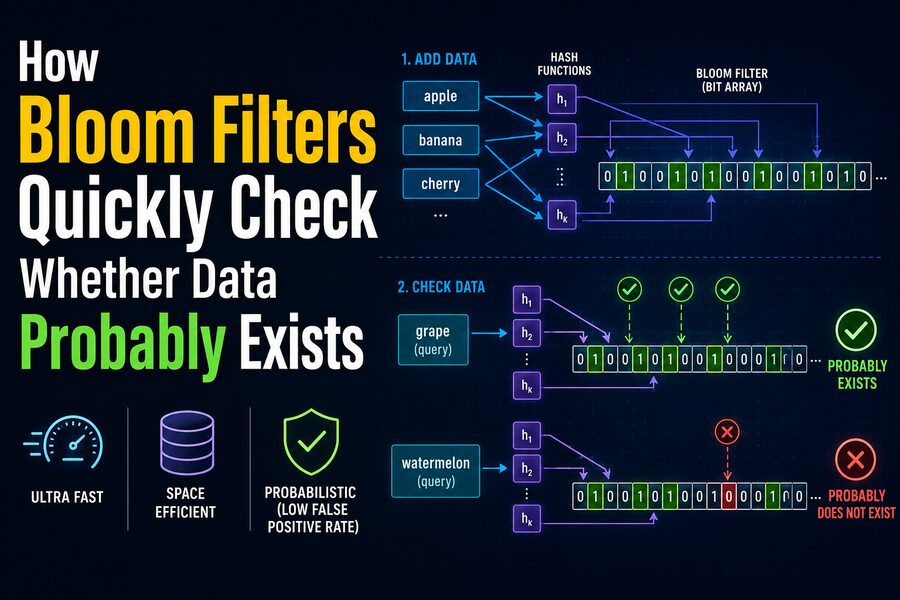
Imagine an array containing 16 positions, each holding either 0 or 1.
Initially, every bit is zero:
0 0 0 0 0 0 0 0 0 0 0 0 0 0 0 0
Now imagine we want to store the word:
“apple” 🍎
Instead of saving the actual word, the Bloom filter runs "apple" through several hash functions.
Suppose three hash functions produce these positions:
- Hash 1 → position 2
- Hash 2 → position 7
- Hash 3 → position 12
The Bloom filter sets those bits to 1:
0 0 1 0 0 0 0 1 0 0 0 0 1 0 0 0
The word "apple" itself is never stored.
Only these tiny markers remain.
That is one reason Bloom filters can use dramatically less memory than storing every original value.
➕ How Data Is Added to a Bloom Filter
Suppose we now insert another word:
“banana” 🍌
The hash functions might produce:
- Position 4
- Position 7
- Position 14
The filter sets those positions to 1.
Notice that position 7 was already set by "apple".
That is completely acceptable.
Multiple items are allowed to share bits.
As more data is inserted, more positions in the bit array become 1.
This overlapping of bits is both the source of the Bloom filter’s memory efficiency and the reason false positives can occur.
🔍 How a Bloom Filter Checks an Item
Now suppose the system wants to know whether:
“orange” 🍊
has already been inserted.
The Bloom filter runs "orange" through the same hash functions.
Imagine the resulting positions are:
- Position 1
- Position 7
- Position 10
The Bloom filter checks those three bits.
If even one of them is zero, then "orange" could not have been inserted.
Why?
Because inserting "orange" would have turned all three required positions into 1.
Therefore:
If any required bit is 0:
The item is definitely not present. ❌
This is one of the most important Bloom-filter guarantees.
✅ What Happens If Every Bit Is 1?
Suppose another search is performed for:
“grape” 🍇
The hash functions generate positions:
- Position 2
- Position 7
- Position 14
Imagine all three bits are already 1.
Does that prove "grape" was inserted?
No.
Those bits might have been set independently by "apple", "banana", and other items.
The Bloom filter therefore responds:
Probably present.
This situation is called a false positive if "grape" was never actually inserted.
🎯 False Positives Are the Key Tradeoff
Bloom filters deliberately accept a small probability of false positives in exchange for very low memory usage and extremely fast membership tests.
Suppose a storage system needs to determine whether a key exists on disk.
Without a Bloom filter:
Request → access disk → search index → discover key is absent
Disk access can be relatively expensive.
With a Bloom filter:
Request → Bloom filter check → definitely absent → skip disk access
⚡ The system avoids unnecessary work.
Occasionally, the Bloom filter might incorrectly say:
“Probably present.”
The system then performs the disk lookup and discovers that the key is actually missing.
That costs some extra time, but the result remains correct because the real storage system performs the final verification.
🚫 What About False Negatives?
A properly implemented standard Bloom filter does not produce false negatives as long as inserted entries have not been improperly removed and the filter’s assumptions hold.
If "apple" was inserted, the bits corresponding to its hash functions were set to 1.
Testing "apple" later will inspect those same positions.
Therefore the filter should respond:
Probably present.
It should not incorrectly respond:
Definitely absent.
This asymmetric behavior is extremely useful.
Bloom filters can incorrectly suspect that something exists, but they do not normally overlook something that was inserted.
⚡ Why Bloom Filters Are So Fast
Bloom-filter operations are computationally simple.
To test an item, the system generally needs to:
- Compute several hashes
- Check several bits in memory
There is no need to scan through every stored value.
If a filter contains information representing millions of items, checking membership may still require only a small, fixed number of bit lookups.
In complexity terms, Bloom-filter membership testing is effectively O(k), where k is the number of hash functions.
Since k is usually a relatively small constant, checks are extremely fast.
💾 Why Bloom Filters Use So Little Memory
Imagine storing one billion URLs.
Storing every URL in a conventional collection could require tens or hundreds of gigabytes depending on representation and indexing.
A Bloom filter does not store the URLs themselves.
Instead, it stores only a bit array encoding their membership probabilistically.
Depending on the desired false-positive rate, a Bloom filter may require only a modest number of bits per entry.
For example, with appropriately chosen parameters, systems can achieve false-positive probabilities around 1% while using roughly ten bits per stored item.
That is dramatically smaller than storing full strings or objects.
🧮 The Mathematics Behind Bloom Filters
Three important values determine Bloom-filter behavior:
- m = number of bits in the array
- n = number of inserted items
- k = number of hash functions
As more items are added, more bits become 1.
If too many bits become occupied, unrelated items increasingly map only to bits that are already set.
The false-positive rate therefore increases.
A commonly used approximation for the false-positive probability is:
p ≈ (1 − e^(-kn/m))^k
where:
pis the false-positive probabilityeis Euler’s number
Engineers use formulas like this to select the array size and number of hash functions before constructing the filter.
🎛️ Why More Hash Functions Are Not Always Better
It might seem that using more hash functions would always improve accuracy.
But there is a tradeoff.
Too few hash functions do not examine enough bits, which can increase collisions.
Too many hash functions set too many bits during insertion, filling the array faster.
There is therefore an optimal number.
For a standard Bloom filter, it is approximately:
k ≈ (m/n) × ln(2)
This means the ideal number of hash functions depends on how many bits are available per stored item.
Good Bloom-filter design is therefore partly an optimization problem. 🧮
🗄️ Bloom Filters in Databases
Databases are one of the most common applications.
Imagine a database organized into multiple files on disk.
A request arrives for:
customer_874129
Without filtering, the database might check several files to determine which one contains the key.
Instead, each file can have its own Bloom filter.
The database asks:
Could this key exist in file A?
If the answer is definitely no, file A is skipped.
Then:
Could it exist in file B?
Again, perhaps no.
Eventually, only a small number of files need expensive disk reads.
This technique is especially valuable in storage engines based on LSM trees, where data may exist across multiple sorted files.
Systems inspired by or using technologies such as Cassandra, RocksDB, HBase, and similar storage architectures have historically used Bloom-filter concepts to reduce unnecessary reads.
🌐 Bloom Filters in Web Crawlers
Search engines and web crawlers encounter enormous numbers of URLs.
Before visiting a webpage, a crawler may ask:
“Have we already processed this URL?”
Storing every URL in a traditional in-memory set might consume enormous amounts of RAM.
A Bloom filter can provide a compact preliminary check.
If the filter says the URL is definitely new, the crawler knows it can proceed.
If it says probably seen, additional checking may be performed depending on the application.
🌍 This makes Bloom filters attractive when billions of identifiers must be tracked efficiently.
🛡️ Security and Network Applications
Bloom filters can also appear in security and networking systems.
Potential uses include preliminary membership checks for:
🔐 Known malicious identifiers
🌐 Network addresses
📧 Spam-related data
🦠 Suspicious content signatures
📦 Cached objects
🔗 Previously encountered URLs
The important point is that a Bloom filter should generally act as an optimization layer, not as unquestionable proof.
Because false positives are possible, security-sensitive decisions may require confirmation using authoritative data.
📦 Bloom Filters in Distributed Systems
Distributed systems often store information across many machines.
Suppose a cluster contains 100 storage servers.
A request arrives for a particular object.
Rather than querying every server, a coordinator might maintain or consult Bloom filters describing which keys each server could contain.
If 95 servers report:
Definitely not present
the system can avoid contacting them.
Only the remaining likely candidates need to be queried.
This can reduce:
⚡ Network traffic
🧠 CPU work
💽 Disk operations
⏱️ Response latency
When operating at enormous scale, eliminating millions of unnecessary requests can have a substantial effect on efficiency.
🧹 Why Basic Bloom Filters Cannot Easily Delete Items
Deletion introduces an important limitation.
Suppose "apple" and "banana" both caused bit 7 to become 1.
If we delete "apple" and simply reset bit 7 to zero, we might accidentally break "banana" as well.
The Bloom filter no longer knows which inserted item was responsible for each bit.
Therefore, traditional Bloom filters do not safely support ordinary deletion.
🔢 Counting Bloom Filters Solve Part of the Problem
A variation called a Counting Bloom Filter replaces individual bits with small counters.
Instead of:
0 or 1
each position may store:
0, 1, 2, 3...
When an item is inserted, the relevant counters are incremented.
When an item is deleted, they are decremented.
This allows deletion while preserving information about overlapping entries.
The downside is increased memory consumption because each position now requires multiple bits rather than just one.
📈 Bloom Filters Can Become Too Full
Bloom filters are normally designed for an expected number of entries.
If an application inserts far more data than planned, the bit array becomes increasingly saturated.
Eventually, most bits may be 1.
At that point, almost every query produces:
Probably present.
The filter is technically still functioning, but it becomes nearly useless because it rarely rejects anything.
Engineers therefore need to estimate capacity correctly or use expandable alternatives such as scalable Bloom-filter designs.
🆚 Bloom Filter vs. Hash Table
A hash table can usually tell you whether an item actually exists.
A Bloom filter cannot.
So why use the Bloom filter?
Because it can be dramatically more memory-efficient.
A typical architecture may use both:
Bloom filter → fast inexpensive rejection → hash table/database only if necessary
They solve different problems.
A Bloom filter is not usually a replacement for the authoritative dataset.
It is a fast gatekeeper standing in front of it. 🚪
🎟️ A Simple Real-World Analogy
Imagine entering a huge concert venue.
Before sending every visitor to an expensive identity-verification desk, staff use a rapid preliminary scanner.
The scanner can say:
“This ticket number definitely isn’t on our guest list.” ❌
That person can immediately be redirected.
But sometimes it says:
“This ticket might be valid.” ✅
The visitor then proceeds to the full verification desk.
Occasionally, the scanner sends an invalid ticket for extra checking.
That is inconvenient, but harmless.
What matters is that it quickly eliminates a huge number of obviously invalid cases.
That is essentially how a Bloom filter helps computer systems.
🚀 Why Bloom Filters Matter at Internet Scale
For a small application containing a few hundred records, Bloom filters may be unnecessary.
But at massive scale, avoiding even a tiny amount of unnecessary work per request can produce enormous savings.
Imagine a system handling 50 million lookups every hour.
If a Bloom filter prevents 80% of unnecessary disk accesses, the reduction in storage traffic can be substantial.
The system may achieve:
💾 Lower storage load
⚡ Faster responses
💰 Lower infrastructure cost
📉 Reduced network usage
📈 Better scalability
This is why probabilistic data structures are so important in large-scale software engineering.
✅ Conclusion
A Bloom filter is an elegant example of how computer science can trade absolute certainty for enormous improvements in efficiency.
Instead of storing every original item, it uses a compact bit array and several hash functions to encode membership information.
When checking an item, the Bloom filter can reliably say:
“Definitely not present.” ❌
Or it can say:
“Probably present.” ✅
That second answer may occasionally be wrong because different inserted items can set overlapping bits, creating a false positive. But when the Bloom filter is used as a preliminary check before an authoritative lookup, these false positives usually affect performance rather than correctness.
This simple idea allows databases, storage engines, distributed platforms, web crawlers, caches, and network systems to avoid huge numbers of unnecessary operations.
The real power of Bloom filters is therefore not that they know exactly where your data is. 🌸💻
It is that they can often tell you—almost instantly—where your data definitely isn’t.