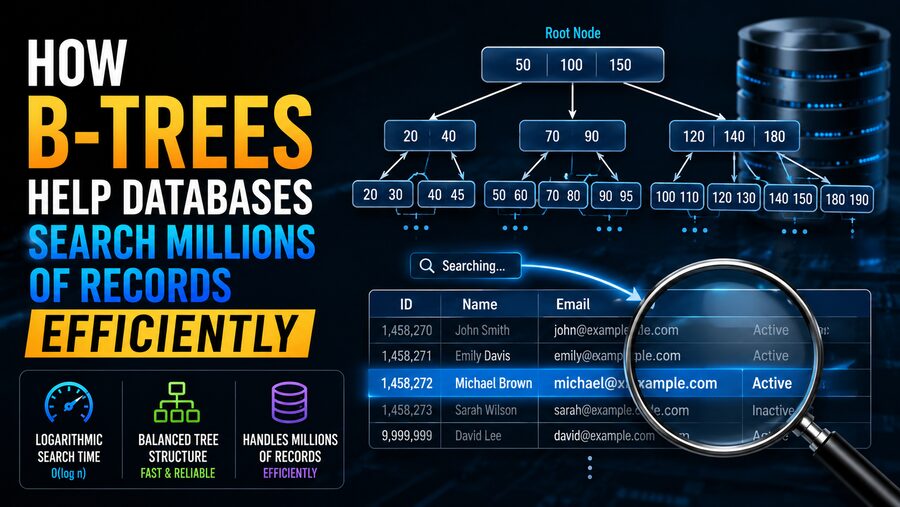

Modern databases can store an astonishing amount of information. A large e-commerce platform may contain millions of products and customer records, a banking system may process billions of transactions, and a social media service may need to locate a specific user or post among enormous datasets. 💾
Yet when you search for a customer by ID, look up an order number, or filter records by date, the database often responds in milliseconds.
How is that possible?
One of the key technologies behind this speed is a data structure called the B-tree. 🌳
B-trees are designed specifically for storing and searching large amounts of ordered data efficiently, especially when that data lives on disks or solid-state drives rather than entirely in memory. They are widely used in database indexes, file systems, and storage engines because they minimize expensive storage accesses while keeping search operations fast.
To understand why B-trees are so effective, it helps to first look at the problem databases are trying to solve.
📚 The Challenge of Searching Millions of Records
Imagine a database table containing 100 million customer records.
Suppose each row contains:
- Customer ID
- Name
- Email address
- Phone number
- Account status
- Registration date
Now imagine running this query:
Find the customer whose ID is 58,214,792.
Without an index, the database may have to perform a full table scan. That means checking record after record until the matching row is found.
In the worst case, the database might inspect nearly all 100 million records. 😬
This becomes increasingly expensive as the table grows.
A database therefore creates an index, which acts somewhat like the index at the back of a textbook. Instead of reading every page to find a topic, you consult the index and jump directly to the relevant location.
B-trees are one of the most common structures used to build these indexes.
🌳 What Is a B-Tree?
A B-tree is a balanced, multi-level search tree.
Unlike a simple binary search tree, where each node usually has at most two children, a B-tree node can contain many keys and many child pointers.
For example, a simplified node might contain:
[100 | 250 | 500 | 900]
These values divide the data into ranges.
The child pointers could represent:
- Values less than 100
- Values between 100 and 250
- Values between 250 and 500
- Values between 500 and 900
- Values greater than 900
This allows the database to eliminate large portions of the search space after examining just one node. 🔍
Because each node can contain many values, B-trees tend to be very wide and relatively shallow.
That shallow structure is extremely important for database performance.
🆚 Why Not Just Use a Binary Search Tree?
A binary search tree can also organize data efficiently.
In a balanced binary search tree, each node typically has two children:
- One containing smaller values
- One containing larger values
Searching one million records would require roughly 20 comparisons because:
2²⁰ ≈ 1,048,576
That sounds fast—and in memory, it often is.
But databases face another problem: disk access is much slower than memory access.
If every node of a binary tree were stored on a separate disk page, a search might require many storage reads.
B-trees solve this by storing many keys inside each node.
Instead of branching two ways, a B-tree node might branch into hundreds of possible paths.
This drastically reduces the number of levels the database must traverse. 🚀
💽 B-Trees Are Designed Around Storage Pages
Databases normally read and write data in blocks called pages.
A page might contain several kilobytes of data. Instead of reading one tiny value from storage, the database retrieves an entire page at once.
B-trees take advantage of this behavior.
A B-tree node is often sized so that it fits efficiently inside one database page.
That page can contain:
- Many index keys
- Pointers to child pages
- Record references
- Metadata
Once the page is loaded into memory, comparing keys inside it is very fast.
The database’s main goal is therefore to reduce the number of page reads needed to find a record.
B-trees excel at exactly that. ⚡
📉 How a B-Tree Reduces Search Depth
Suppose each B-tree node can point to 100 child nodes.
A tree with just a few levels can represent an enormous amount of data.
At the first level:
100 possibilities
At two levels:
100 × 100 = 10,000
At three levels:
100 × 100 × 100 = 1,000,000
At four levels:
100,000,000
So a B-tree with a branching factor around 100 might reach one of 100 million possible record ranges in only a few steps. 🤯
Real database indexes vary in size and structure, but the principle remains the same.
A high branching factor creates a shallow tree, and a shallow tree means fewer storage accesses.
🔎 Step-by-Step Example of a B-Tree Search
Imagine an index containing employee IDs.
The root node contains:
[1000 | 5000 | 9000]
You search for employee ID:
7250
The database compares 7250 with the keys in the root.
It determines:
5000 < 7250 < 9000
So it follows the child pointer representing values between 5000 and 9000.
That child node might contain:
[6000 | 7000 | 8000]
The database now determines:
7000 < 7250 < 8000
It follows the appropriate pointer again.
A leaf page may then contain entries such as:
7100, 7200, 7250, 7300, 7400
The database finds 7250 and uses the associated pointer to locate the actual row.
Instead of checking millions of records, the database may have examined only a handful of index pages. ⚡🔍
⚖️ Why B-Trees Stay Balanced
One of the most important characteristics of a B-tree is that it remains balanced.
In a balanced B-tree, all leaf nodes are generally at the same depth.
This means searching for one value does not require dramatically more levels than searching for another.
Without balancing, a search tree could slowly become distorted.
Imagine inserting sorted values:
1, 2, 3, 4, 5, 6, 7...
A poorly designed tree could become a long chain rather than a branching structure.
Searching such a structure could become nearly as slow as scanning a list.
B-trees prevent this through controlled node splitting and restructuring.
✂️ What Happens When a B-Tree Node Becomes Full?
Suppose a B-tree node can hold only four keys:
[10 | 20 | 30 | 40]
Now the database inserts:
50
The node no longer has enough space.
Instead of allowing the node to grow indefinitely, the B-tree splits it.
The keys are divided between two nodes, and a separator key is promoted to the parent level.
A simplified result might look like:
Parent:
[30]
Children:
[10 | 20] and [40 | 50]
This process allows the tree to expand while remaining balanced. 🌳
If the parent is also full, the split can propagate upward.
In rare cases, the root itself splits, increasing the tree’s height by one level.
➕ Efficient Insertions
B-trees are useful not only because they search quickly but also because they support efficient insertions.
When a new database row is inserted, the database:
- Locates the correct leaf node.
- Inserts the new index key in sorted order.
- Splits nodes if necessary.
- Updates parent references.
Because the tree stays balanced, the database does not normally need to rebuild the entire index after every insertion.
This is crucial for applications where data is constantly changing, such as banking systems, online stores, analytics platforms, and reservation systems. 🏦🛒
➖ What Happens During Deletion?
Deleting entries also requires maintaining the B-tree’s structure.
Removing a key can cause a node to become too empty.
The database may then:
- Borrow an entry from a neighboring node
- Redistribute entries
- Merge neighboring nodes
- Adjust parent keys
These operations help maintain minimum occupancy requirements and preserve the balanced structure.
The exact algorithm depends on the database and index implementation.
🌿 B-Tree vs. B+ Tree
When discussing database indexes, you will often hear about B+ trees.
A B+ tree is a closely related structure and is even more common in database systems.
The major difference is how data references are organized.
In a traditional B-tree, record pointers or values may appear in both internal nodes and leaf nodes.
In a typical B+ tree:
- Internal nodes mainly contain keys used for navigation.
- Actual row references are stored primarily in leaf nodes.
- Leaf nodes are often linked together sequentially.
This design has important advantages. 🔗
Because internal nodes contain mostly navigation information, they can hold more keys, increasing the branching factor.
And because leaf nodes are linked together, range queries become especially efficient.
📊 Why B+ Trees Are Excellent for Range Queries
Suppose you run:
Find all orders between $500 and $1,000.
A B+ tree first searches for the beginning of the range.
Once it finds the leaf containing $500, it can follow linked leaf pages in sorted order until it reaches values greater than $1,000.
This is far more efficient than searching separately for every value.
Range queries appear constantly in real databases.
Examples include:
- Orders placed between two dates 📅
- Products priced between $50 and $100 💰
- Customers with IDs between 10,000 and 20,000
- Transactions above a certain amount 🏦
- Events occurring within a particular time period
This is one reason B+ trees are such a natural fit for database indexing.
🧠 The Role of Caching
B-tree performance becomes even better when combined with memory caching.
The upper levels of a B-tree are accessed frequently, so databases often keep those pages in memory.
Imagine a four-level tree.
If the root and second-level pages are already cached in RAM, searching the index might require only one or two storage reads.
Because RAM is much faster than persistent storage, this can dramatically reduce query latency. ⚡
The small size of the upper levels also makes them relatively easy to cache.
💿 Why B-Trees Work Well on SSDs Too
B-trees were originally valuable partly because traditional hard drives had high seek latency.
Reading widely scattered disk locations was expensive because the mechanical read head had to physically move.
Solid-state drives eliminate mechanical movement and offer much faster random access.
However, B-trees remain extremely useful.
Databases still operate in pages, and accessing storage is still slower than accessing RAM.
B-trees also provide:
- Efficient ordered indexing
- Predictable search performance
- Fast range scans
- Efficient insertions and deletions
- Good page utilization
So even in modern SSD-based systems, B-tree-style indexes remain fundamental. 💾⚡
🗃️ How Database Indexes Use B-Trees
Suppose you create a table:
Customers
with columns including:
CustomerID, Name, Email, City
The database might automatically create an index on CustomerID.
Conceptually, that index could organize IDs in a B-tree or B+ tree.
When you execute:
SELECT * FROM Customers WHERE CustomerID = 428195;
the query engine can navigate the index rather than scan every customer.
If an appropriate index exists, the performance difference can be enormous.
A scan might examine millions of rows.
An index lookup might require only a few page accesses.
🔑 Primary and Secondary Indexes
Databases can use B-tree structures for different kinds of indexes.
🥇 Primary or Clustered Indexes
In some database engines, the main table data is organized according to a B-tree-like structure based on a primary key or clustered index.
The leaf pages may contain the actual table rows.
🥈 Secondary Indexes
A secondary index is built on another column, such as:
- Email address
- Username
- Order date
- Product price
Its leaf nodes typically contain references that help the database locate the corresponding table row.
Different database products implement these concepts differently, but B-tree-family structures frequently appear underneath.
📈 B-Tree Search Complexity
In computer science terms, B-tree search generally has logarithmic complexity:
O(log n)
where n is the number of stored keys.
However, the practical advantage comes from the tree’s high branching factor.
A binary tree might require many levels.
A B-tree can often represent the same amount of data using only a handful.
The theoretical complexity may look similar, but the number of expensive storage operations can be dramatically smaller.
That difference matters enormously in real database systems. 🚀
🆚 B-Trees vs. Hash Indexes
Hash indexes are another popular indexing technique.
A hash index can be extremely fast for exact-match searches such as:
WHERE UserID = 12345
But hash structures generally do not preserve sorted order.
That makes them less useful for range queries such as:
WHERE UserID BETWEEN 10000 AND 20000
A B-tree maintains sorted keys, making it effective for both:
- Exact lookups
- Range searches
This versatility is one of its biggest strengths.
📋 B-Trees Can Help With Sorting
Because B-tree indexes maintain ordered keys, a database may sometimes use an index to avoid performing a separate sorting operation.
Consider:
ORDER BY LastName
If an appropriate B-tree index exists on LastName, the database may be able to read entries directly in sorted order.
Similarly, indexes can assist operations involving:
MIN()MAX()- Ordered pagination
- Prefix matching
- Range filtering
The exact behavior depends on the query optimizer and the structure of the index.
⚠️ Why Not Index Every Column?
If indexes make searching faster, why not create one for every column?
Because indexes have costs.
Each index requires:
- Additional storage space
- Extra writes during inserts
- Extra work during updates
- Extra work during deletions
- Maintenance and caching resources
Imagine inserting one new customer record into a table with ten indexes.
The database may need to update all ten index structures.
Therefore, database engineers carefully choose which columns should be indexed.
Indexes are especially valuable for columns frequently used in:
- Search conditions
- Joins
- Sorting
- Grouping
- Range filters
Too few indexes can make reads slow, while too many can make writes expensive. ⚖️
🌍 Where B-Trees Are Used
B-tree-family structures appear throughout modern computing.
They are used in many:
- Relational databases 🗄️
- Storage engines
- File systems 📁
- Key-value stores
- Embedded databases
- Operating-system storage structures
Popular database systems commonly use B-tree or B+ tree variants for many kinds of indexes.
The exact internal implementation may differ, but the underlying principle remains remarkably consistent: organize large datasets into wide, balanced, page-friendly trees.
🧩 Why B-Trees Scale So Well
The true strength of a B-tree comes from several properties working together.
It is:
- Balanced, keeping paths short
- Wide, allowing each node to represent many possible ranges
- Ordered, enabling range scans and sorting
- Page-friendly, matching how databases access storage
- Dynamic, supporting inserts and deletes without rebuilding everything
- Cache-friendly, because upper tree levels are small and frequently reused
Together, these characteristics allow B-tree indexes to scale from thousands to millions or even billions of records while maintaining practical search performance. 🌳⚡
✅ Conclusion
B-trees are one of the hidden technologies that make modern databases feel incredibly fast.
Instead of scanning millions of rows one by one, a database can use a B-tree index to repeatedly narrow the search space until it reaches the small group of records containing the desired value.
The key idea is simple but powerful: store many ordered keys in each node and keep the tree balanced and shallow.
Because each node can correspond closely to a database storage page, a single page read can eliminate huge portions of the dataset from consideration. This dramatically reduces expensive disk or SSD accesses.
B+ tree variants improve the design further by placing record references primarily in leaf nodes and linking those leaves together, making range queries especially efficient. 🔗
Whether you’re searching for a customer, retrieving an order, sorting millions of transactions, or filtering records by date, a B-tree-based index may be doing much of the work behind the scenes.
The next time a database finds one record among millions in a fraction of a second, remember that beneath the SQL query may be a carefully balanced tree quietly guiding the database straight to the answer. 🌳🔍⚡