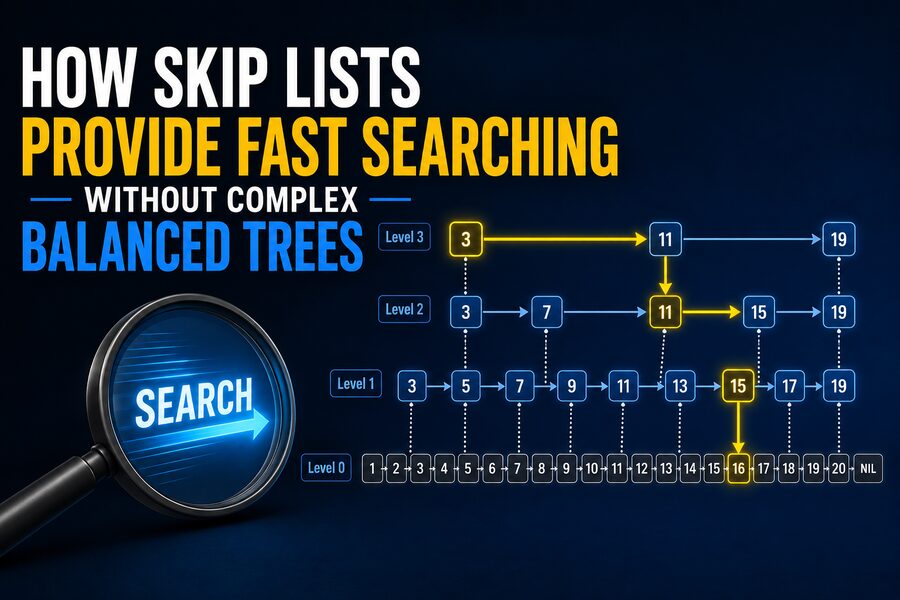

When computer programs need to store data in sorted order while still supporting fast searches, insertions, and deletions, developers often turn to sophisticated data structures such as AVL trees or Red-Black trees. These balanced search trees can provide excellent performance, but maintaining their structure requires rotations, balance rules, and careful bookkeeping.
A skip list offers a very different idea. Instead of continuously restructuring a tree to preserve balance, a skip list builds several linked-list “express lanes” above an ordinary sorted linked list. 🚀
The result is a surprisingly powerful data structure that can achieve expected O(log n) search, insertion, and deletion performance while remaining comparatively simple to implement.
Skip lists are especially interesting because they obtain their efficiency through randomization rather than strict balancing rules.
🔗 1. The Problem With an Ordinary Linked List
Consider a sorted linked list containing the numbers:
3 → 8 → 12 → 19 → 25 → 31 → 44 → 57
Because the elements are already sorted, you might expect searching to be quick.
Unfortunately, a normal linked list does not allow direct access to arbitrary positions.
Suppose we want to find 44.
We must begin at the first node and follow pointers one at a time:
3 → 8 → 12 → 19 → 25 → 31 → 44
That requires examining almost every preceding element.
For a list containing n elements, searching can therefore take:
O(n) time.
If the list contains one million elements, a search might require traversing hundreds of thousands of nodes. 🐢
Arrays solve this problem differently because they allow indexed access, enabling binary search in O(log n) time. But inserting into the middle of an array can require shifting many elements.
Skip lists attempt to combine useful properties of both approaches.
🛣️ 2. The Express-Lane Idea
Imagine driving along a road where every destination is connected by local streets.
Traveling through every intersection would be slow.
Now imagine that above those local streets are highways that skip over many intersections. You can travel quickly on the highway, exit near your destination, and then use local roads for the final part of the journey.
That is essentially how a skip list works. 🚗💨
The bottom level contains every element:
3 → 8 → 12 → 19 → 25 → 31 → 44 → 57
A higher level might contain only some elements:
3 ─────→ 12 ─────→ 25 ─────→ 44
Another level might contain even fewer:
3 ─────────────→ 25
Each higher level skips over more elements.
Searching begins at the highest available level and moves horizontally as far as possible without passing the target. The algorithm then drops down one level and continues.
This process resembles navigating a hierarchy of increasingly detailed routes.
🏗️ 3. The Structure of a Skip List
A skip list consists of multiple levels of linked lists.
The lowest level, usually called level 0, contains every stored key.
Higher levels contain subsets of those keys.
A node might therefore participate in several levels.
For example, imagine a node containing the value 25.
It might have pointers such as:
Level 0 → next nearby element
Level 1 → farther element
Level 2 → even farther element
Level 3 → much farther element
Nodes that appear in many levels effectively act as shortcuts.
A special header node usually appears at the beginning of the structure and contains pointers into each level.
Some implementations also use a tail or sentinel node representing positive infinity.
🔎 4. How Searching Works
Suppose a skip list contains the values:
2, 5, 9, 14, 18, 27, 33, 41, 50
We want to search for 33.
The search begins at the highest level.
If the next node at that level contains a value smaller than 33, the algorithm moves forward.
If the next node would exceed 33, it moves down one level instead.
The process repeats until the search reaches either the target or the bottom level.
Conceptually, the algorithm follows this strategy:
Move right when it is safe; move down when moving right would overshoot the target. ➡️⬇️
This is similar to how binary-search-like structures eliminate large portions of the search space.
Instead of visiting every node, the algorithm skips over many irrelevant elements.
⚡ 5. Why Searching Is Fast
The power of a skip list comes from the decreasing number of nodes at each level.
A common implementation gives each node approximately a 50% probability of appearing in the next higher level.
If there are 1,000 elements at level 0, we might expect approximately:
Level 0: 1,000 nodes
Level 1: 500 nodes
Level 2: 250 nodes
Level 3: 125 nodes
Level 4: about 62 nodes
Level 5: about 31 nodes
Level 6: about 15 nodes
Level 7: about 7 nodes
Level 8: about 3 nodes
The number of levels therefore grows roughly logarithmically with the number of elements.
This produces an expected search complexity of:
O(log n)
For one million elements, the number of levels may be only around 20 with a 50% promotion probability. 📈
That is dramatically better than scanning a million-node linked list from beginning to end.
🎲 6. Randomization Replaces Tree Balancing
This is where skip lists differ fundamentally from balanced binary search trees.
An AVL tree carefully tracks node heights.
A Red-Black tree follows coloring rules.
When insertion or deletion disrupts the required balance, the tree may need rotations or recoloring.
Skip lists avoid those operations entirely.
When inserting a node, the system randomly determines how many levels that node should occupy.
A typical method works like repeatedly flipping a coin. 🪙
The new node always appears at level 0.
Then:
Heads → promote it to level 1
Another heads → promote it to level 2
Another heads → promote it again
Tails → stop
Most nodes therefore appear only at the bottom level.
Fewer appear at level 1.
Even fewer appear at level 2.
Very few reach the highest levels.
This probabilistic distribution naturally creates the hierarchy of shortcuts.
➕ 7. How Insertion Works
Suppose we want to insert the value 22.
The skip list first performs essentially the same traversal used during a search.
At each level, it remembers the last node encountered before the insertion point.
These remembered nodes form an update path.
At the bottom level, the algorithm discovers where 22 belongs between its neighboring values.
Next, it randomly generates a height for the new node.
Suppose 22 receives three levels.
The system creates forward pointers for those levels and rewires the surrounding nodes.
Importantly, it does not need to rebalance the entire structure.
Only pointers near the insertion location are modified. 🔧
The expected insertion complexity is therefore:
O(log n)
➖ 8. How Deletion Works
Deletion is similarly straightforward.
Suppose we want to remove the value 27.
The algorithm searches for 27 while recording which nodes point toward it at each level.
Once the target is found, every pointer leading to that node is redirected to the appropriate following node.
If the removed node occupied four levels, pointers at those four levels are updated.
The remaining skip list does not require rotations or complex rebalancing.
Expected deletion time is again:
O(log n).
This relative simplicity is one of the biggest attractions of skip lists.
🌳 9. Skip Lists vs. Balanced Binary Search Trees
Balanced trees and skip lists solve similar problems but use very different mechanisms.
A balanced binary search tree tries to maintain a carefully controlled tree height.
A skip list accepts a probabilistic structure and relies on the statistical distribution of node levels.
Both can support fast ordered operations.
Balanced trees usually provide deterministic worst-case guarantees such as:
O(log n) search.
A typical randomized skip list provides:
Expected O(log n) search.
That distinction matters.
A skip list can theoretically become poorly shaped if random choices are extremely unlucky. For example, almost every node could theoretically receive the same minimal height.
However, the probability of severe degeneration is extremely small when the randomization scheme is implemented correctly. 🎯
📊 10. Expected Performance vs. Worst-Case Performance
Skip lists are randomized data structures.
Therefore, their complexity is often described in terms of expected performance.
Typical operations have:
Search: expected O(log n)
Insert: expected O(log n)
Delete: expected O(log n)
Space: expected O(n)
The theoretical worst-case search time is:
O(n)
because randomness could produce very few useful shortcuts.
However, a properly designed skip list makes such pathological structures statistically unlikely.
In many practical workloads, performance remains reliably close to logarithmic.
💾 11. Why Skip Lists Use More Than One Pointer Per Node
An ordinary singly linked list uses one forward pointer per node.
Skip-list nodes may have several.
Does that create excessive memory overhead?
Not necessarily.
If each node has a probability p of being promoted to the next level, the expected number of pointers remains bounded.
With a common promotion probability of p = 0.5, the expected number of forward pointers per node is around two.
So although some tall nodes may contain many pointers, most nodes contain very few.
This allows the total expected memory usage to remain:
O(n).
📚 12. Ordered Operations Are Especially Useful
Skip lists do more than locate exact keys.
Because the bottom layer is a sorted linked list, they are naturally useful for ordered queries.
For example, a skip list can efficiently find:
The first value greater than a target
The first value greater than or equal to a target
All values within a range
The predecessor of a value
The successor of a value
Suppose a database wants all records with scores between 80 and 90.
The skip list can first locate 80 in approximately logarithmic time, then move through level 0 sequentially until the keys exceed 90. 🔍
This makes skip lists useful for range-oriented workloads.
🗄️ 13. Skip Lists in Databases and Storage Systems
Skip-list-inspired structures have appeared in real-world databases, storage engines, and in-memory systems.
One reason is that their ordered nature makes them well suited to maintaining sorted collections.
They are also conceptually compatible with Log-Structured Merge Tree, or LSM-tree, storage engines.
Some systems use skip lists as an in-memory ordered structure before accumulated records are written to persistent storage.
Skip lists can be appealing because inserts are relatively simple and because ordered iteration is straightforward.
The lowest level already forms a sorted sequence of all records.
🧵 14. Why Skip Lists Can Be Attractive for Concurrent Programming
Concurrent data structures allow multiple threads to perform operations simultaneously.
Balanced trees can become complicated in concurrent environments because rotations may modify several interconnected nodes.
Skip lists often support more localized pointer changes.
That can make certain concurrent implementations easier to reason about.
Advanced designs may use:
Fine-grained locks
Atomic compare-and-swap operations
Lock-free algorithms
to let multiple threads search, insert, or delete efficiently. 🧵⚙️
Concurrent skip lists are therefore used in some high-performance systems where ordered data must be accessed by many threads.
🪜 15. A Helpful Mental Model
One of the easiest ways to understand a skip list is to imagine a multi-level railway system.
The bottom level stops at every station. 🚉
The level above stops at roughly half the stations.
The next level stops at fewer stations.
The highest level may stop only at a handful of major hubs.
If you need to reach a distant station, you first take the fastest express route available.
As you approach your destination, you transfer to slower routes with more frequent stops.
Eventually, you reach the exact station.
Skip-list search follows essentially the same logic.
⚖️ 16. Advantages of Skip Lists
Skip lists offer several attractive characteristics.
They provide simple algorithms compared with many balanced tree structures.
Search, insertion, and deletion have expected logarithmic performance.
Ordered iteration is easy because the bottom level is already a linked list.
Insertion and deletion typically involve only localized pointer modifications.
They can also work well in concurrent designs.
Perhaps most importantly, their performance emerges without complex rotation logic or strict balancing invariants. ✨
⚠️ 17. Limitations of Skip Lists
Skip lists are not automatically superior to balanced trees.
They have several tradeoffs.
Performance depends partly on randomness.
Worst-case lookup remains O(n).
Multiple pointers create memory overhead compared with a basic linked list.
Pointer-heavy structures can also have less favorable CPU cache behavior than tightly packed arrays.
Meanwhile, balanced trees provide deterministic logarithmic guarantees that may be important in real-time or security-sensitive applications.
The correct data structure therefore depends on the workload and system requirements.
🛡️ 18. Why Randomness Usually Works So Well
At first, trusting random coin flips to organize important data may sound unreliable.
But the probability distribution is precisely what makes skip lists effective.
If promotion probability is 1/2, the chance that a node reaches increasingly high levels falls exponentially:
Level 0 or higher: 100%
Level 1 or higher: about 50%
Level 2 or higher: about 25%
Level 3 or higher: about 12.5%
Level 4 or higher: about 6.25%
This naturally creates a pyramid-shaped hierarchy.
Instead of explicitly forcing the data structure to remain balanced, the algorithm obtains approximate balance statistically.
That is the central insight behind skip lists. 🎲
💡 19. Skip Lists Demonstrate a Powerful Computer Science Principle
Skip lists illustrate a broader lesson in algorithm design:
A randomized solution can sometimes replace complicated deterministic machinery with something simpler while still achieving excellent practical performance.
Balanced binary trees solve ordering through structural rules.
Skip lists solve it through probability.
Both approaches are valid, but skip lists demonstrate that maintaining perfect or near-perfect structural balance is not always necessary.
Sometimes it is enough to create enough random shortcuts that searches are overwhelmingly likely to be fast.
🚀 Conclusion
Skip lists transform an ordinary sorted linked list into a fast searchable structure by adding layers of increasingly long-distance pointers.
The bottom layer contains every element. Higher layers contain progressively smaller random subsets. During a search, the algorithm travels quickly across high levels and drops toward the bottom as it approaches the target. 🔎
New nodes are assigned heights randomly rather than through complicated balancing rules. As a result, insertions and deletions require local pointer updates instead of tree rotations.
The typical result is:
Expected O(log n) search
Expected O(log n) insertion
Expected O(log n) deletion
Expected O(n) storage
Balanced search trees remain extremely important and provide stronger deterministic guarantees, but skip lists offer an elegant alternative when simplicity, ordered access, and probabilistic performance are attractive.
Their brilliance comes from a surprisingly modest idea: instead of rebuilding a complicated structure to keep every path short, simply place enough random express lanes above a sorted list. 🛣️🧠
Those shortcuts allow skip lists to achieve fast searching while avoiding much of the structural complexity associated with traditional balanced trees.