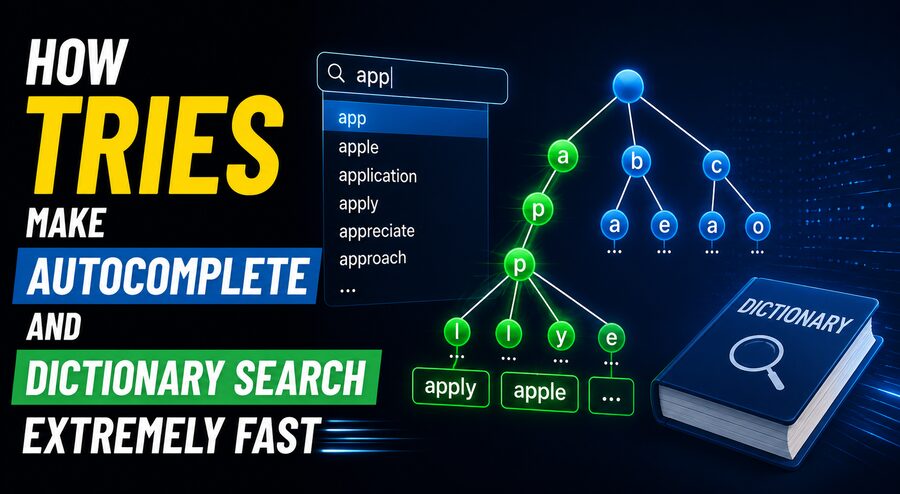

Whenever you type a few letters into a search box and instantly see suggestions appear, there is a good chance that a data structure similar to a trie is helping behind the scenes. 🔎⌨️
Tries are especially useful for applications involving words, prefixes, dictionaries, search suggestions, spell checking, contact lists, routing tables, and autocomplete systems. Their main advantage comes from the way they organize strings: instead of storing every word independently, they arrange characters into a shared tree-like structure.
This allows a computer to answer questions such as:
- “Which words begin with
app?” - “Is
dictionarya valid stored word?” - “What completions are available for
micro?” - “Which stored term most closely matches this prefix?”
very efficiently.
For systems containing thousands or even millions of strings, this approach can be remarkably powerful. 🌳⚡
🌿 What Is a Trie?
A trie, pronounced either like “tree” or sometimes “try,” is a tree-based data structure designed primarily for storing strings.
It is also known as a prefix tree because words that share the same prefix also share the same path through the structure.
Imagine storing these words:
car
card
care
cat
A trie would begin with a root node. From the root, there might be an edge representing the letter c.
The next node would contain a path for a.
After that, the structure branches:
carcardcarecat
The letters c and a do not need to be stored separately for every word. They are represented once in the shared prefix.
Conceptually, the structure looks something like this:
        root
          |
          c
          |
          a
         / \
        r   t*
       / \
      d*  e*
The asterisks indicate positions where complete words end.
So the trie represents:
carcardcarecat
while sharing their common prefixes. 🌱
🔤 Why Prefix Sharing Matters
Suppose a dictionary contains these words:
- computer
- compute
- computing
- computation
- computerized
All of them begin with comput.
A simple list stores each complete string independently.
A trie stores the shared prefix once and branches only when the words differ.
That shared structure is exactly what makes tries so effective for prefix-based searches.
If a user types:
comp
the computer does not have to examine every word in the dictionary.
Instead, it follows four character transitions:
c → o → m → p
If that path exists, the system has immediately found the part of the trie containing all words beginning with comp. 🚀
⚡ Why Trie Searches Can Be So Fast
Suppose the search word has length m.
Looking up a word in a trie typically requires following one node for each character.
Therefore, the lookup complexity is commonly described as:
O(m)
where m is the length of the word or prefix being searched.
This is an important property.
The search time is largely determined by the length of the query rather than directly by the total number of words stored.
For example, checking whether the word:
technology
exists requires examining roughly the characters in that word.
Whether the trie stores:
- 10,000 words
- 1 million words
- or potentially many millions of words
does not fundamentally change the number of character-level steps needed to follow that exact path.
That makes tries extremely attractive for large dictionaries. ⚙️
🔎 How Dictionary Lookup Works
Imagine a trie storing thousands of English words.
You want to check whether:
planet
is in the dictionary.
The algorithm begins at the root and follows:
p → l → a → n → e → t
If all those nodes exist and the final node is marked as an end-of-word node, then planet exists.
If any character path is missing, the lookup can stop immediately.
Suppose instead you search for:
plxnet
After following p → l, the system discovers that no valid x child exists.
The search ends at once.
There is no need to continue checking the remaining characters. ❌
This early termination makes trie searches especially efficient when many invalid strings are queried.
✅ Why an End-of-Word Marker Is Important
A trie must distinguish between a complete stored word and a prefix.
Consider these words:
car
carpet
The letters c → a → r appear in both words.
If the trie did not track word endings, it would be impossible to know whether car itself was stored or merely existed as the beginning of carpet.
For this reason, trie nodes often contain a Boolean value such as:
isEndOfWord = true
The node representing the final r in car would be marked as a complete word.
The path could then continue:
p → e → t
to form carpet.
This simple marker allows one string to be both a complete word and the prefix of a longer word. 🌳
⌨️ How Tries Power Autocomplete
Autocomplete is one of the most natural applications of a trie.
Suppose a search engine stores:
- apple
- application
- apply
- appointment
- appreciate
- approach
Now the user types:
app
The autocomplete system first follows:
a → p → p
This immediately locates the trie node representing the prefix app.
The system then explores the descendants of that node to find complete words.
Possible results include:
- apple
- application
- apply
- appointment
- appreciate
Instead of searching the entire vocabulary, the algorithm only examines the branch beginning with the requested prefix. 🎯
That is the key idea behind trie-based autocomplete.
🚀 Searching a Prefix vs Searching Every Word
Consider a database containing one million search terms.
A naive autocomplete algorithm might compare the user’s prefix against many or even all of those terms.
If the user types:
trans
the system could potentially check:
- transportation
- translate
- transaction
- tree
- technology
- hotel
- sports
- thousands of unrelated words
Most comparisons would be unnecessary.
A trie avoids this waste.
It follows:
t → r → a → n → s
and then examines only the branch containing words beginning with trans.
This reduces the search space dramatically. ⚡
📚 Dictionary Search Using Tries
Digital dictionaries need to perform many kinds of string searches.
A trie can help with:
- Exact word lookup
- Prefix search
- Word suggestions
- Spell checking
- Word completion
- Lexicographic traversal
- Finding related word forms
Suppose a dictionary app receives the prefix:
bio
The trie can immediately navigate to the corresponding prefix node and retrieve entries such as:
- biology
- biography
- biomedical
- biotechnology
- biodiversity
Because all these words share the same branch, prefix retrieval becomes highly efficient. 📖
🔢 Trie Nodes and Their Children
Each trie node typically stores references to possible next characters.
For lowercase English letters, one implementation might maintain an array of 26 child pointers:
children[0]  → a
children[1]  → b
children[2]  → c
...
children[25] → z
This allows extremely fast access to a particular child.
If the system needs the next letter t, it can directly access the position corresponding to t.
The downside is memory consumption.
Many nodes may have only one or two children while still reserving space for all 26 possible letters.
Alternative implementations therefore use structures such as:
- Hash maps
- Dictionaries
- Balanced maps
- Compact arrays
- Compressed representations
These can reduce wasted memory. 💾
🧮 Trie Time Complexity
For a word containing m characters, common trie operations have roughly the following complexity:
Insertion: O(m)
Exact lookup: O(m)
Prefix lookup: O(m)
Deletion: O(m), plus possible cleanup
This is one reason tries work well for text-oriented applications.
A lookup does not ordinarily require scanning every stored word.
However, retrieving all autocomplete results introduces an additional cost.
If a prefix matches thousands of words, the system still needs time to discover or return those results.
Therefore, finding the prefix itself may be O(m), but generating every matching completion depends on how much of the subtree must be explored.
🏆 Ranking Autocomplete Suggestions
Real autocomplete systems usually do more than find every matching word.
They must decide which suggestions should appear first.
For example, after typing:
new
a search engine might have thousands of possible completions.
Instead of displaying them alphabetically, it might prefer popular suggestions.
Trie nodes can store additional metadata such as:
- Search frequency 📊
- Popularity score ⭐
- Last-used timestamp 🕒
- User-specific ranking 👤
- Geographic relevance 🌍
- Language probability 🗣️
This allows the system to rank autocomplete results efficiently.
For example, a node might remember the top five most frequently selected completions beneath it.
When the user types a prefix, the system can return those cached suggestions immediately rather than traversing the entire subtree.
This optimization can make autocomplete feel nearly instantaneous. ⚡
🧠 Example: Searching for “car”
Imagine the following stored terms:
- car
- card
- care
- careful
- cargo
- carpet
- cat
- camera
A user types:
car
The trie follows:
c → a → r
At this point, all unrelated branches disappear from consideration.
The system no longer needs to inspect:
- cat
- camera
because they branch earlier.
Only descendants of car matter.
Possible suggestions include:
- car
- card
- care
- careful
- cargo
- carpet
This illustrates why tries are so effective: prefix matching is built directly into their structure.
🧩 Tries vs Hash Tables
Hash tables are also extremely fast for dictionary-style lookups.
If you want to determine whether an exact word exists, a hash table may provide average-case lookup close to:
O(1)
So why use a trie?
Because hash tables are not naturally optimized for prefix searches.
Suppose you want every word beginning with:
astro
A hash table can instantly check whether the exact word astro exists, but it does not automatically organize astronaut, astronomy, and astrophysics together.
A trie does.
Its structure preserves the characters and prefixes of stored keys.
Therefore:
Hash tables are excellent for exact key lookup.
Tries are particularly powerful for prefix-oriented operations.
Many practical systems use both. 🔄
🌲 Tries vs Binary Search Trees
A balanced binary search tree stores complete strings and organizes them according to comparison order.
Searching typically requires approximately:
O(log n) comparisons,
where n is the number of stored entries.
However, comparing strings can involve examining multiple characters.
Tries take a different approach.
Instead of comparing complete strings against one another, they navigate character by character.
This can provide very predictable performance for prefix matching.
Binary search trees may consume less memory in some situations, while tries provide more natural prefix operations.
The best structure depends on the application. 🧠
📋 Tries vs Sorted Arrays
A sorted array or sorted list can also support efficient dictionary searches using binary search.
Autocomplete can be implemented by locating the first and last entries that match a prefix.
This approach can work extremely well and may even be more memory-efficient than a traditional trie.
However, inserting new values into a large sorted array can be expensive because elements may need to be moved.
Tries allow new words to be inserted incrementally by creating only the missing nodes along the word’s path.
This makes them attractive when stored data changes frequently. 🔧
💾 The Main Disadvantage: Memory Usage
Tries can be fast, but they are not always memory-efficient.
Imagine storing millions of words.
Each character may require its own node, and every node may contain:
- Child pointers
- Word-ending flags
- Metadata
- Memory-management overhead
A conventional trie can therefore use substantially more memory than simply storing compressed strings.
This is one of the biggest trade-offs associated with the data structure. 💽
Engineers often use specialized trie variants to reduce the problem.
🗜️ Compressed Tries
A compressed trie, sometimes associated with radix-tree designs, merges chains of nodes that have only one child.
Suppose a normal trie stores the word:
internet
as:
i → n → t → e → r → n → e → t
If no other stored word branches along much of that path, storing every character as a separate node may be unnecessary.
A compressed representation could store multiple characters together in one edge.
This reduces:
- Node count
- Pointer overhead
- Memory consumption
while preserving many of the advantages of prefix search.
Compressed tries are especially valuable in large-scale systems. 📦
🌐 Radix Trees and Patricia Tries
Related trie structures include radix trees and Patricia tries.
These data structures compress paths so that nodes usually appear only where branching actually occurs.
Patricia tries have historically been used in applications including networking and routing.
For example, IP addresses are naturally suited to prefix-based lookup because network routes are defined using address prefixes.
Routers may need to identify the longest matching prefix for a destination.
Trie-like structures make this operation efficient. 🌐
🛜 Tries Are Not Just for Words
Although autocomplete and dictionaries are famous trie applications, the idea is much broader.
Any sequence that can be represented as symbols can potentially be stored in a trie.
Examples include:
- URLs 🌐
- File paths 📁
- IP addresses 📡
- DNA sequences 🧬
- Phone numbers 📞
- Product codes 🏷️
- Commands 💻
- Search queries 🔎
The important property is that entries share meaningful prefixes.
📱 Contact Search on Smartphones
Consider the contact list on a smartphone.
You might have thousands of names.
As soon as you type:
Mar
the device displays:
- Marcus
- Maria
- Marina
- Mark
- Martin
A trie can locate the Mar branch immediately.
Additional ranking information could then prioritize contacts you call frequently.
The same technique can support predictive contact search with extremely low latency. 📱⚡
✍️ Spell Checking With Tries
Tries can also help with spell checking.
If a typed word does not exist, the system can explore nearby character possibilities.
For example, someone types:
computar
but the dictionary contains:
computer
The application can search for alternatives based on:
- Character substitution
- Character insertion
- Character deletion
- Adjacent-character swaps
Advanced algorithms may combine tries with techniques such as edit distance to find likely corrections efficiently.
That allows software to display suggestions such as:
“Did you mean computer?” 💡
🔡 Longest Prefix Matching
Another important trie operation is finding the longest stored prefix matching a given input.
Suppose a system contains:
- app
- apple
- application
and receives:
applepie
It can follow the input character by character and remember the deepest node marked as a complete key.
The longest stored match would be:
apple
This concept appears in:
- Networking
- Text processing
- Compilers
- Language parsers
- Routing systems
Tries are particularly well suited to this kind of task.
🌍 Supporting Multiple Languages
A simple English trie may assume only 26 lowercase letters.
Real-world search engines must handle far more.
Unicode includes characters from languages such as:
- Hindi
- Arabic
- Chinese
- Japanese
- Korean
- Russian
- Greek
- Many others
A trie can still store these strings, but nodes need more flexible child mappings.
Systems may also normalize input so that equivalent forms are treated consistently.
For example, search engines may account for:
- Uppercase and lowercase letters
- Accented characters
- Unicode normalization
- Alternate spellings
- Language-specific rules
Designing a global autocomplete engine is therefore much more complex than building a classroom trie. 🌎
⚙️ How Large Search Systems Optimize Tries
At massive scale, engineers rarely use the simplest textbook implementation.
They may combine tries with:
- Caching
- Compression
- Distributed storage
- Frequency counters
- Precomputed suggestions
- Sharding
- Machine-learning ranking
- Personalized search history
Imagine a search platform containing billions of possible queries.
The trie or trie-like index might identify candidate completions quickly.
Then a ranking system determines which candidates are most useful based on signals such as:
Popularity + freshness + location + language + context + user preference
This is how a simple computer-science concept can become part of an extremely sophisticated production system. 🧠🚀
🤖 Tries and Modern AI Systems
Modern predictive interfaces increasingly use machine learning, but classic data structures like tries remain useful.
A machine-learning model may predict likely text, while a trie can enforce constraints such as:
- Valid dictionary words
- Valid commands
- Known product names
- Allowed tokens
- Valid database entries
This hybrid approach combines intelligent prediction with fast structured lookup.
For example, an AI-powered application might generate several possible next words and use a trie to quickly verify which ones belong to an approved vocabulary. 🤖
🧪 Simple Conceptual Trie Algorithm
The basic insertion procedure is surprisingly straightforward.
To insert the word cat:
- Start at the root.
- Look for a child representing
c. - Create it if it does not exist.
- Move to
c. - Repeat for
a. - Repeat for
t. - Mark the final node as a complete word.
Searching follows essentially the same path but does not create missing nodes.
To perform a prefix search for ca, the algorithm stops after reaching the node representing a.
Every valid word below that node begins with ca.
This simplicity is part of what makes tries so elegant. 🌳
🚦When Should You Use a Trie?
A trie can be an excellent choice when an application frequently needs:
- Prefix searches
- Autocomplete
- Dictionary lookups
- Incremental character searches
- Longest-prefix matching
- Lexicographic word traversal
- Predictable string-search performance
However, it may not be ideal when:
- Memory is extremely limited
- Only exact lookups are needed
- Stored strings share few prefixes
- Data is mostly static and highly compressible
- Simpler structures provide adequate performance
Choosing a data structure always involves trade-offs. ⚖️
🔮 The Future of Autocomplete Systems
Autocomplete systems are increasingly becoming more contextual and intelligent.
Future systems may combine trie-like indexes with artificial intelligence to consider:
- What the user previously searched
- What words are trending
- Current location
- Language preferences
- Conversation context
- Time of day
- Application context
Yet even as AI becomes more sophisticated, efficient underlying data structures remain important.
Machine-learning models can rank and predict suggestions, while optimized tries can rapidly organize, retrieve, and validate huge collections of possible completions.
The result is a system that feels instantaneous even though enormous amounts of information may exist behind the interface. ⚡🤖
🌳 Final Thoughts
Tries make autocomplete and dictionary search fast because they organize words according to their shared prefixes.
Instead of repeatedly comparing a query against thousands or millions of complete strings, a trie follows one character at a time through a structured path.
Searching for a prefix of length m can typically be performed in roughly O(m) time, making performance depend mainly on the length of the query rather than directly on the number of stored words.
That is why a user can type just a few letters and receive suggestions almost instantly. ⌨️⚡
The concept is beautifully simple:
Shared prefixes share storage, and prefix searches follow shared paths.
From autocomplete boxes and digital dictionaries to spell checkers, contact searches, IP routing, and intelligent search engines, tries remain one of computer science’s most useful structures for handling strings efficiently.
Behind many seemingly instantaneous search experiences is a carefully organized tree of characters, quietly guiding software toward the right answer one letter at a time. 🌳🔎✨