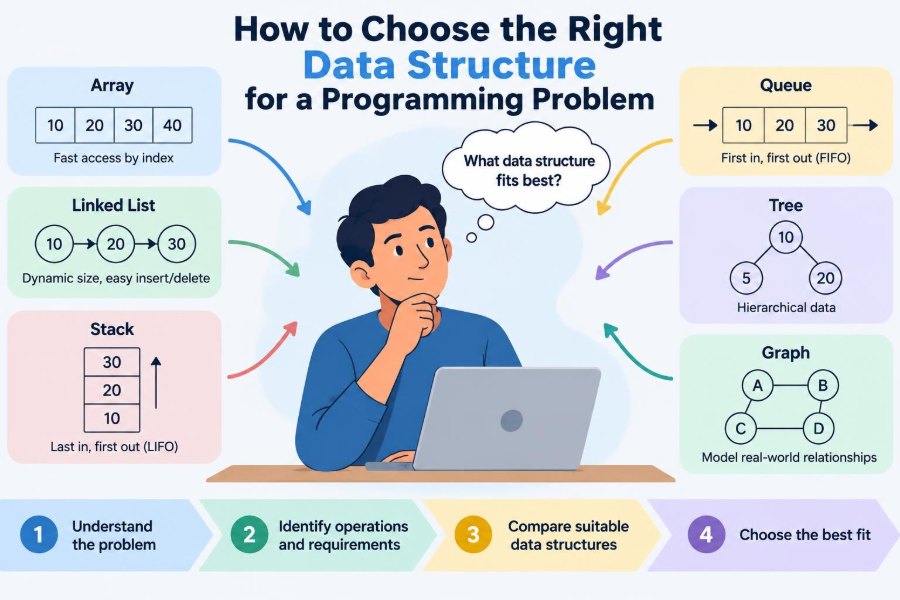

You are building a small task app. At first, a simple list of tasks works perfectly: add an item, display it, mark it complete. Then someone asks for instant search, priorities, due-date reminders, undo, and a view of the next task due.
The features sound like interface decisions, but many are really decisions about how data is stored and accessed. A program can be logically correct yet feel slow, consume unnecessary memory, or become difficult to change because its data structure does not match its work.
Choosing a data structure is not about memorizing a catalog of names. It is about translating a problem into operations: what must be found, inserted, removed, ordered, grouped, or processed first?
This skill matters in interview exercises, production systems, and everyday scripting alike. A thoughtful choice often makes the code simpler before it makes it faster.
🧭 Start with the Problem, Not the Structure
A common mistake is beginning with “Should I use a hash map?” before describing the actual job. Start instead with the objects your program manages and the questions it must answer.
For example, a library system manages books, members, and loans. “Find a book by its ISBN” and “show loans due soon” are different operations, and they may call for different ways of organizing the same underlying information.
⚙️ Think in Operations
An operation is an action your program performs on data: lookup, insertion, deletion, traversal, sorting, updating, or finding a minimum value. Write down the operations before writing code.
- Must an item be found by a unique identifier?
- Do items need to remain in a particular order?
- Will new items arrive frequently?
- Is removing an arbitrary item common?
- Does the program repeatedly need the smallest, largest, or highest-priority item?
The most frequent or most expensive operation usually deserves the greatest weight in your choice.
📦 Know What a Data Structure Provides
A data structure is an organized way to hold values so particular operations can be performed efficiently and predictably. Arrays, linked lists, stacks, queues, hash tables, trees, graphs, and heaps are all arrangements with different trade-offs.
The same values can be stored in more than one structure. What changes is the cost and clarity of the operations you need to perform on them.
⏱️ Use Big-O as a Planning Tool
Big-O notation describes how an operation’s work tends to grow as the input grows. It does not predict an exact runtime, but it helps reveal whether a design will remain practical when data becomes larger.
For example, scanning an unsorted collection to find one matching item is usually O(n), meaning the work can grow with the number of items. A well-designed hash table lookup is typically O(1) on average, meaning it does not usually require scanning every stored item.
📏 Distinguish Average, Worst, and Real-World Cost
Big-O is useful, but it is not the entire performance story. Hash tables generally provide fast average lookup, yet collisions, resizing, poor hash functions, or adversarial input can make individual operations less favorable.
Small collections also behave differently from large ones. A linear scan through ten items may be clearer and faster in practice than building a complicated index. Measure when performance matters, and do not optimize a problem that has not appeared.
🪜 Choose an Array for Indexed Sequences
An array stores elements in an ordered sequence and supports direct access by position. If you need “the item at index 500,” an array is a natural fit because indexed access is typically O(1).
Arrays work well for pixels in an image, monthly measurements, game-board cells, and lists that are mostly read or appended to. In many languages, dynamic arrays automatically grow, making appends efficient on average.
Inserting or deleting near the beginning or middle can be costly because later elements must shift to close or create a gap.
🔗 Choose a Linked List for Local Rewiring
A linked list stores each element in a separate node that points to the next node, and sometimes the previous one. Once you already have a reference to a node, inserting or removing nearby nodes can be efficient because only a few links change.
Its weakness is random access. Reaching the hundredth node requires following links from the start, so linked lists are often a poor choice when frequent indexing is required.
They are useful in specialized designs, but built-in dynamic arrays are often the better default for general application lists because of their simpler access patterns and favorable memory layout.
📚 Use a Stack for Last-In, First-Out Work
A stack follows the last-in, first-out rule: the most recently added item is the first one removed. Think of browser history, undo actions, or nested function calls.
The central operations are push to add an item and pop to remove the top item. A stack is a strong signal that only the latest unresolved item should be handled next.
🚶 Use a Queue for First-In, First-Out Work
A queue follows first-in, first-out order. Customers waiting for service, print jobs, messages awaiting processing, and breadth-first graph traversal all fit this pattern.
Use a queue when fairness or arrival order matters. Be careful with a plain array implementation that removes from the front by shifting every remaining value; a deque, linked structure, or circular buffer can avoid that repeated work.
↔️ Reach for a Deque When Both Ends Matter
A deque, pronounced “deck,” is a double-ended queue. It supports adding and removing items at both the front and the back.
This makes it useful for sliding-window algorithms, work scheduling, and situations where a process may need to revise either end of a sequence. It is more expressive than forcing an array or queue to imitate two-ended behavior.
🗂️ Use a Hash Table for Fast Key Lookup
A hash table stores values under keys, such as a customer record under a customer ID. It uses a hash function to map each key to a location, enabling fast average-case lookup, insertion, and deletion.
Use one when the question is “Do we already have this?” or “What value belongs to this identifier?” Examples include caches, username records, frequency counts, and configuration settings.
Keys should have stable, meaningful equality rules. Mutable objects used as keys can cause confusing failures if their value changes after insertion.
🔍 Use a Set for Membership and Uniqueness
A set stores unique values. It is ideal when duplicates should disappear or when fast membership checks matter more than preserving every occurrence.
Suppose an import process receives product codes from several files. A set can track codes already processed, preventing repeated work. Many set implementations are hash-based, so membership checks are typically fast on average.
Do not use a set if duplicate counts are meaningful. For word frequencies, use a map from word to count instead.
🌳 Choose a Search Tree for Ordered Keys
A balanced search tree keeps keys in sorted order while supporting lookup, insertion, and deletion in roughly logarithmic time. Unlike a standard hash table, it can efficiently answer range-style questions.
For instance, a scheduling system may need all appointments between two timestamps, not merely an appointment with one exact ID. Ordered maps and ordered sets are often backed by balanced tree structures.
The word “balanced” matters. A poorly shaped binary search tree can degrade toward the behavior of a list, which is why production code usually relies on a library’s self-balancing implementation.
🏔️ Use a Heap for the Next Best Item
A heap is designed to quickly reveal the smallest or largest item according to a priority rule. It is not fully sorted; it guarantees that the best candidate is at the top.
A hospital triage simulation, a job scheduler, or an algorithm that repeatedly selects the earliest deadline can use a priority queue backed by a heap. Adding an item and removing the top priority item are typically logarithmic.
Choose a heap when you repeatedly need the next best item. Choose a sorted structure when you often need to iterate through everything in order.
🕸️ Model Relationships with a Graph
A graph represents entities as vertices and connections as edges. Roads between cities, friendships between users, prerequisites between courses, and dependencies between software modules are relationship problems rather than simple lists.
Once a problem includes questions such as “What can be reached from here?” or “What is the shortest route?”, a graph model often becomes clearer than trying to force relationships into nested arrays.
🧩 Pick the Right Graph Representation
An adjacency list records each vertex’s neighbors and works well when most possible connections do not exist. An adjacency matrix records connection information in a grid and can make direct edge checks simple, but uses much more space for sparse graphs.
| Need | Usually suitable representation |
|---|---|
| Few connections per entity | Adjacency list |
| Frequent check for a specific connection | Adjacency matrix or hash-based neighbor set |
| Connections carry costs or distances | Weighted adjacency list |
The representation should follow the graph’s density and the queries your program performs.
🔤 Use Tries for Shared Text Prefixes
A trie stores strings by their characters, sharing common prefixes. If many words begin with the same letters, this can support prefix search and autocomplete naturally.
A dictionary feature that suggests words after a user types “prog” is a good conceptual example. Tries can use substantial memory, however, especially with large alphabets or sparse branches, so a sorted list or search index may be preferable in smaller systems.
🪟 Match Sliding Windows to Deques and Maps
Some problems inspect a moving region of data: the last minute of events, the last ten sensor readings, or each substring of a fixed length. This is called a sliding window.
A deque can maintain candidates whose values might become the current maximum, while a map can count items currently inside the window. The key insight is that items enter once and leave once, avoiding repeated rescans of the whole window.
🧮 Separate Storage from Indexes
One structure does not have to do every job. A system may keep complete product records in an array or database-like store, then maintain a hash map from product ID to location and a heap of products by reorder priority.
These supporting structures are indexes: additional organizations of the same information created to make specific queries faster. They improve access at the cost of memory and update complexity.
🔄 Account for Updates and Consistency
Every additional index creates a maintenance obligation. If a product’s priority changes, the priority structure must be updated; if it is removed, stale references must not remain.
For a small or rarely queried dataset, recomputing an answer may be safer than maintaining a complex live index. Select structures based on the full lifecycle of data, not only on read speed.
🧠 Consider Memory Layout and Overhead
Two structures with similar asymptotic complexity can have noticeably different memory behavior. Arrays often keep elements close together, which can be efficient to traverse. Linked nodes and tree nodes usually require extra references and may be scattered in memory.
This does not make pointer-based structures wrong. It means performance involves allocation behavior, cache locality, object overhead, and language runtime details in addition to Big-O.
📐 Ask Whether Order Is a Requirement
“Order” has several meanings: insertion order, sorted order, priority order, and arbitrary iteration order. State which one you need instead of assuming a collection provides it.
A hash map may be ideal for lookup yet unsuitable when output must be alphabetically sorted. An ordered map can preserve key order, while a list may preserve arrival order. The distinction prevents subtle correctness bugs.
🧪 Work Through a Concrete Example
Imagine a help-desk tool. Tickets have an ID, a creation time, a severity, and a status. Agents must find tickets by ID, take the most urgent open ticket, and show tickets created by a particular customer.
- A hash map can associate ticket IDs with ticket records.
- A priority queue can surface the most urgent open ticket.
- A map from customer ID to a collection of ticket IDs can support customer history.
- A list can preserve an audit trail in creation order.
No single collection cleanly supports all four requirements. Combining structures is often the correct design, provided updates are controlled carefully.
📝 Turn Requirements into a Decision Checklist
Before committing to a structure, answer a short set of concrete questions:
- What is the primary data item?
- Which operations occur most often?
- Which operations must be fast enough for the expected input size?
- Is exact lookup, order, uniqueness, priority, or connectivity the central requirement?
- How often does the data change?
- What memory limits or implementation constraints apply?
This checklist moves the conversation from preference to evidence.
🛠️ Prefer the Simplest Structure That Fits
A sophisticated structure is not automatically a better structure. If a program stores a few dozen settings and reads them once at startup, a straightforward list may be entirely adequate.
Start with the simplest option that clearly satisfies known requirements. Add an index, tree, heap, or specialized representation when a measured bottleneck or a new query pattern justifies the extra complexity.
🚫 Avoid Optimizing for an Imaginary Scale
Developers sometimes choose elaborate structures because a program might someday handle millions of records. That can make ordinary code harder to understand and easier to break.
Plan for plausible growth, but distinguish a real requirement from a vague possibility. Encapsulating data access behind clear functions or classes can make later replacement easier without prematurely building a complex system.
🐛 Watch for Common Selection Mistakes
Several errors recur because the data structure appears to work on small test cases:
- Using an array for repeated membership checks instead of a set.
- Sorting a collection again and again when a heap or ordered structure better matches the query.
- Using a stack when arrival order, not recency, determines processing.
- Choosing a hash table when range queries or sorted traversal are required.
- Maintaining multiple indexes without a reliable update strategy.
The cure is to name the required operation precisely and test with realistic patterns, not only with realistic data sizes.
🔬 Validate Assumptions with Measurement
Profiling reveals where a program actually spends time; benchmarks compare alternatives under representative workloads. Use both carefully, because a benchmark that measures only one artificial operation can favor the wrong design.
Measure end-to-end behavior when possible: loading data, processing requests, allocating memory, and producing results. Performance is a property of a workload, language, runtime, and machine—not a label attached permanently to a structure.
📚 Learn Your Language’s Standard Library
Most languages already provide reliable collections with documented behavior. Their names differ—such as list, vector, dictionary, map, set, deque, or priority queue—but their guarantees are what matter.
Read the documentation for ordering, duplicate handling, iterator behavior, mutability, and complexity. A familiar library collection is usually safer than a custom implementation unless you have a specific reason to build one.
🧱 Let Interfaces Protect Future Changes
Keep the rest of your program focused on operations rather than internal storage. For example, expose actions such as findTicket(id) or nextUrgentTicket() rather than allowing every component to manipulate a collection directly.
This separation makes it easier to replace a list with a map, or a sorted array with a heap, when requirements evolve. It also concentrates correctness rules in one place.
🎯 Recognize the Core Pattern
The right data structure follows from the questions your program asks most often. Direct access suggests an array; unique membership suggests a set; key-based retrieval suggests a hash map; sorted ranges suggest a tree; next-best selection suggests a heap; connected entities suggest a graph.
These are not rigid laws. Real programs may combine structures, accept a slower operation for simpler code, or choose differently because of memory, concurrency, persistence, or library constraints. The goal is a reasoned trade-off, not a perfect universal answer.
✅ Bring the Choice Back to the Work
When you encounter a new programming problem, pause before reaching for a familiar collection. Describe the data, list the operations, identify the dominant access pattern, and consider how updates, ordering, memory, and scale change the decision.
That habit turns data structures from a memorization topic into a practical design tool. It also makes your code easier to explain: every collection exists because it serves a specific need.
Choose the structure that makes your program’s most important operations natural, clear, and efficient enough for its real workload. That is the durable principle behind every array, map, queue, tree, and graph. 💻🧠📚