
A navigation app suggests a faster route, but the route is suddenly crowded. A video call freezes even though both people have strong internet connections. A hospital system must decide which record belongs to which patient without exposing private information.
These situations may involve software, but the central challenge is not typing code. It is deciding what information matters, how a process should behave, what trade-offs are acceptable, and how to tell whether a result can be trusted.
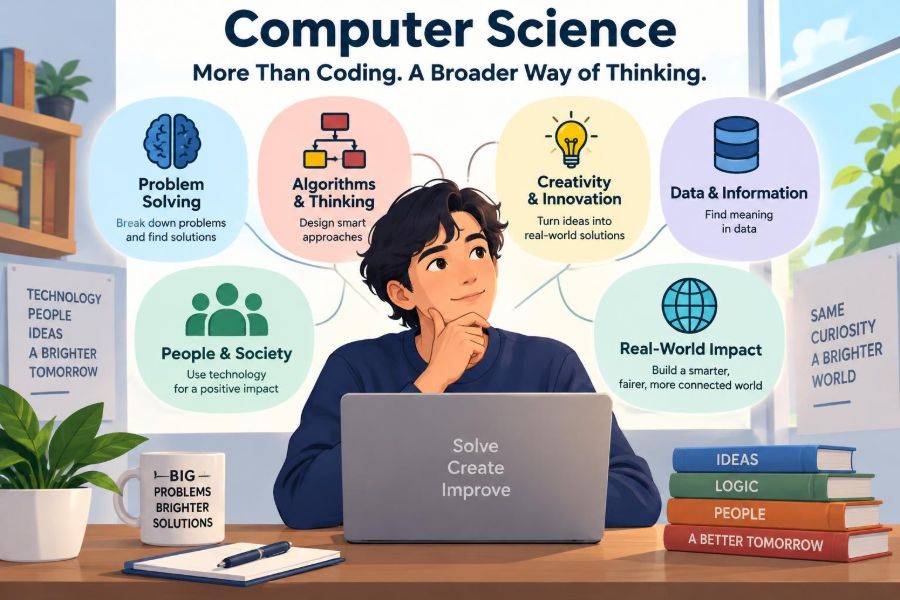
That is why computer science reaches far beyond laptops, programming languages, and the image of someone writing lines of code. It is a way of studying information, processes, problems, and limits.
Understanding that broader view helps students choose what to learn and helps working professionals collaborate more effectively with technical teams. It also makes many everyday systems less mysterious.
🧭 Computer Science Is the Study of Computation
At its core, computer science asks what can be computed: what problems can be solved by following precise steps, what resources those steps require, and where the limits lie. A computation is simply a process that transforms input into output according to rules.
A recipe, a tax form, and a sorting procedure all contain computational ideas. Computers are exceptionally useful machines for carrying out computations, but the field is not defined by the machine itself.
🔍 The Central Question: What Problem Are We Solving?
Before building anything, computer science begins with problem formulation. “Make the app faster” is a request; “reduce the time needed to find matching records while preserving accuracy” is a problem that can be analyzed.
Good formulation identifies inputs, desired outputs, constraints, and failure cases. If those are unclear, even perfectly written code can produce the wrong result.
📝 Algorithms Are Precise Methods, Not Just Programs
An algorithm is a sequence of unambiguous steps for completing a task. It can be written in ordinary language, diagrams, pseudocode, or a programming language.
For example, a library shelf can be searched one book at a time, or by repeatedly checking the middle of an alphabetized range and discarding half the possibilities. The second method illustrates an algorithmic idea whether or not anyone writes software for it.
🧩 Abstraction Makes Complex Systems Manageable
Abstraction means focusing on the details relevant to a particular task while temporarily hiding others. When you use a map, you need roads and destinations, not every tree, pipe, and building foundation.
Software uses abstraction constantly. A payment system may expose a simple “charge customer” operation while hiding encryption, bank communication, and error handling underneath. This separation makes systems easier to design, test, and change.
📦 Data Structures Shape What Is Easy to Do
Information is not useful only because it exists; its organization matters. A data structure is a deliberate arrangement of data that supports particular operations efficiently.
A contact list sorted by name makes lookup easier. A queue, where the first arrival is served first, suits print jobs and customer support requests. A network of connected nodes can represent roads, friendships, or dependencies between tasks.
- Lists preserve an ordered collection of items.
- Stacks support “last in, first out” actions, such as undoing recent edits.
- Hash-based structures support rapid lookup by a key, such as an account identifier.
- Graphs represent relationships rather than a simple sequence.
⏱️ Efficiency Is About Resources and Scale
A solution that works for ten items may become impractical for ten million. Computer science evaluates algorithms by the resources they consume, especially time, memory, network capacity, and energy.
This is not merely a concern for giant companies. A spreadsheet that repeatedly scans an entire dataset can feel fine until the dataset grows. Choosing a better method early can prevent a system from becoming slow, expensive, or unreliable later.
📈 Big-O Describes Growth, Not a Stopwatch Result
Big-O notation describes how an algorithm’s work tends to grow as input size grows. It does not predict an exact number of seconds, because actual performance also depends on hardware, implementation details, and the data itself.
For example, checking every item in an unsorted collection generally grows in proportion to the number of items. Searching an already sorted collection by halving the search range grows far more slowly. The key lesson is to compare patterns of growth, not to treat notation as a speed guarantee.
🧠 Decomposition Turns Large Problems into Parts
Complex problems become workable when they are divided into smaller responsibilities. An online store, for instance, can separate product search, inventory tracking, payments, delivery updates, and customer accounts.
This is called decomposition. It allows people to reason about one component at a time, reuse useful parts, and locate failures more quickly. But the boundaries matter: poorly divided components create constant coordination problems.
🔄 Systems Matter More Than Isolated Programs
Many real products are systems rather than single programs. They include databases, user interfaces, networks, operating systems, third-party services, devices, policies, and people operating them.
A delivery tracker may calculate a route correctly but still show misleading information if its location data is delayed. Computer science therefore studies how components interact, not just how an individual function behaves.
🌐 Networks Move Information Under Constraints
Networking concerns how information travels between machines. Data is commonly broken into smaller units, routed across shared infrastructure, checked for errors, and reassembled at its destination.
Networks must cope with delay, congestion, failure, and changing routes. A message may arrive late, arrive twice, or not arrive at all; systems need rules for handling each case. “Connected” does not mean communication is instant or perfectly dependable.
🗄️ Databases Preserve Useful, Consistent Records
A database is more than a large file. It is a system for storing, organizing, retrieving, and updating data while maintaining agreed rules about what the data means.
Consider a booking system. It must avoid assigning the same seat to two people, handle cancellations, and let staff find a reservation quickly. These requirements involve data modeling, transaction handling, permissions, and recovery from failure.
🔐 Security Is Designing for Adversarial Conditions
Many engineering tasks assume that inputs are ordinary mistakes or random failures. Security adds a harder condition: someone may deliberately try to bypass rules, steal information, impersonate another user, or interrupt service.
Secure design considers authentication, authorization, encryption, logging, safe defaults, and careful handling of input. It also recognizes that security is not a switch that can simply be turned on at the end of a project.
🕵️ Privacy Concerns Appropriate Data Use
Security asks whether unauthorized people can access data. Privacy asks broader questions: should the data be collected, who should use it, how long should it be retained, and can people understand the consequences?
A fitness app might protect its database from attackers and still collect more location detail than users expect. Computer science supports privacy through technical measures, but good privacy decisions also require policy, communication, and ethical judgment.
✅ Correctness Means Meeting a Specification
A program is correct relative to a specification: a clear statement of what it is supposed to do. If a calculator returns accurate multiplication but rounds currency in a way the business does not allow, it may still be incorrect for that purpose.
Specifications should include ordinary cases, boundary cases, invalid input, and expected behavior when something goes wrong. Ambiguous requirements are a common source of bugs because different people may build different interpretations.
🧪 Testing Finds Evidence, Not Absolute Perfection
Testing runs a system with selected cases to look for defects. Unit tests examine a small part, integration tests examine components working together, and user-oriented tests check whether a workflow serves its intended purpose.
Passing tests is valuable, but it does not prove that no bug exists. There are usually too many possible inputs, states, devices, and timing conditions to try them all. Testing provides confidence through evidence; it is not magic certainty.
🐛 Debugging Is Structured Investigation
Debugging is the process of finding why observed behavior differs from expected behavior. The most effective approach is usually to reproduce the issue, reduce it to a small case, inspect assumptions, and change one plausible cause at a time.
Random edits can hide the real cause or create new problems. A useful debugging habit is to ask: what must be true for this output to occur, and which assumption can be checked next?
🧾 Formal Reasoning Provides Stronger Guarantees
For some critical components, testing alone may not be enough. Formal methods use mathematical logic to specify and reason about system behavior, sometimes proving that certain errors cannot occur under stated assumptions.
These methods can be demanding and are not necessary for every website or internal tool. They are especially valuable when mistakes have serious consequences, such as in safety-related control systems, cryptographic protocols, or core infrastructure.
🤖 Artificial Intelligence Learns Patterns from Data
Artificial intelligence includes many approaches, but modern machine learning commonly builds models that identify patterns from examples. A model may classify an image, rank search results, estimate a likely outcome, or generate text based on learned statistical relationships.
This differs from writing every rule by hand. The model’s behavior depends on its training data, objective, design, and deployment context. It can be useful without being infallible or able to explain every result in human terms.
⚖️ Data Quality and Bias Affect Automated Decisions
Data can be incomplete, outdated, unevenly collected, or shaped by earlier human decisions. When a model learns from such data, it may reproduce patterns that are unsuitable or unfair in a new context.
Accuracy averaged across a dataset can also conceal poor performance for particular groups or rare cases. Responsible use requires defining the decision carefully, reviewing data sources, monitoring real-world behavior, and keeping human oversight where the stakes justify it.
👥 Human-Computer Interaction Starts with People
Human-computer interaction, often shortened to HCI, studies how people use and experience technology. A technically capable system can still fail if its controls are confusing, its instructions are unclear, or it excludes users with different needs.
For example, a form that silently rejects an entry forces users to guess what went wrong. Clear feedback, sensible defaults, accessible design, and user testing are computational concerns because they shape whether a system works in practice.
♿ Accessibility Is Part of Good System Design
Accessibility means designing so that people with a range of abilities can use a product. Captions assist people who cannot hear audio, keyboard support helps people who cannot use a mouse, and good contrast can help users with low vision.
These choices often improve usability for everyone. A video watched in a noisy train, a website used with one hand, or an interface viewed in bright sunlight all reveal why flexible design is valuable.
🌍 Computing Has Environmental Costs
Digital services use physical resources: devices must be manufactured, data must be stored and transmitted, and machines consume power and produce heat. The impact varies considerably by hardware, workload, location, and operational choices.
Computer science can help reduce unnecessary work through efficient algorithms, sensible data retention, workload scheduling, and longer-lived software. Efficiency is not the only environmental question, but it is one meaningful design lever.
🏗️ Software Engineering Makes Ideas Dependable
Software engineering applies computer science in a team and organizational setting. It includes planning, version control, code review, documentation, release practices, incident response, and maintenance.
Writing a feature is only one stage. Teams must also ensure that future changes do not break it, that others can understand it, and that the system can be restored when a deployment fails.
🧱 Legacy Systems Reveal Why Maintenance Matters
A legacy system is an older system that remains important to an organization. It may contain valuable business rules, connect to essential processes, or store records that cannot simply be abandoned.
Replacing it can be riskier than improving it because hidden dependencies often emerge only during change. Computer science is therefore not only about inventing new tools; it is also about understanding, preserving, and carefully evolving existing ones.
📚 Theory Explains Fundamental Limits
Computer science theory studies questions that remain meaningful even when hardware changes. Can a problem be solved at all? Can it be solved efficiently? What kinds of memory or communication are necessary?
Some problems are undecidable: no general algorithm can correctly solve every possible instance. Others may be solvable in principle but too expensive at a useful scale. These results prevent wasted effort and sharpen practical expectations.
🎲 Randomness Can Be a Useful Tool
Not every algorithm must make the same choice every time. Randomness can help distribute work across servers, sample large datasets, simulate uncertain systems, or support cryptographic techniques.
Randomized methods require careful analysis because chance does not excuse poor design. A system must define what outcomes are acceptable, how random values are generated, and whether repeated runs produce suitably reliable results.
🔁 Trade-Offs Are Usually Unavoidable
Technical choices often optimize one goal while making another harder. Stronger encryption may add computational cost. More detailed logging can aid diagnosis while increasing privacy obligations. A highly flexible design can be harder to understand.
| Design goal | Common tension | Useful question |
|---|---|---|
| Speed | Memory use or cost | Which delay actually affects users? |
| Simplicity | Flexibility | Which future changes are genuinely likely? |
| Automation | Human review | What is the cost of a wrong decision? |
| Data collection | Privacy | What minimum information is needed? |
There is rarely one universally best answer. Sound decisions make trade-offs explicit, connect them to real requirements, and revisit them when conditions change.
🧑🤝🧑 Computing Is Collaborative Work
Real systems are built by people with different expertise: developers, designers, analysts, researchers, operations staff, domain specialists, managers, and users. The ability to explain assumptions clearly is often as valuable as knowing a technical tool.
A health application, for example, needs medical expertise to define meaningful terms and workflows. A technically elegant solution cannot compensate for misunderstanding the domain it is meant to serve.
🗣️ Communication Turns Requirements into Reality
Many project failures begin with a communication gap. A stakeholder may describe a desired outcome, while a technical team must translate it into rules, data definitions, edge cases, and measurable behavior.
Useful questions include:
- Who will use this and in what situation?
- What should happen when information is missing or contradictory?
- Which errors are tolerable, and which are unacceptable?
- How will we know the system is meeting its purpose?
These questions are not administrative overhead. They are part of solving the computational problem.
🛠️ Coding Is a Powerful Means, Not the Whole Field
Programming converts an algorithm or design into instructions a machine can execute. It is an essential skill in many computer science roles because it makes ideas testable and useful.
But coding without algorithmic thinking, data understanding, system awareness, and user context is limited. Conversely, a product manager, researcher, analyst, or designer can use computer science ideas even if they do not write production code every day.
🎓 Learning Computer Science Builds Transferable Habits
Learning the field develops habits that apply beyond technology: breaking down ambiguity, modeling a situation, testing assumptions, identifying constraints, and explaining a decision precisely.
Start with small problems. Describe an everyday process as steps, identify where information is stored, ask what can go wrong, and compare two possible methods. Programming can reinforce these lessons, but the deeper goal is disciplined problem solving.
🚫 Common Misunderstandings Limit Good Decisions
One mistake is treating technology as automatically objective. Systems reflect choices about data, goals, categories, and thresholds. Another is assuming that a sophisticated model removes the need for clear requirements and accountability.
It is also misleading to divide people into “technical” and “nontechnical” groups too sharply. Everyone affected by a system can contribute useful knowledge about needs, risks, language, and real-world conditions.
🌟 The Core Idea: Computation in Service of People
Computer science combines logical rigor with practical judgment. It asks how information can be represented, transformed, protected, communicated, and used to support decisions or actions.
The best work does not celebrate complexity for its own sake. It selects appropriate methods, recognizes limits, checks consequences, and serves a clearly understood purpose. That is why computer science belongs in conversations about business, science, education, public services, art, and everyday life—not only in conversations about computers.
Computer science is really about using precise thinking to build trustworthy processes for an imperfect, changing human world. Once you see it that way, code becomes one valuable tool in a much larger toolkit. 💻🧠🌍