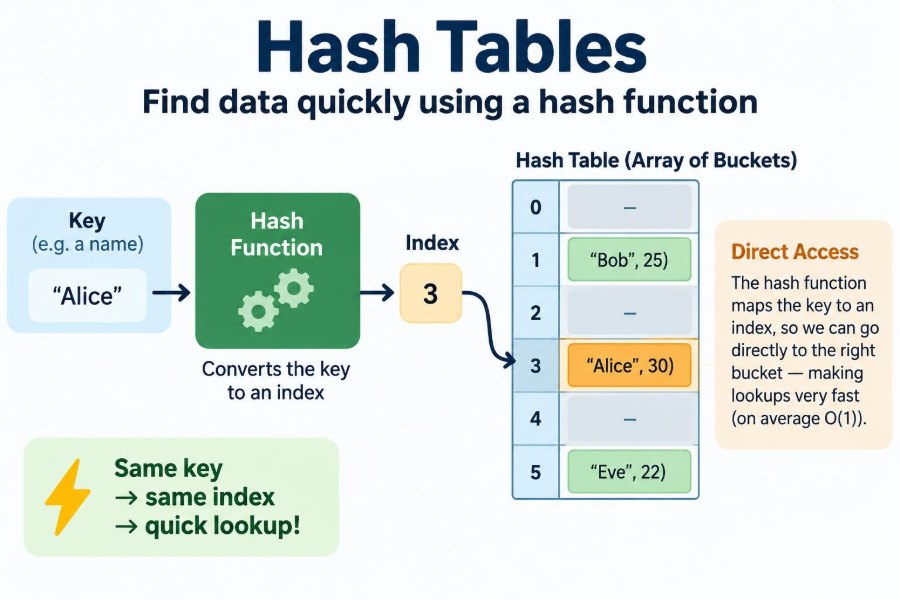

You type a username into a sign-in form, and the application quickly finds the matching account. You search a contact list by email, and the right person appears almost immediately. A browser cache checks whether it has already saved a page resource instead of downloading it again.
These actions feel simple because the result arrives so quickly. Behind many of them is a data structure designed for fast lookup: the hash table.
Hash tables are one of the most useful ideas in computer science because they connect a meaningful key, such as an email address or product code, to a stored value. They are common in programming languages, databases, operating systems, and everyday software.
The speed is not magic, and it is not unlimited. It comes from converting a key into a location where the value is likely to be stored, then carefully handling the cases where multiple keys want the same location.
🗂️ The Basic Problem: Finding One Item
Suppose a program stores employee records and needs to find the record for employee ID E4821. A simple list can hold every record, but locating one particular item may require checking records one by one.
With 10 records, that may be unnoticeable. With many thousands or millions, repeatedly scanning a list can waste time. The central question is: can the program use the ID to jump close to the answer rather than begin at the first item?
🔑 A Hash Table Connects Keys to Values
A hash table stores key-value pairs. The key identifies an item; the value is the associated information. For example, a key might be an email address and the value might be a customer profile.
Keys should represent the identity used for lookup. Values can be almost anything: a number, a string, a complex object, or another collection. In many languages, a hash table is exposed as a dictionary, map, associative array, or object-like collection.
🧭 Think of Numbered Mailboxes
Imagine an apartment building with numbered mailboxes. Instead of looking through every envelope in a pile, a delivery system uses an address rule to select a mailbox. The mailbox is the likely place for that resident’s mail.
A hash table works similarly. It has an underlying array of positions, often called buckets or slots. A calculation turns a key into an index, such as 0 through 15, so the program can inspect one small area first.
🧮 What a Hash Function Does
The calculation that maps a key to an array position is a hash function. Given a key, it produces a hash value, usually an integer. The table then turns that value into a valid bucket index.
For a conceptual table with 16 buckets, the final step might resemble hash(key) mod 16. Real implementations may use more sophisticated techniques, but the essential purpose remains the same: map a potentially huge key space into a manageable set of locations.
🔁 The Same Key Must Produce the Same Result
A useful hash function is deterministic: during the lifetime of a table, the same unchanged key must lead to the same hash value. If a program stores a value under user@example.com, a later lookup of that exact key has to visit the same starting bucket.
This requirement explains why mutable keys are dangerous. If an object used as a key changes in a way that changes its hash, the table may no longer be able to find the entry where it originally placed it.
📥 Inserting an Entry
When inserting a pair, the table hashes the key, calculates a bucket location, and stores the entry there. If the key already exists, many map implementations replace its value rather than create a second independent entry.
For example, a temperature map might store "London" → 18. Writing "London" → 21 later normally updates the value for London. The exact behavior is part of a language or library’s map contract.
🔎 Looking Up an Entry
Lookup follows the same route in reverse. The program hashes the requested key, checks the resulting bucket, and compares candidate stored keys to the requested key before returning the matching value.
The comparison step matters. A bucket location is a useful clue, not proof that two keys are identical. Two different keys can share a location, so a correct hash table confirms equality before declaring a match.
⚡ Why Average Lookup Is So Fast
With a well-sized table and reasonably distributed hashes, each bucket contains very few entries. The program usually computes a hash and examines only one bucket or a short sequence of positions.
That is why insertion, lookup, and deletion are commonly described as average O(1) time. “O(1)” means the expected amount of work does not grow in direct proportion to the number of stored entries. It does not mean every individual operation takes exactly one machine instruction.
📈 Big O Describes Growth, Not a Stopwatch
Big O notation compares how algorithms grow as input grows. A linear search through a list is O(n): in the worst case, doubling the number of items can roughly double the number checked. A balanced search tree is commonly O(log n), which grows more slowly.
A hash table’s average O(1) behavior is compelling for direct key lookups. Actual timing still depends on memory access, the cost of hashing and equality checks, cache behavior, collisions, resizing, and the programming language runtime.
💥 Collisions Are Normal
A collision occurs when distinct keys map to the same bucket or initial position. Collisions are unavoidable when a very large universe of possible keys is mapped into a finite number of buckets.
This is not automatically an error. Good hash tables are built around collision handling. The real problem is too many collisions in the same places, which forces the table to do more comparisons and weakens its expected performance.
🔗 Separate Chaining Stores Small Groups
One common collision strategy is separate chaining. Each bucket holds a small collection of entries, historically often shown as a linked list. On a collision, the new entry joins that bucket’s collection.
To find a key, the table scans only that bucket’s entries and compares keys. Some real implementations use lists at first and may switch heavily populated buckets to tree-like structures, reducing the harm from unusually long chains.
🚗 Open Addressing Searches for Another Slot
Another strategy is open addressing. Each entry lives directly in the table’s array. If its first slot is occupied by a different key, the implementation probes other slots according to a defined sequence.
Linear probing checks nearby positions; other methods use different steps or a second hash-derived value. Open addressing can be memory-efficient and cache-friendly, but it becomes less effective when the table is too full.
🧹 Deletion Is Trickier Than It Looks
In a chained table, deleting an entry means removing it from its bucket’s collection. In an open-addressed table, simply clearing a slot can accidentally break the probe path for a later entry.
For that reason, open-addressed designs may use a special deleted marker, sometimes called a tombstone, or reorganize nearby entries. This is a good reminder that fast lookup depends on preserving the table’s internal search rules.
📊 Load Factor Measures Crowding
The load factor is broadly the number of stored entries divided by the number of buckets or slots. A table containing 75 entries with capacity for 100 positions has a load factor around 0.75.
As crowding rises, collisions and probe lengths tend to rise too. The preferred threshold differs by implementation and collision strategy, so programmers should not assume one universal value. The key principle is to leave enough room for distribution to work.
📦 Resizing Restores Breathing Room
When a hash table becomes crowded, it often allocates a larger backing array and redistributes entries. This process is commonly called rehashing, although terminology varies.
Each key’s position can change because the capacity has changed. Resizing can make one insertion noticeably more expensive, since many entries may be moved, but spread across many ordinary insertions, the average insertion cost can still be O(1).
🎲 Good Hashes Spread Keys Evenly
A useful hash function aims to spread typical keys across available buckets rather than clustering them. Similar inputs should not predictably land together just because they share a prefix, suffix, or nearby numeric value.
For example, a naïve function that uses only the first character of a last name would group every name beginning with A. A stronger function considers the full key and mixes its information so ordinary input produces a more balanced distribution.
🪪 Hashing Is Not the Same as Equality
Hashing narrows the search; equality decides whether two keys represent the same thing. A common rule is: if two keys are equal, they must have the same hash value. The opposite is not required, because collisions can occur.
Suppose two customer objects are considered equal when their customer IDs match. Their equality method and hash calculation must be consistent with that definition. Otherwise, an entry may be inserted under one equivalent object and fail to be found with another.
🔐 Hash Tables Are Not Password Storage
The word “hash” also appears in security discussions, but the uses differ. A hash table uses hashing to organize data for fast retrieval. It may use non-cryptographic hashes chosen for speed and distribution.
Password storage needs deliberately slow, password-specific cryptographic schemes with salts and carefully chosen parameters. A general-purpose hash table, a fast checksum, and a password hashing system solve different problems and should not be treated as interchangeable.
🧱 Arrays, Lists, Trees, and Hash Tables
No data structure wins every task. The right choice depends on the operations a program must perform, the order it needs to preserve, and the guarantees it requires.
| Structure | Strong use case | Typical lookup behavior |
|---|---|---|
| Array | Access by known numeric index | O(1) by index |
| List | Simple ordered traversal | O(n) by arbitrary value |
| Balanced tree map | Sorted keys and range queries | O(log n) |
| Hash table | Direct lookup by key | Average O(1) |
The table describes common behavior, not a promise about every language implementation or workload. Details such as key type, memory pressure, and collision patterns matter.
📚 When Sorted Order Matters
A normal hash table does not inherently arrange keys alphabetically, numerically, or by insertion order. Some language-specific map types preserve insertion order, but that is a separate feature, not a consequence of hashing.
If you need “all orders between 1000 and 2000” or “the next key after this one,” a tree-based ordered map is often a better fit. Hash tables excel at asking, “Do you have this exact key?”
🧠 Real Uses You May Already Know
Hash tables appear wherever software needs a fast association from an identifier to information. Typical uses include:
- caches that map a request or resource key to a saved result;
- symbol tables that map variable names to program information in compilers;
- session stores that map session IDs to session data;
- counting maps that associate a word with its frequency;
- deduplication sets that remember which identifiers have already appeared.
A set is closely related to a hash table. It usually stores keys without separate user-visible values, using the table to answer whether a key is present.
🧾 A Word-Counting Example
Imagine counting words in a document. For each word, a program looks it up in a map. If it is absent, the program stores a count of one; if it is present, the program increments the existing count.
for each word in document:
    count[word] = count.get(word, 0) + 1
This avoids repeatedly scanning a separate list of every distinct word. The map turns “find this word’s current count” into a direct-key lookup, which is why frequency counting is a classic hash-table task.
🧩 Choosing Useful Keys
A key should be stable, meaningful, and specific enough to identify what the program needs. Database IDs, normalized email addresses, configuration names, and immutable coordinate pairs can all work when their equality rules match the application.
Be careful with ambiguous keys. If a system treats Sam as a unique customer key, two different customers named Sam may overwrite each other. A more suitable key might be a generated customer ID or a combination designed to be unique.
🛑 Avoid Mutable-Key Bugs
Using mutable objects as keys is a common source of confusing behavior. Consider a key object whose hash depends on a project code. If the code changes after insertion, the map may search a different bucket during lookup.
Prefer immutable key types such as strings, numbers, tuples, or immutable records where available. If a custom object is a key, avoid changing the fields used by its equality and hash logic while it belongs to the table.
🧪 Test Equality and Edge Cases
When implementing custom keys, test more than the happy path. Check that two logically equal objects retrieve the same stored value, that unequal objects do not accidentally compare equal, and that null-like or missing-key behavior matches the library’s rules.
Also test updates, deletions, unusual text, and large input sets. Most developers use a standard library hash map rather than implement the structure from scratch, but understanding these cases helps diagnose bugs in real code.
🛡️ Adversarial Inputs Can Change Performance
Average O(1) performance assumes hashes distribute the keys reasonably. Poorly designed custom hash functions, or deliberately crafted inputs in some contexts, can create many collisions and make operations approach O(n).
Libraries may include defenses such as stronger hash processing, randomized behavior, or different bucket representations. Application developers should still avoid simplistic key hashing and should treat untrusted, unusually large input collections with appropriate care.
💾 Memory and Cache Trade-Offs
Hash tables gain speed partly by reserving extra space. A lightly loaded table has fewer collisions, but it consumes more memory than a tightly packed list of entries.
Memory layout also matters. Open-addressed tables often keep data close together, which can work well with processor caches. Chained tables may allocate separate nodes, adding pointer overhead. These are implementation trade-offs, not reasons to abandon hash tables for ordinary lookups.
🔄 Iteration Has Different Strengths
Iterating through every item in a hash table is usually O(n), just as it is for many collections. It is not a shortcut for processing all values; its special advantage is locating a particular key quickly.
Iteration order may be unspecified in a standard hash map and can change after resizing or between runtime versions. Do not rely on an observed order unless the collection documentation explicitly guarantees it.
🧰 A Practical Selection Checklist
Before choosing a hash table, ask what the program needs most often:
- Do you repeatedly retrieve values by an exact identifier?
- Can keys remain stable after insertion?
- Is arbitrary or documented map order acceptable?
- Do you need sorted traversal or range queries instead?
- Will the collection be large enough that memory overhead matters?
- Are multiple threads accessing it, requiring a suitable concurrent or synchronized design?
A hash table is often the default choice for key-based lookup, but “default” is not the same as “always correct.”
🧵 Concurrency Needs Extra Care
Many ordinary hash maps are not safe for unsynchronized writes from multiple threads. Two operations that appear independent can interfere with insertion, resizing, or internal bookkeeping.
Use the concurrency tools provided by the language or platform when shared mutation is required. Options may include a concurrent map, locks, immutable snapshots, or a design that confines each map to one thread. The correct choice depends on access patterns.
🧭 The Core Principle to Remember
A hash table is fast because it replaces a broad search with a calculated starting location. The key is transformed into a hash, the hash directs the program to a small part of the structure, and equality checks resolve any collisions.
Its performance depends on several cooperating ideas: stable keys, consistent equality and hashing, enough capacity, sensible collision handling, and a workload suited to exact-key retrieval. Understand those conditions, and the phrase “average O(1)” becomes a practical design insight rather than a slogan.
Hash tables find data quickly not by eliminating search entirely, but by making the search remarkably small for the usual case. Once you recognize keys, buckets, collisions, and load factor, many familiar software features become easier to understand. 💻🔑⚡