
A bank transfer, a medical portal login, a software update, and a private work video call may look unrelated. Behind each one is a quiet agreement: the systems involved must be able to prove who they are and protect information while it travels.
Much of that protection depends on mathematical problems that ordinary computers cannot solve efficiently. Quantum computers could eventually change that assumption for some widely used cryptographic methods.
That does not mean a practical quantum computer can suddenly read every encrypted message tomorrow. It does mean that organizations handling long-lived secrets cannot wait for a dramatic “quantum day” before preparing.
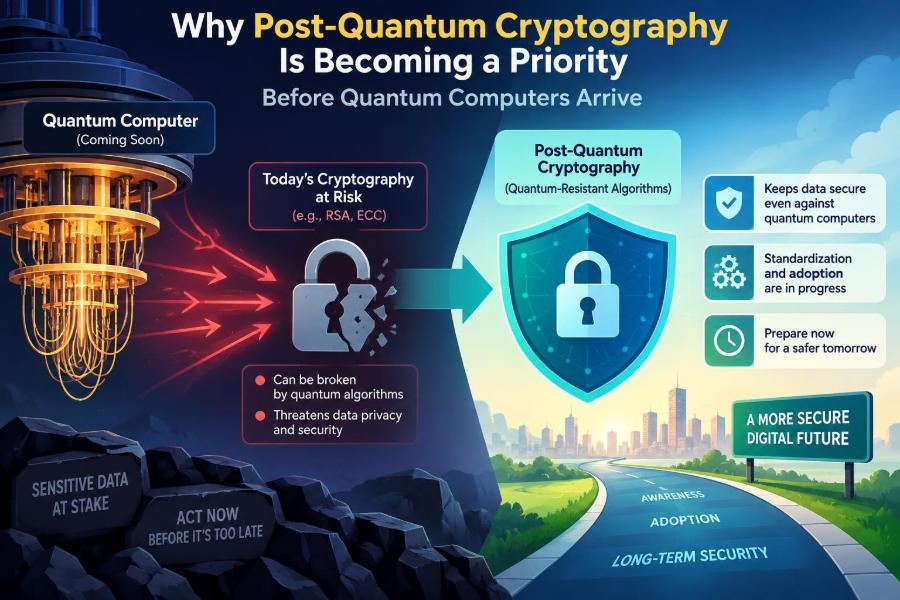
Post-quantum cryptography is the effort to replace vulnerable public-key tools with algorithms designed to resist both conventional and sufficiently capable quantum attacks. The transition is already a planning, inventory, testing, and engineering problem—not merely a future research topic.
🔐 The Security We Rarely See
Cryptography is the machinery that protects data from unauthorized reading or alteration. It helps a browser establish a secure connection, lets an app verify an update, and allows two organizations to exchange data without first sharing a secret in person.
Most people encounter its results rather than its mechanisms: a padlock in a browser, a verified sender, or a prompt to approve a sign-in. When it works, it is deliberately invisible.
The challenge is that digital systems often remain in service for years. A cryptographic choice made when an application is built can continue protecting archived documents, devices, and identities long after its designers have moved on.
🧩 Public-Key Cryptography Solves a Distribution Problem
Modern security uses two broad categories of encryption tools. Symmetric cryptography uses the same secret key to encrypt and decrypt data. It is fast and well suited to protecting large amounts of information.
Public-key cryptography uses a matched pair: a public key that can be shared and a private key that must remain secret. It solves the awkward problem of how two strangers can establish a protected connection over an untrusted network.
Public-key systems also support digital signatures. A signature lets a recipient check that a message or software package was approved by the holder of a private key and has not been changed since signing.
⚙️ The Mathematical Assumptions Behind Today’s Systems
Several common public-key systems rely on mathematical problems believed to be impractical for ordinary computers at appropriately chosen key sizes. RSA relies on the difficulty of factoring a large number into its prime components.
Elliptic-curve cryptography, often called ECC, relies on a different hard problem involving points on an elliptic curve. Its efficiency has made it common in web services, mobile devices, and protocols such as TLS.
These are not secret algorithms. Their safety comes from the cost of reversing a mathematical operation without the private key. That cost is manageable for legitimate users but intended to be beyond an attacker’s available computing resources.
🧠 What Makes Quantum Computing Different
A quantum computer is not simply a faster version of a laptop or data center server. It uses quantum states and operations that can enable different ways of processing certain classes of problems.
Quantum computing will not automatically accelerate every task. Many everyday workloads will not receive a magical improvement. Its significance for cryptography comes from specific quantum algorithms that can attack particular mathematical structures more efficiently than known classical methods.
Building a large, reliable quantum computer is itself a difficult engineering problem. Useful machines need many controlled quantum operations, error correction, and stability that current systems have not yet demonstrated at the scale needed to break broadly deployed public-key cryptography.
🧮 Shor’s Algorithm Changes the Public-Key Picture
In the 1990s, Peter Shor described a quantum algorithm that can efficiently solve integer factorization and discrete logarithm problems on a sufficiently capable fault-tolerant quantum computer. Those are the foundations of RSA and many elliptic-curve systems.
That is why quantum computing creates a structural concern for existing public-key cryptography. The concern is not that quantum devices merely try passwords faster; it is that they can use a fundamentally different route through the underlying mathematics.
A capable machine running Shor’s algorithm could, in principle, derive private keys from public information for affected schemes. It could then decrypt intercepted key exchanges or forge signatures associated with compromised keys.
🔎 Grover’s Algorithm Has a Different Effect
Quantum computing also has implications for symmetric encryption and hash functions, but the story is more measured. Grover’s algorithm provides a theoretical quadratic speedup for brute-force searching.
In simplified terms, a quantum attacker may need roughly the square root of the work needed by a classical brute-force attacker. This does not make well-designed symmetric cryptography unusable; it generally means security parameters may need to be increased.
For example, using larger symmetric keys is a practical response. The disruptive replacement problem is mainly concentrated in public-key encryption, key establishment, and digital signatures rather than in every cryptographic tool at once.
📨 “Harvest Now, Decrypt Later” Is the Immediate Risk
An attacker does not need a cryptographically relevant quantum computer today to create future risk. They can collect encrypted traffic or stolen encrypted archives now, preserve them, and attempt decryption later if technology permits.
This threat is often called harvest now, decrypt later. It matters only when the data will still be valuable or sensitive by the time a future decryption capability exists.
Examples may include long-lived government records, intellectual property, health information, legal communications, source code, product plans, and identity data. A short-lived shopping-session detail has a different risk profile from a secret expected to remain confidential for decades.
⏳ The Data Lifetime Test
The central planning question is not “When will quantum computers arrive?” It is “How long must this information remain protected?” A system that stores or transmits durable secrets may need quantum-resistant protection before the hardware threat is fully mature.
Organizations should consider three timelines together:
- How long confidentiality, authenticity, or integrity must last.
- How long it will take to discover, change, test, and deploy cryptography across systems.
- How soon a relevant quantum capability could plausibly change the threat model.
If the first two timelines extend into the third, delaying migration can leave a protection gap.
🏗️ Migration Takes Longer Than Replacing an Algorithm
Changing a cipher in a single modern application can be manageable. Changing cryptography across a large organization can involve old services, vendor products, device firmware, certificate systems, hardware security modules, network appliances, and partners.
A digital certificate may be embedded in a device that is difficult to update. A protocol may have a fixed message-size limit. A legacy system may accept only one signature format. These are engineering constraints, not abstract mathematical details.
That is why post-quantum readiness is often compared with infrastructure renovation. The new component must fit into a complex building without interrupting everyone who depends on it.
🗺️ Cryptographic Inventory Comes First
No organization can sensibly migrate what it cannot find. A cryptographic inventory identifies where algorithms, keys, certificates, protocols, and cryptographic libraries are used.
This work should reach beyond obvious web servers. Encryption may appear in backups, database connections, code-signing pipelines, identity systems, industrial equipment, payment devices, remote administration tools, and third-party integrations.
A useful inventory records more than an algorithm name. It should capture the asset it protects, data sensitivity, key ownership, software version, upgrade path, dependency owner, and expected operational lifetime.
📊 Prioritization Should Follow Real Exposure
Not every system needs the same migration schedule. Prioritization should reflect consequences if information is decrypted or a signature is forged in the future.
| System characteristic | Why it may receive earlier attention |
|---|---|
| Long-lived confidential data | Captured data could retain value long after collection. |
| Firmware or signed updates | Signature compromise can affect device trust and supply chains. |
| Hard-to-update devices | Deployment windows may be rare or costly. |
| External trust relationships | Partners may need coordinated protocol and certificate changes. |
| Short-lived, easily updated services | They may be suitable for later phases or pilot deployments. |
This is risk management, not a contest to replace the most algorithms first.
🛡️ What Post-Quantum Cryptography Means
Post-quantum cryptography, or PQC, refers to cryptographic algorithms intended to run on ordinary computers while resisting known attacks from both classical and quantum computers.
The phrase does not mean cryptography that runs only after quantum computing exists. It also does not usually mean using quantum physics to distribute keys. PQC is primarily software and protocol technology designed for conventional systems.
Its practical appeal is that organizations can begin deploying it through familiar channels: software updates, library upgrades, certificate changes, protocol negotiation, and device refresh cycles.
🧱 The Main Families of PQC Algorithms
Researchers have explored several mathematical approaches for quantum-resistant cryptography. Their security assumptions differ, which is valuable because it avoids placing all trust in one type of problem.
- Lattice-based cryptography uses hard problems related to high-dimensional geometric structures and is central to many current standardization efforts.
- Hash-based signatures build signatures from the well-understood security properties of cryptographic hash functions.
- Code-based cryptography is based on difficult problems involving error-correcting codes.
- Multivariate cryptography and other approaches have also been studied, though proposed schemes require continued scrutiny.
No category should be treated as permanently unquestionable. Cryptography advances through public analysis, attempts to break proposals, and careful implementation review.
📐 Standards Turn Research Into Deployable Tools
Organizations need interoperable, reviewed algorithms rather than a collection of experimental choices. Standardization provides named algorithms, parameters, test vectors, implementation guidance, and a foundation for products to support compatible behavior.
The U.S. National Institute of Standards and Technology, commonly known as NIST, has led a public process to evaluate post-quantum algorithms. It finalized initial standards for a key-encapsulation mechanism and digital signatures in 2024, while work on additional options continues.
Standards do not end the need for judgment. Teams must still choose appropriate parameters, validate library support, monitor guidance, and understand which protocols use which cryptographic function.
🔑 Key Encapsulation Replaces a Familiar Handshake Pattern
Many public-key systems establish a shared secret that is then used with fast symmetric encryption. A key encapsulation mechanism, or KEM, is a common post-quantum tool for this purpose.
In a simplified exchange, one party has a public key. Another party uses it to create an encapsulated value and a shared secret. The holder of the private key recovers the same secret, which can protect the rest of the connection.
This differs in details from classic key agreement methods, but the practical goal is recognizable: securely create a fresh secret for a session without exposing it to observers.
✍️ Digital Signatures Need Their Own Transition
Encryption protects confidentiality, while signatures protect authenticity and integrity. These roles are related but distinct, and they may migrate on different schedules.
Post-quantum signatures can be larger than familiar elliptic-curve signatures and may have different performance trade-offs. That affects certificates, signed software packages, secure boot processes, document workflows, and bandwidth-constrained devices.
A code-signing key deserves special attention. If an attacker could forge signatures trusted by an update system, the issue would extend beyond reading old data to distributing software that appears legitimate.
🔀 Hybrid Cryptography Reduces Transition Risk
Many early deployments use a hybrid approach: combine a traditional algorithm with a post-quantum algorithm. The intent is that the connection remains protected if at least one component remains secure under the assumed conditions.
For key establishment, a protocol might combine an existing elliptic-curve method with a post-quantum KEM. For signatures, designs may use more than one signature during a transition, although the details depend on protocol and trust requirements.
Hybrid designs are not automatically safer in every implementation. They add complexity, require careful combination rules, and can increase message sizes. Still, they provide a practical bridge while newer algorithms gain operational experience.
📦 Larger Keys and Messages Are Operational Facts
Some post-quantum algorithms use larger public keys, ciphertexts, or signatures than the public-key tools they replace. This does not make them unsuitable, but it changes practical assumptions.
Protocol messages may become large enough to expose limits in packet handling, certificate storage, QR-code workflows, embedded memory, or old middleware. A connection that works in a lab may behave differently through proxies, load balancers, and restrictive networks.
Testing should therefore include realistic paths, not just a successful cryptographic function call. Measure handshake size, latency, CPU use, memory use, error behavior, and interoperability with actual clients.
🧪 Implementation Security Still Matters
A mathematically strong algorithm can fail in software. Bugs, weak randomness, leaked secret material, incorrect parameter handling, and unsafe error messages can undermine an otherwise sound design.
Post-quantum implementations also need resistance to side-channel attacks. A side channel leaks information through timing, power consumption, electromagnetic signals, memory-access patterns, or other physical behavior rather than through the intended protocol output.
Use well-maintained libraries where possible, apply updates, follow vendor guidance, and test error conditions. Writing custom cryptography remains a high-risk choice unless a team has specialized expertise and a compelling reason.
🔄 Crypto Agility Is the Long-Term Design Goal
Crypto agility is the ability to change cryptographic algorithms, keys, parameters, and protocols without rebuilding an entire system. It is not simply adding a settings menu with a list of ciphers.
Good agility separates business logic from cryptographic choices, supports version negotiation safely, records what is deployed, and permits key rotation. It also avoids allowing an attacker to force a downgrade to a weaker option.
Quantum migration makes the value of agility visible, but the lesson is broader. Future vulnerabilities, new standards, and changing regulations will require cryptographic changes again.
🧰 Protocols Must Negotiate Safely
Protocols such as TLS protect communications only when both ends agree on compatible, secure behavior. Adding post-quantum support requires attention to version negotiation, certificate chains, handshake messages, and fallback rules.
A dangerous mistake is treating compatibility fallback as harmless. If an active attacker can interfere with negotiation and make both sides select a weaker legacy option, the new capability may offer little protection.
Protocol designers and operators need authenticated negotiation, clear deprecation plans, telemetry for failed handshakes, and a way to identify clients that cannot support the new configuration.
📱 Constrained Devices Have Special Challenges
Phones, sensors, smart cards, routers, vehicles, and industrial controllers can have limited processing power, memory, battery capacity, or network bandwidth. Some also operate for many years with difficult update procedures.
These constraints do not mean such devices should ignore PQC. They mean planners must identify them early and select migration paths suited to their limits, including gateway-based designs, firmware updates, hardware refreshes, or carefully chosen algorithms.
For a connected device expected to operate for a decade, the question is especially practical: can its trust anchors and update-verification process be changed after deployment?
🏢 Vendors and Supply Chains Share the Work
Few organizations control their entire technology stack. Cloud providers, certificate authorities, operating-system vendors, hardware makers, managed-service providers, and software suppliers all influence what can be deployed.
Procurement and vendor management should ask concrete questions: Which post-quantum standards are supported? Which versions and protocols are affected? Is hybrid deployment available? What is the upgrade timeline for products already in use?
Contract language and product roadmaps cannot substitute for testing, but they help make cryptographic transition a shared delivery requirement rather than an emergency request later.
🧾 Governance Gives Migration an Owner
Post-quantum migration crosses security, infrastructure, application engineering, compliance, procurement, and business teams. Without ownership, inventories become stale and pilot work never reaches production.
A governance plan should assign responsibility for algorithm policy, asset discovery, risk ranking, vendor coordination, testing standards, exception handling, and monitoring of standards developments. It should also define who can approve temporary use of older cryptography.
The objective is not bureaucracy for its own sake. Clear ownership prevents a critical certificate, device fleet, or archival system from falling between teams.
🚫 Common Mistake: Waiting for a Countdown Date
No one can responsibly promise the precise date when a quantum computer will threaten a specific key size in practice. Hardware progress, error correction, algorithms, and attacker resources all matter.
But uncertainty is not a reason to do nothing. Organizations routinely plan for uncertain events when the cost of preparation is lower than the cost of a rushed response.
A better approach is to start with discovery and high-value pilots now, then adapt deployment plans as standards, products, and threat assessments evolve.
🚫 Common Mistake: Replacing Everything at Once
A full immediate replacement may sound decisive, but it can create outages, compatibility failures, and poorly reviewed implementations. Systems have different data lifetimes, risk levels, and upgrade constraints.
Phased migration allows teams to learn. A sensible program can begin with cryptographic discovery, test environments, selected internet-facing services, high-value archival protection, and new systems being designed today.
Success means reducing meaningful exposure while keeping systems reliable, not declaring victory after a single algorithm has been enabled somewhere.
🚫 Common Mistake: Confusing PQC With Quantum Key Distribution
Quantum key distribution, or QKD, uses properties of quantum physics to help detect interception during key exchange in certain settings. It is a separate technology from post-quantum cryptography.
QKD can require specialized hardware and suitable communication links. It may have niche uses, but it is not a general drop-in replacement for internet security, software signing, or every enterprise application.
PQC is receiving broad attention because it can be integrated into conventional computing and networks. The two approaches address related security concerns but have different deployment models and limitations.
🎓 What Students Should Learn From This Shift
Students do not need to become cryptographers to understand the transition. A strong foundation includes the difference between symmetric encryption, public-key encryption, hashing, key exchange, and digital signatures.
It is also useful to learn why security depends on assumptions, implementation, and operations together. An algorithm name alone does not make a system secure; key management, updates, protocol design, and user behavior all matter.
Hands-on learning can include examining a TLS connection, generating test keys with established tools, reading protocol documentation, and following how a mainstream library introduces post-quantum support. Always use authorized environments when experimenting.
💼 What Working Professionals Can Do Now
Professionals do not need to wait for a company-wide mandate to improve readiness. Application owners can identify cryptographic dependencies, architects can build agility into new systems, and security teams can add quantum risk to data-classification discussions.
- Document certificates, key stores, libraries, protocols, and external dependencies.
- Classify data by how long it must remain confidential and trustworthy.
- Ask vendors for specific PQC and hybrid-support roadmaps.
- Test standardized approaches in isolated, realistic environments.
- Design new systems so algorithms and keys can be rotated without major redesign.
These actions are useful even if the final deployment choices change.
🧭 A Practical Migration Sequence
A disciplined program usually progresses through a sequence rather than a single upgrade event. The details vary by organization, but the pattern is broadly useful.
- Discover: map cryptography, dependencies, owners, and protected assets.
- Assess: rank systems by data lifetime, signature importance, exposure, and upgrade difficulty.
- Plan: choose standards-aligned options, vendor requirements, and transition milestones.
- Pilot: test hybrid or post-quantum configurations with realistic performance and compatibility checks.
- Deploy: roll out in phases, monitor failures, rotate keys where needed, and document exceptions.
- Maintain: track standards, implementation advisories, and systems that still depend on legacy methods.
This sequence turns an uncertain future threat into manageable present-day engineering work.
🌍 The Broader Lesson: Trust Has a Shelf Life
Post-quantum cryptography highlights an uncomfortable but useful truth: digital trust is not permanent. A certificate, key, or algorithm can be correct today and inadequate later because technology, attacks, or operational needs change.
Security programs are strongest when they treat cryptography as a lifecycle. That includes selecting algorithms, deploying them correctly, protecting keys, monitoring use, rotating credentials, retiring weak choices, and preparing for the next transition.
Quantum computing is a major reason to accelerate this discipline, but it is not the only reason. The ability to evolve safely is itself a security capability.
✅ The Core Principle: Prepare Before the Emergency
The priority around post-quantum cryptography is not based on claiming that every current encrypted connection is about to fail. It comes from the combination of long-lived data, stored intercepted traffic, slow technology replacement cycles, and the disruptive effect quantum algorithms could have on current public-key systems.
Preparation means using standardized, well-reviewed options; testing carefully; preserving compatibility where needed; and avoiding panic-driven changes. It also means recognizing that the most difficult step is often finding where cryptography lives in the first place.
The practical goal is straightforward: ensure that important systems can move to stronger cryptography before their current protection becomes an unacceptable liability.
Post-quantum readiness is less about predicting one exact quantum milestone and more about building the ability to protect valuable information through inevitable cryptographic change. 🔐⚙️🌱