
A company can encrypt a customer record today, store it in a well-managed cloud system, and still face a security decision that reaches far beyond today’s hardware. The record may need to remain private for years: perhaps it contains health information, trade secrets, legal documents, or infrastructure plans.
For most people, quantum computers still sound like a future technology. They are real, but they are not yet broadly capable of breaking the strongest widely used encryption at practical scale. That fact can make post-quantum encryption feel premature.
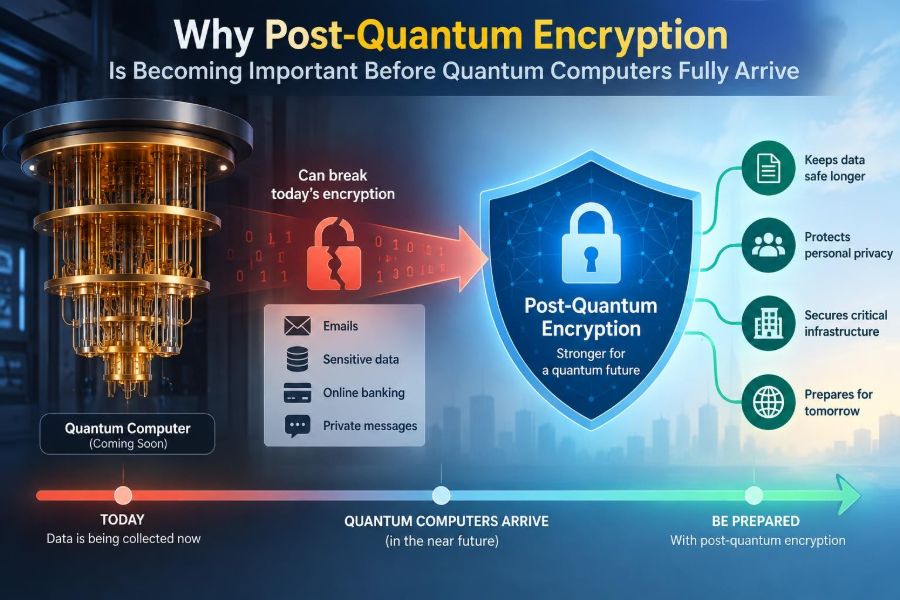
The complication is that attackers do not always need to decrypt data immediately. They can copy encrypted traffic or stolen archives now and wait for a better way to read them later. This changes the question from “Can a quantum computer break this today?” to “Will this information still matter when one can?”
That is why organizations are beginning a long, careful transition to cryptography designed for a post-quantum world. It is not a prediction that ordinary encryption has suddenly failed. It is a preparation project with technical, operational, and business consequences.
🔐 What Post-Quantum Encryption Means
Post-quantum cryptography, often shortened to PQC, refers to cryptographic algorithms designed to remain secure against both conventional computers and sufficiently capable quantum computers.
It does not mean encryption performed by quantum machines. It also does not mean every existing security mechanism must be thrown away. The goal is to replace the parts of modern cryptographic systems that a quantum computer could eventually undermine, while keeping strong practices that still work.
🧩 Encryption Is More Than Locking a File
People often picture encryption as a lock placed directly on a message. In real systems, several cryptographic tools work together. A website connection, for example, needs to establish a secret, verify the server’s identity, protect the data in transit, and detect tampering.
Post-quantum planning must examine this whole chain. Replacing one algorithm in a protocol does not help if a vulnerable signature, certificate, device update process, or key-exchange method remains elsewhere in the design.
🔑 Public-Key Cryptography Is the Main Concern
The biggest quantum risk concerns public-key cryptography. This is the family of methods that lets two parties establish trust or a shared secret without having met privately beforehand.
It supports familiar activities: visiting an HTTPS website, connecting through a VPN, checking that a software update is genuine, signing a contract electronically, or receiving an encrypted email. Popular public-key systems include RSA and elliptic-curve cryptography, commonly called ECC.
🧮 Why Today’s Public-Key Systems Work
RSA depends on the difficulty of factoring a very large number into its prime-number components. ECC relies on mathematical problems involving points on elliptic curves. Ordinary computers have no known efficient method for solving these problems at the sizes used by well-configured modern systems.
This does not mean the problems are impossible. It means solving them would require an impractical amount of conventional computing effort. Security is based on that gap between what is easy for an authorized user and what is infeasible for an attacker.
⚛️ What Makes Quantum Computing Different
A quantum computer uses quantum states to process certain kinds of problems differently from a conventional computer. It is not simply a faster laptop, and it will not make every task dramatically quicker.
For particular mathematical problems, however, quantum algorithms can change the security assumptions that underpin public-key cryptography. The concern comes from the algorithmic advantage, not from a vague idea that quantum computers are “very powerful.”
📐 Shor’s Algorithm and the Long-Term Threat
In the 1990s, mathematician Peter Shor described a quantum algorithm that could, in principle, factor large integers and solve the discrete-logarithm problems behind common public-key systems efficiently on an appropriate quantum computer.
A practical machine capable of doing this reliably at useful cryptographic scale has not been publicly demonstrated. Building one would require far more than small experimental quantum processors: it would need many dependable, error-corrected quantum operations. Still, the existence of the algorithm means RSA and widely used ECC are not long-term quantum-safe assumptions.
🛡️ Symmetric Encryption Has a Different Story
Symmetric encryption uses the same secret key, or closely related secret keys, to encrypt and decrypt data. AES is a common example. Once two parties have shared a symmetric key, it can protect large volumes of data efficiently.
Quantum computing is expected to affect symmetric cryptography differently. Grover’s algorithm offers a theoretical speedup for searching keys, but it does not create the same kind of collapse that Shor’s algorithm creates for RSA and ECC. Using sufficiently large symmetric keys, such as AES-256 where appropriate, is generally part of quantum-resilient planning.
⏳ The “Harvest Now, Decrypt Later” Problem
Harvest now, decrypt later describes an attacker collecting encrypted information now with the intention of decrypting it later if capable quantum computers become available. The attacker may capture internet traffic, obtain backups, or steal encrypted databases.
The data does not need to be useful forever. A stolen product roadmap may lose value quickly, but a government record, identity document, medical history, research result, or long-lived industrial design could remain sensitive for decades.
📦 Data Has a Security Shelf Life
A useful planning exercise is to ask how long information must remain confidential. This period is sometimes called its confidentiality lifetime. It varies sharply by data type and by organization.
- A short-lived retail promotion may need protection for only a limited period.
- Authentication secrets and signing keys require protection while they are active, but their misuse can have lasting consequences.
- Personal records, defense-related data, proprietary formulas, and critical infrastructure designs may require long-term confidentiality.
If data must remain secret longer than the likely time required to migrate systems and for quantum capability to become relevant, postponing the transition can create a gap.
🗓️ Why Waiting for a Clear Deadline Is Risky
No one can provide a reliable calendar date for a cryptographically relevant quantum computer. Progress depends on hardware quality, error correction, engineering advances, and scaling challenges. Predictions should therefore be treated as uncertain, not as a countdown clock.
But uncertainty is not a reason to do nothing. Cryptographic migration is often slow because security is embedded in products, devices, suppliers, contracts, certificates, operating systems, and compliance processes. By the time a threat is obvious, changing everything may take longer than expected.
🏗️ Migration Is an Engineering Project, Not a Switch
Updating a cryptographic algorithm sounds simple until it reaches real infrastructure. A bank may have mobile apps, payment systems, hardware security modules, ATMs, internal services, archival systems, vendor connections, and devices that cannot be upgraded easily.
Each component may have different performance limits and upgrade schedules. Some use cryptography directly; others inherit it through libraries, cloud services, network appliances, or identity providers. The work is closer to renovating a city’s water pipes than changing a password.
🧾 Standards Create a Practical Starting Point
Post-quantum cryptography needs public algorithms that have received extensive analysis, clear implementation guidance, and broad ecosystem support. The U.S. National Institute of Standards and Technology, known as NIST, has run a multi-year process to evaluate and standardize post-quantum algorithms.
Standards do not eliminate all risk. Cryptography must continue to be tested as researchers look for mathematical weaknesses and implementation flaws. Yet standardized algorithms give software vendors, hardware makers, and organizations a common basis for interoperable migration.
🔄 Key Encapsulation Replaces a Familiar Role
One major post-quantum tool is a key encapsulation mechanism, or KEM. A KEM helps two parties establish a shared secret over an untrusted network. That secret can then be used with fast symmetric encryption to protect the actual data.
This fills a role similar to traditional public-key key exchange. In current post-quantum standards discussions, ML-KEM is a prominent example. The exact protocol details matter to implementers, but the general idea is simple: use quantum-resistant mathematics to create the temporary secret that protects a connection.
✍️ Digital Signatures Need Quantum-Safe Replacements
Digital signatures answer a different question: “Did this message or software really come from the claimed sender, and has it been changed?” They are essential for code signing, certificates, document workflows, firmware updates, and identity systems.
Post-quantum signature schemes, including standardized approaches such as ML-DSA and SLH-DSA, are intended to address this need. Organizations should not treat key exchange and signatures as one interchangeable task; each has distinct formats, performance characteristics, and migration paths.
📏 Bigger Keys Are Not the Whole Answer
A common misunderstanding is that organizations can protect RSA simply by choosing a much larger key. Larger keys make conventional attacks harder, but Shor’s algorithm attacks the underlying mathematical structure. Enlarging the same structure does not solve the quantum problem in the way it does against ordinary brute force.
The solution is to use a different family of hard mathematical problems. That is why post-quantum migration is about changing algorithms and protocols, not merely adjusting a configuration value.
🧠 The Main Families of Post-Quantum Methods
Researchers have explored several mathematical approaches. Modern standardization efforts have focused strongly on lattice-based cryptography, while hash-based signatures also play an important role. Other families have been studied, sometimes with promising properties and sometimes with weaknesses discovered during public review.
| Approach | General idea | Typical migration consideration |
|---|---|---|
| Lattice-based | Uses difficult problems involving high-dimensional mathematical structures. | Often efficient, but key and message sizes can differ from current systems. |
| Hash-based signatures | Builds signatures from the security properties of cryptographic hash functions. | Can offer conservative design choices, with trade-offs in signature size or speed. |
| Code-based and other approaches | Uses different hard mathematical problems. | May provide diversity, but operational practicality and standard support vary. |
Diversity can be valuable, but it must be balanced against the cost of supporting multiple algorithms. A system should not add cryptographic complexity without a clear reason.
🤝 Hybrid Cryptography Eases the Transition
A hybrid approach combines a conventional algorithm with a post-quantum algorithm. For example, a connection might derive its session secret using both an existing elliptic-curve exchange and a post-quantum KEM.
When designed correctly, this can provide protection if either component remains secure. It is useful during migration because it limits dependence on a newer algorithm alone while helping systems gain quantum-resistant capability. However, hybrid designs must be specified carefully; combining two methods carelessly does not automatically create stronger security.
🌐 TLS Is a Major Migration Surface
Transport Layer Security, or TLS, protects much of the web and many application-to-application connections. It is a natural place to introduce post-quantum key establishment because it protects traffic that could otherwise be recorded for future decryption.
Browsers, content delivery networks, cloud providers, and server software can begin supporting new options before every organization has redesigned every internal application. Compatibility testing remains essential, especially for older clients, network inspection tools, and devices with rigid TLS implementations.
📱 Devices Can Be Harder Than Servers
Servers can often be patched or replaced on a planned schedule. Embedded devices may remain deployed for a decade or longer: medical equipment, industrial controllers, vehicles, sensors, smart meters, and networking appliances are common examples.
A device that cannot accept a cryptographic update may become a long-term weak point. Procurement teams should therefore ask not only whether a product supports post-quantum algorithms today, but whether it has a secure, realistic path for future cryptographic updates.
📜 Certificates and Public-Key Infrastructure Matter
Public-key infrastructure, or PKI, manages certificates that bind identities to public keys. A web certificate, an employee credential, or a code-signing certificate all depend on this trust machinery.
Moving to post-quantum signatures may affect certificate formats, chain sizes, validation software, issuance systems, and storage limits. Because certificates are embedded across enterprise networks, this work needs coordination between security teams, platform owners, application developers, and external certificate providers.
🧰 Cryptographic Agility Is the Long-Term Skill
Cryptographic agility means designing systems so algorithms, keys, and protocol settings can be changed without rebuilding the entire product. It is not the same as allowing every algorithm at once. Uncontrolled flexibility can accidentally preserve weak options.
Good agility means using well-maintained libraries, keeping algorithms separate from business logic, recording where cryptography is used, and supporting orderly upgrades. Post-quantum preparation is a strong reason to build this capability, but it will also help when future vulnerabilities or standards changes appear.
🔍 Start With a Cryptography Inventory
Organizations cannot protect what they have not located. A practical first step is a cryptographic inventory: a map of systems, algorithms, key sizes, certificates, protocols, data lifetimes, dependencies, and responsible owners.
The inventory should include third parties and managed services. A cloud platform may handle encryption well, but an organization still needs to understand which controls are provided by the service and which are configured or managed by the customer.
🎯 Prioritize by Exposure and Data Lifetime
Not every system needs the same migration schedule. Prioritization should consider whether data travels over public networks, how long it remains valuable, whether a system signs software or commands, how difficult it is to update, and what disruption a change could cause.
For example, a public-facing service handling long-lived sensitive information may deserve early testing. A short-lived internal tool with easily replaceable data may reasonably follow later. This is risk management, not a race to apply identical technology everywhere.
🧪 Test Performance and Compatibility Early
Post-quantum algorithms can have larger public keys, ciphertexts, or signatures than traditional alternatives. That can affect packet sizes, certificate chains, memory use, database fields, bandwidth-constrained networks, and device startup time.
These effects are not necessarily deal-breakers. They are engineering facts to measure. Pilot deployments can reveal whether a legacy load balancer rejects a larger handshake, whether a constrained device needs optimization, or whether an API assumed a fixed signature length.
🚫 Do Not Invent Your Own Quantum-Safe Crypto
When a major technological shift appears, it can tempt teams to create custom encryption schemes or combine algorithms in undocumented ways. This is especially dangerous. Cryptographic designs often fail because of subtle mathematical, protocol, randomness, or implementation mistakes.
Use reviewed standards, mature libraries, and configurations recommended by the relevant platform or vendor. A home-grown “quantum-proof” solution may provide less security than established conventional cryptography, even before quantum computing becomes relevant.
🧑💻 Implementation Errors Still Matter
A mathematically sound algorithm can be defeated by weak random-number generation, exposed private keys, flawed access controls, insecure backups, side-channel leaks, or an unpatched server. Post-quantum cryptography does not replace ordinary security hygiene.
In fact, migration can introduce fresh implementation risk because developers are working with unfamiliar key formats and APIs. Code review, test vectors, secure key storage, monitoring, and incident response remain essential parts of the security model.
⚖️ Quantum-Safe Does Not Mean Risk-Free
“Quantum-safe” is a useful shorthand, but it should not be understood as a permanent guarantee. Security assumptions can change as cryptanalysis improves, implementation experience grows, and quantum hardware develops in unexpected directions.
Organizations should avoid both extremes: dismissing the transition because practical quantum attacks are not available today, and claiming that a new algorithm makes security solved forever. Responsible planning keeps options open and follows evolving standards.
💼 What Working Professionals Should Ask Vendors
Security decisions often involve products that an organization does not build itself. Useful vendor questions focus on evidence and upgradeability rather than marketing language.
- Which public-key algorithms and protocol versions does the product use?
- Does the product have a documented post-quantum migration roadmap?
- Can its cryptographic components be updated without replacing the whole system?
- Does it support standards-based hybrid or post-quantum modes where appropriate?
- How will it handle certificates, key storage, interoperability, and older clients?
A vague claim of being “quantum ready” is not enough. The meaningful details are the algorithms, versions, deployment model, and upgrade path.
🎓 What Students Should Learn From This Shift
For students, post-quantum cryptography is a useful lesson in how computer science connects theory and operations. Abstract mathematics influences web browsers, payment systems, software supply chains, and the private information people expect organizations to protect.
Learning the difference between symmetric encryption, public-key encryption, hashing, signatures, certificates, and key exchange creates a strong foundation. The deeper lesson is that secure systems depend on assumptions, and good engineers plan for the day those assumptions need to change.
🧭 A Sensible Migration Roadmap
There is no single rollout plan for every organization, but a staged approach reduces avoidable surprises.
- Identify cryptographic assets, data lifetimes, and systems that are difficult to update.
- Track standards and supported options from operating system, cloud, browser, hardware, and software vendors.
- Test post-quantum or hybrid approaches in controlled environments.
- Prioritize high-value, long-lived, externally exposed, and long-replacement-cycle systems.
- Deploy gradually with monitoring, rollback plans, and compatibility checks.
- Maintain cryptographic agility so later changes are manageable.
The right pace depends on an organization’s threat model and technology estate. Starting the discovery and testing work early is different from rushing unproven changes into every production system.
🌱 The Core Principle: Prepare Before the Emergency
Post-quantum encryption is becoming important not because quantum computers have already broken the internet, but because confidentiality can outlive the technology used to protect it. Recorded encrypted data, long-lived devices, and slow replacement cycles make advance preparation rational.
The most durable response is not panic or blind adoption. It is an informed transition: understand where public-key cryptography is used, protect long-lived information first, adopt reviewed standards as ecosystems mature, and design systems that can evolve again.
The practical goal is simple: make cryptographic change routine before a future breakthrough makes it urgent. That approach protects information with a realistic view of both today’s systems and tomorrow’s uncertainty. 🔐⚛️🛡️