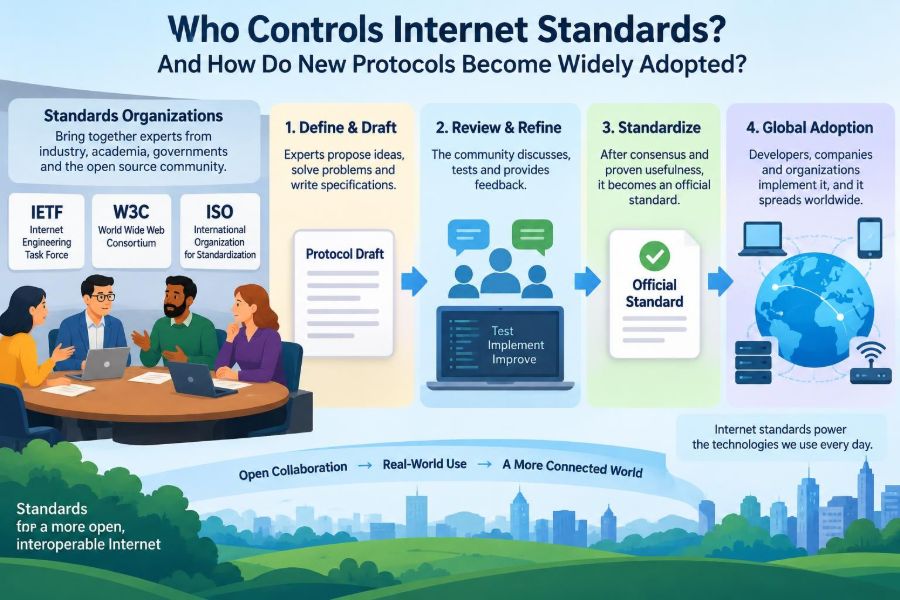

You open a website on your phone, send a message, join a video call, and connect headphones over Bluetooth. These actions involve many companies, networks, operating systems, and devices. Yet they usually work together without asking who built each piece.
That smooth experience depends on shared technical rules. A browser and a web server need the same way to request a page. Your home router and an internet provider need compatible ways to move data. A security system needs both sides to recognize the same encryption methods.
It is natural to wonder who makes those rules. Is there one organization that controls the internet? Can a company simply announce a new protocol and expect everyone to use it?
The answer is more distributed—and more practical—than most people expect. Internet standards emerge from a mix of open technical work, formal coordination, software implementation, network deployment, and real-world demand.
🌐 The Internet Has No Single Owner
The internet is a network of networks. Universities, businesses, cloud providers, governments, internet service providers, and home users operate parts of it independently. No central office owns all of those networks or can command every participant.
This arrangement makes global coordination harder, but it also prevents one organization from being a single point of control. Standards provide the common language that lets independently operated systems exchange data.
🧩 What an Internet Standard Actually Is
An internet standard is an agreed technical specification: a detailed description of how software or hardware should behave. It may define message formats, field names, error handling, security requirements, or timing rules.
A standard does not have to be a law. In many cases, participants follow it because interoperability is valuable. A web service using a private language would be far less useful if ordinary browsers could not understand it.
Specifications also leave room for choice. For example, a standard can define a common connection process while allowing different vendors to optimize their own implementations.
📦 Protocols Are Rules for Communication
A protocol is a set of rules that systems use to communicate. Think of it as a structured conversation: who speaks first, what each message contains, what a receiver must do, and what happens when something goes wrong.
HTTP helps browsers and servers exchange web resources. DNS helps turn names such as a site address into network locations. TCP and IP help data travel across networks. These protocols work in layers, with each layer solving a different part of the problem.
🏛️ The IETF Shapes Many Core Internet Protocols
The Internet Engineering Task Force, or IETF, is one of the most influential organizations in internet standardization. It develops many of the protocols that support internet communication, including work related to routing, email, web transport, naming, and security.
The IETF is not a global internet government. It is an open technical community with participants from companies, universities, public institutions, and independent backgrounds. Its influence comes from the quality and usefulness of its specifications, not from ownership of the internet.
📝 RFCs Preserve the Technical Record
IETF and related internet specifications are commonly published as RFCs, short for Request for Comments. Despite the modest name, RFCs are permanent technical documents with a long history.
Not every RFC is a standard. Some describe experimental work, informational guidance, or historical methods. Reading the document’s status matters; treating every RFC as a current requirement is a common misunderstanding.
RFCs are valuable because they make protocol details inspectable. An implementer can check the expected behavior rather than relying only on another vendor’s interpretation.
🤝 Rough Consensus and Working Code
The IETF is often associated with the phrase “rough consensus and running code.” In practice, this means technical progress is not usually decided by a simple vote count or by waiting for universal enthusiasm.
Participants discuss trade-offs, identify serious objections, and look for a workable direction that the community can support. “Running code” matters because a proposal that sounds elegant may reveal hidden problems when people try to build and use it.
Consensus is not the same as unanimity. It means remaining concerns have been considered and the group can reasonably move forward.
👥 Working Groups Do the Detailed Work
Much IETF work happens in focused working groups. A group has a defined charter, such as improving a transport protocol or addressing a security problem. Its members review drafts, debate design choices, and refine text.
Working groups rely heavily on public technical discussion. That openness allows implementers and operators to point out issues that might be invisible from a purely theoretical design.
A proposal can also be discussed outside a formal group, especially while the problem is still being understood. Not every idea becomes a lasting standard.
🧭 The IESG Reviews Internet Standards Work
The Internet Engineering Steering Group, or IESG, provides technical oversight for much of the IETF’s standards process. It reviews documents before publication and checks whether the process, technical review, and security considerations have been handled appropriately.
This review does not guarantee that every future deployment will be easy. It helps catch ambiguity, unresolved conflicts with existing standards, and operational risks before a specification receives broader recognition.
🔢 IANA Coordinates Shared Identifiers
Many protocols need globally unique values. Examples include protocol numbers, port numbers, media types, and DNS-related parameters. If two unrelated things used the same reserved number in the same context, systems could misunderstand each other.
The Internet Assigned Numbers Authority, or IANA, maintains many of these registries. Its role is coordination, not deciding every protocol’s design. A specification can state which values need registration and how assignments should be managed.
🌍 ICANN and the Domain Name System
The Internet Corporation for Assigned Names and Numbers, ICANN, has a highly visible role in coordinating parts of the Domain Name System and the global allocation of IP address resources through related structures. Because domain names are familiar, people sometimes mistake ICANN for the controller of the whole internet.
Its scope is narrower than that. ICANN does not define every web protocol, run every network, or decide what browsers support. DNS coordination is essential, but it is one component of a much larger system.
📐 Other Standards Bodies Matter Too
Internet technology overlaps with many fields, so no single standards body covers everything. Different organizations specialize in different layers or industries.
| Organization or forum | Typical area of work |
|---|---|
| IETF | Internet protocols and operational practices |
| W3C and WHATWG | Web platform technologies and browser-facing specifications |
| IEEE | Networking and hardware standards, including widely used local-network technologies |
| ISO and IEC | Broad international technical standards |
| ITU-T | Telecommunications standards and coordination |
These groups may cooperate, reference one another’s work, or address adjacent problems. Their processes differ, so “internet standard” is a useful broad phrase rather than one single legal category.
🕸️ Web Standards Follow a Related Path
The web sits on top of internet networking, but browsers need their own shared behavior. HTML, CSS, JavaScript APIs, accessibility behavior, and browser security features need coordination so that a page does not behave completely differently in each browser.
The W3C and WHATWG are prominent in this area. Browser makers, web developers, and other contributors help shape specifications through discussion, tests, and implementation experience. Web compatibility is especially demanding because old sites can remain in use for years.
🔒 Security Standards Need Extra Scrutiny
A security protocol does more than move information; it protects confidentiality, integrity, or identity. Small design mistakes can have serious consequences, so security proposals receive extensive review from implementers and security specialists.
For example, a secure protocol needs clear rules for negotiating cryptographic options, checking certificates where relevant, rejecting unsafe fallbacks, and handling errors without leaking sensitive information. A vague “be secure” instruction is not enough.
Security also changes over time. Algorithms that were once acceptable may later become unsuitable, which is why standards need ways to evolve without leaving the entire internet behind.
💡 A New Protocol Usually Starts With a Problem
Successful protocols usually begin with a concrete limitation. Perhaps applications need lower delay, connections recover poorly on changing networks, devices need a safer authentication method, or an existing format cannot represent new information cleanly.
A good problem statement distinguishes a real gap from a preference for novelty. It explains who is affected, why existing options are insufficient, and what constraints a replacement must respect.
For a hypothetical example, a team might propose a protocol for sensors that lose connectivity frequently. Before designing messages, it would need to show why established messaging methods cannot be configured to meet the requirement.
🧪 Drafts Turn Ideas Into Testable Rules
An initial proposal often appears as an Internet-Draft or a similar draft specification. Drafts are working documents, not finished promises. They can change substantially as reviewers identify missing cases.
Useful drafts specify more than the happy path. They define terminology, message structure, state changes, invalid input handling, version negotiation, security considerations, and interoperability expectations.
A protocol that relies on unstated assumptions can lead to several incompatible implementations, even when every team believes it followed the same document.
🛠️ Implementations Expose Design Problems
Writing code forces precision. An implementation may reveal that a field is ambiguous, a required lookup is too slow, a handshake fails behind common network equipment, or error recovery is impractical.
Independent implementations are particularly useful. If two teams can build compatible software from the specification alone, that is stronger evidence than one codebase talking only to itself.
Testing does not make a protocol perfect. It does replace some guesses with observed behavior, which is essential before broad deployment.
🧫 Interoperability Testing Builds Confidence
Interoperability means separate systems can work together correctly. It is more demanding than a demo because it includes differences in programming languages, platforms, configurations, and interpretations of optional features.
Test suites, shared test environments, and compatibility events can uncover disagreements early. Teams may find that one implementation accepts malformed input while another rejects it, or that each chooses a different default behavior.
These findings often improve both code and specification text. Clearer standards reduce the chance that future adopters repeat the same confusion.
🚦 Deployment Is the Real Adoption Test
A published specification is not automatically a widely used protocol. Adoption begins when software libraries, operating systems, browsers, servers, network operators, and application teams decide that implementation is worth the cost.
Deployment exposes conditions that lab tests cannot fully represent: unusual routers, corporate firewalls, high traffic volumes, legacy devices, monitoring requirements, and support teams with limited time.
For this reason, standards and deployment influence each other. Operational feedback may lead to revisions, clearer guidance, or a safer rollout strategy.
📈 Network Effects Can Accelerate or Stall Adoption
Protocols gain value when more compatible participants use them. An email format is useful because many senders and receivers understand it; a new format with only one endpoint has limited reach.
This is a network effect. It can speed up a useful standard once major tools support it, but it can also make established technologies difficult to replace. Compatibility is often more valuable than technical elegance alone.
Adoption therefore depends on incentives. A new protocol may save bandwidth or improve privacy, yet still wait for a compelling reason that justifies engineering and operational work.
🔁 Backward Compatibility Reduces Migration Pain
Internet systems cannot usually stop worldwide for an upgrade. New protocols often need to coexist with older ones, use negotiated versions, or provide fallback behavior while adoption grows.
Backward compatibility is helpful when it lets newer and older systems communicate safely. It becomes harmful when it preserves insecure behavior indefinitely or makes the design impossible to understand.
The key question is not “Does it support every old system?” but “What transition path provides useful compatibility without locking in unacceptable risk?”
🧱 Middleboxes Can Change What Is Deployable
Between two endpoints, traffic may pass through devices such as firewalls, network address translators, proxies, traffic filters, and load balancers. These are often called middleboxes.
Middleboxes can improve security or manage networks, but they can also interfere with unfamiliar traffic. A protocol may be valid on paper yet fail because an older device assumes packets must follow an older pattern.
Protocol designers test against this reality. Sometimes they choose deployment techniques that work through existing infrastructure; sometimes they deliberately encrypt more metadata to reduce unwanted interference. Both choices have trade-offs.
⚖️ Open Standards and Proprietary Protocols Serve Different Needs
An open standard is generally available for public review and implementation under defined conditions. Openness can encourage multiple vendors, independent security review, and long-term interoperability.
A proprietary protocol is controlled by a company or other private party. It can evolve quickly within one product ecosystem and may be appropriate for specialized internal needs. However, outside developers may face limited documentation, licensing constraints, or dependence on one vendor.
Neither label alone proves quality. The practical questions are whether the protocol is documented, secure enough for its use, interoperable where needed, and governed in a way its users can rely on.
🧾 Patents and Licensing Affect Participation
Technical standards sometimes involve patented techniques. Licensing terms can affect whether hobbyists, startups, open-source projects, and competitors can realistically implement a specification.
Standards organizations may have policies for disclosing relevant intellectual-property claims, but those policies do not remove every legal or commercial question. Implementers should understand the applicable terms rather than assuming that “standardized” always means unrestricted.
This is one reason a technically strong proposal can still face adoption barriers. Cost, legal uncertainty, and implementation freedom influence ecosystem decisions.
🗳️ Governance Is Technical and Social
Protocol decisions involve engineering, but they also affect users, operators, vendors, and public institutions. Choices about identifiers, privacy, accessibility, language support, and security can distribute costs and benefits unevenly.
Open participation helps bring more perspectives into a design, though openness does not automatically make participation easy. Time zones, technical jargon, employer support, and experience all shape whose voice is heard.
Healthy governance makes decision-making visible, documents objections, and gives technical arguments a path to be evaluated. It cannot eliminate disagreement, but it can make outcomes more accountable.
🌎 Governments Influence Without Running the Internet
Governments influence internet use through laws, procurement rules, security requirements, spectrum policy, competition policy, and operation of public networks. They may also participate in standards discussions directly or through national bodies.
That influence is significant, but it differs from operating every protocol registry or directing every network. Internet governance is distributed across technical groups, businesses, civil-society participants, network operators, and governments.
This distribution can be slow and complex. It also reflects the fact that the internet crosses borders and depends on many independently managed systems.
📬 Email Shows Why Standards Need Shared Operations
Email uses long-established standards for message transfer, addressing, and message format. Yet compatible syntax alone does not solve every operational problem. Spam, spoofing, deliverability, encryption, and attachment handling have required additional conventions and protective mechanisms.
Email demonstrates that a protocol can be globally successful while remaining imperfect. Its openness enabled broad interoperability, but that same openness created opportunities for abuse that operators had to manage over time.
The lesson is practical: protocol design must consider not only legitimate messages, but also misuse, scale, maintenance, and the incentives of participants.
⚡ HTTP/3 Illustrates Layered Adoption
HTTP/3 is a modern example of web-protocol evolution. It uses QUIC, a transport protocol designed to improve aspects of web communication, particularly in conditions where connection setup and packet loss can affect responsiveness.
Its adoption required more than publishing a specification. Browsers needed support, servers and content-delivery networks needed deployment, operators needed observability, and networks needed to carry the traffic reliably.
Older HTTP versions did not disappear overnight. This coexistence reflects a common pattern: a new protocol earns use gradually while fallback options keep services reachable for users on older software or restrictive networks.
🧑💻 What Developers Should Check Before Adopting a Protocol
Developers often encounter a protocol as a library option or a product feature. Before enabling it, look beyond whether it is fashionable or technically interesting.
- Check the specification’s maturity and whether multiple credible implementations exist.
- Understand security requirements, authentication choices, and safe default settings.
- Test compatibility with your clients, servers, proxies, and monitoring tools.
- Plan fallback behavior and measure failures during a gradual rollout.
- Confirm that your team can operate, update, and troubleshoot the technology.
For a small internal system, a simpler established protocol may be the better decision. For a public platform, broad compatibility and a careful migration plan are often decisive.
🔍 How to Read Standards Without Getting Lost
Standards can feel dense because precision matters. Start with the abstract and terminology, then identify the core message flow or data model. Read mandatory requirements before optional extensions.
Words such as MUST, SHOULD, and MAY have deliberate meanings in many technical specifications. In general, MUST indicates a requirement for interoperability or correctness, SHOULD indicates a strong recommendation with possible exceptions, and MAY indicates an allowed option.
Pair reading with a known implementation and test data. A packet capture, request log, or small prototype can turn abstract fields into observable behavior.
🚫 Common Misunderstandings About Internet Standards
One mistake is believing a standard is automatically mandatory. Many standards are voluntary, though contracts, regulation, platform policies, or market expectations can make particular ones effectively required in a context.
Another is assuming a standards body picks winners in isolation. A formal process matters, but adoption ultimately depends on implementers and operators. Conversely, widespread use does not automatically mean a protocol is well designed or formally standardized.
A final mistake is treating protocol evolution as a clean replacement. The internet contains old software, specialized equipment, and local constraints. Transition work is part of the technology, not an afterthought.
🧠 The Core Principle: Coordination Creates Compatibility
No one organization controls all internet standards or all internet adoption. Different groups coordinate specifications, identifiers, web behavior, networking technologies, and telecommunications concerns, while actual deployment remains decentralized.
New protocols become widely adopted when several conditions align: they solve a real problem, have clear specifications, survive implementation and security review, work across independent systems, and offer enough value to justify migration.
The central insight is simple: standards are not merely documents. They are ongoing agreements maintained through technical evidence, shared incentives, and continued operational experience.
The internet works at global scale because independent participants choose compatible rules—and keep improving those rules when reality reveals their limits. Understanding that process makes everyday technology feel less mysterious and makes better technical decisions possible. 🌐🤝💻