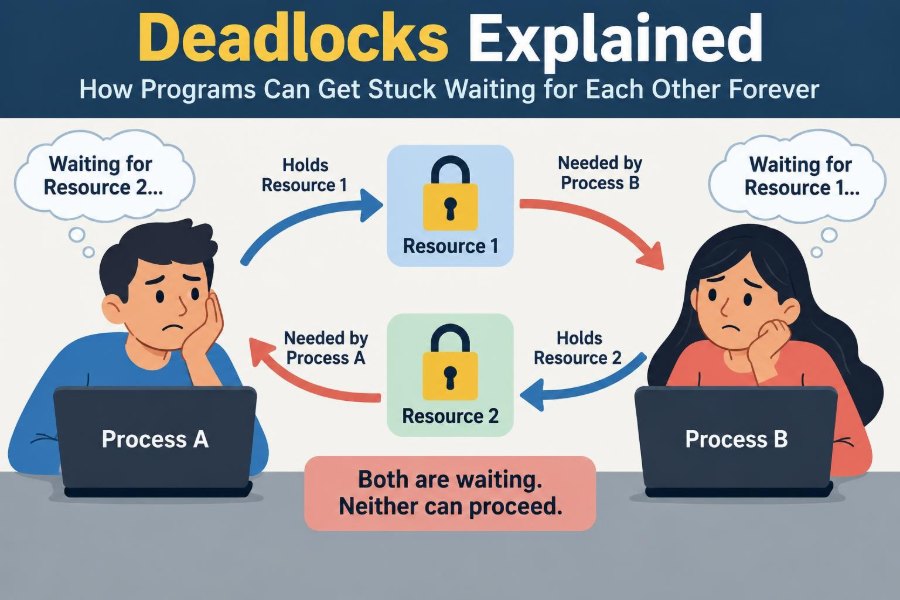

Imagine two people meeting in a narrow hallway. Each is waiting for the other to step aside, but neither will move first. Nothing is broken; both are simply stuck.
A similar situation can occur inside a computer program. One part of the program holds something another part needs, while that other part holds something needed in return. Both wait, and the work stops.
This problem is called a deadlock. It can freeze a desktop application, stall a database transaction, delay a web service request, or leave an operating system task unable to continue.
Deadlocks matter because modern software runs many activities at once. Understanding why waiting turns into permanent waiting is a practical skill for programmers, system administrators, and anyone debugging a system that appears to have “just stopped.”
🔒 What a Deadlock Is
A deadlock is a state in which two or more executing tasks are each waiting for an event that the others must cause. Because every participant is waiting, none can make progress.
A task might be a thread, process, database transaction, networked service, or even a person following a workflow. The exact technology changes, but the pattern is the same: a circular chain of unmet waiting conditions.
Deadlock differs from a slow operation. A slow operation may eventually finish. In a true deadlock, progress will not resume unless something outside the waiting cycle intervenes.
🧵 Why Concurrent Programs Face This Risk
Concurrency means multiple tasks make progress during overlapping periods. They may run on different processor cores, or they may take turns rapidly on one core.
Concurrency improves responsiveness and throughput. A web server can handle several requests, and an application can update its interface while work happens in the background. Yet shared data and shared devices create coordination problems.
When tasks need exclusive access to the same resources, they use rules such as locks. Those rules prevent data corruption, but careless combinations of locks can create deadlocks.
🧰 Understanding Resources and Locks
A resource is anything a task must obtain before it can proceed. It may be a memory structure, file, printer, database row, network connection, or a lock protecting shared data.
A lock is a synchronization mechanism that gives one task controlled access to a resource or critical code region. A task acquires the lock, performs its protected work, and releases it.
Locks are not inherently bad. Without them, two tasks could change shared information at the same time and leave it inconsistent. The danger appears when tasks acquire several resources in incompatible ways.
🚪 A Simple Two-Lock Example
Consider a hypothetical program with two locks: Lock A and Lock B. Thread 1 acquires A and then needs B. At nearly the same time, Thread 2 acquires B and then needs A.
Thread 1: acquire A → wait for B
Thread 2: acquire B → wait for A
Thread 1 cannot release A until it finishes work requiring B. Thread 2 cannot release B until it finishes work requiring A. Neither can finish, so neither releases anything.
The timing may be rare, which makes the bug especially frustrating: the same program can run correctly many times before one unlucky scheduling order exposes it.
🔄 The Circular Wait Pattern
The heart of many deadlocks is circular wait. Task A waits for a resource held by Task B, B waits for one held by C, and eventually some task waits for A.
The cycle can involve only two tasks, but real systems may create longer chains. For example, three database transactions might each hold one record lock and request the next record in a different order.
A wait cycle is not merely a queue. In an ordinary queue, the resource holder can finish and release the resource. In a cycle, every holder is blocked by another holder.
🧩 The Four Conditions Behind Deadlock
A classic way to reason about deadlock uses four conditions. All four must be present for a deadlock to be possible, so preventing even one can break the pattern.
| Condition | Meaning |
|---|---|
| Mutual exclusion | A resource can be used by only one task at a time. |
| Hold and wait | A task holds resources while requesting additional ones. |
| No preemption | A resource is not forcibly taken away; its holder releases it voluntarily. |
| Circular wait | A closed chain exists in which each task waits for another. |
These conditions describe possibility, not certainty. A program can use exclusive locks and still avoid deadlock through careful ordering and design.
🛑 Mutual Exclusion Is Often Necessary
Mutual exclusion means a resource cannot safely be shared simultaneously. A single printer, for example, should not interleave pages from unrelated jobs. A mutable data structure may also need one writer at a time.
Eliminating mutual exclusion is sometimes possible. Read-only data can often be shared freely, and immutable objects do not need protection after creation.
But many resources genuinely require exclusivity. For those cases, the goal is usually not to remove locks altogether, but to make their use predictable and brief.
🤲 Hold and Wait Creates a Dangerous Gap
With hold and wait, a task keeps the resources it already has while asking for more. This is common because releasing everything before each new request can be inefficient or difficult.
Suppose a transaction locks a customer record and then needs an order record. If another transaction takes those records in the opposite order, both may hold one lock while waiting for the other.
One prevention approach is to request all needed resources at once. It can reduce deadlock risk, but it may reserve resources earlier and longer than necessary, reducing overall concurrency.
✋ Why No Preemption Matters
No preemption means the system does not simply seize a resource from a task that holds it. With a lock, taking it away while its holder is changing shared state could leave that state inconsistent.
Some resources can be preempted safely. A scheduler can pause a running process and let another run. Locks, open transactions, and external operations are more complicated because safe interruption depends on what work has already occurred.
Systems often approximate preemption by aborting a transaction or cancelling a request. That is only safe when the system can roll back or clean up its partial work correctly.
⭕ Breaking Circular Wait with an Order
The most common practical defense is a global resource order. Every task acquires locks in the same predefined sequence.
For example, if an application assigns every account an identifier, a money-transfer operation can always lock the lower-numbered account before the higher-numbered one. Two transfers involving the same accounts then cannot take the locks in opposite orders.
This rule works because a cycle would require some task to wait “backward” in the ordering. When every task only requests resources in one direction, that circular path cannot form.
🍽️ The Dining Philosophers Analogy
The dining philosophers problem is a well-known teaching example. Several philosophers sit around a table, and each needs the utensil on both sides before eating. If everyone picks up the utensil on the left first, each waits for the one on the right.
It is a hypothetical model, not a description of everyday dining. Its value is that it makes competing resource requests visible.
Possible solutions include numbering utensils and picking them up in order, allowing only some philosophers to try at once, or using a coordinator that grants permission to eat. Each solution trades simplicity, parallelism, and implementation cost differently.
🗄️ Database Deadlocks
Databases use locks or related concurrency controls to keep transactions consistent. A transaction may need to update several rows, tables, or indexes before it can commit.
A deadlock can occur when two transactions update overlapping data in different orders. Database systems commonly detect this situation and choose one transaction as a victim, aborting it so the other can complete.
An application should expect a deadlock error in workloads with meaningful concurrency. The normal response is usually to retry the aborted transaction when doing so is safe, while also investigating whether a consistent access order can reduce repeated conflicts.
🌐 Deadlocks Across Services
Deadlocks are not limited to memory locks. Distributed systems can create waiting cycles through synchronous calls: Service A waits for Service B, B waits for C, and C waits for A or for a resource A holds.
Network failures make these situations harder to interpret. A service may be waiting because another service is overloaded, unreachable, or genuinely caught in a dependency cycle.
Timeouts, clear ownership boundaries, and avoiding long chains of blocking calls help reduce this risk. A timeout does not solve every underlying design problem, but it prevents a request from waiting forever.
⏳ Deadlock Versus Starvation
Starvation occurs when a task is repeatedly denied a resource because other tasks keep receiving it first. The starved task may wait indefinitely, but the system as a whole is still moving.
In a deadlock, the involved tasks block one another and no member of the cycle progresses. This distinction matters because the remedies differ.
Fair scheduling, such as queueing lock requests, can help starvation. Detecting cycles, changing lock order, or aborting work addresses deadlock.
🐢 Deadlock Versus Livelock
In a livelock, tasks are active but still fail to make useful progress. Imagine two people repeatedly stepping to the same side of a hallway to be polite, then switching again together.
A program may repeatedly release a resource, retry, collide, and retry again. Unlike deadlock, tasks are not blocked; they are busy responding to each other.
Randomized backoff, delays before retrying, and fair coordination can help livelock. Monitoring CPU use can offer a clue: a deadlock often leaves tasks blocked, while a livelock may consume processing time.
📉 Why Deadlocks Can Be Hard to Reproduce
Concurrent execution depends on timing. Processor scheduling, input volume, cache behavior, network delays, and other activity on the machine can change the order in which tasks reach a lock.
Adding a log statement may change timing enough to hide the bug. This is why reports such as “it only happens under load” are common with concurrency failures.
Reliable diagnosis requires collecting evidence from the stalled system rather than relying only on a later attempt to recreate the same timing.
🔍 Reading a Wait-For Graph
A wait-for graph represents tasks as nodes. Draw an arrow from Task X to Task Y when X is waiting for a resource held by Y.
If the graph contains a cycle, it indicates a deadlock among the tasks in that cycle. For example, an arrow from A to B and another from B to A forms a two-task cycle.
Operating systems, database engines, and debugging tools may expose equivalent information through lock reports, thread dumps, or transaction diagnostics. The display differs, but the question remains: who holds what, and who is waiting for whom?
🧪 Using Thread Dumps and Diagnostics
A thread dump is a snapshot of program threads and their current states. In many runtimes, it can show whether a thread owns a monitor or lock and which lock it is waiting to acquire.
Take several snapshots when possible. A thread doing slow work may appear in the same place briefly but later move on; a deadlocked thread stays blocked on the same dependency.
For databases, inspect the engine’s deadlock report or lock-wait information. For operating systems, use platform-specific process and lock inspection tools. Tool names vary, so the transferable skill is interpreting ownership and waiting relationships.
🧭 Establishing a Lock Hierarchy
A lock hierarchy is a documented rule for acquisition order. It might state that application-wide configuration locks come before account locks, which come before order locks.
The hierarchy should be simple enough that developers can follow it during maintenance. A rule that depends on too many special cases is easy to violate accidentally.
When code truly needs several locks, acquire them in hierarchy order and release them promptly. Code review should treat an exception to that order as a design decision requiring careful justification.
🧹 Keep Critical Sections Small
A critical section is the code that runs while holding a lock. Shorter critical sections reduce the period during which other tasks must wait.
Do not hold a lock while performing slow input/output, making a remote call, waiting for user input, or doing large computations unless the design genuinely requires it. These actions increase contention and make a deadlock involving other locks more likely.
Shortening a critical section is not a substitute for correct ordering. It is a complementary practice that improves responsiveness and narrows the opportunity for problematic interleavings.
📦 Avoid Calling Unknown Code While Locked
“Unknown code” includes callbacks, event handlers, plugins, and library functions whose internal locking behavior you do not control. Such code may acquire additional locks, call back into your program, or block on external work.
A safer pattern is to copy the needed state while holding the lock, release it, and then invoke the callback. This is not always possible, especially when atomic behavior is required, but it is worth considering.
The principle is straightforward: the fewer hidden dependencies created inside a locked region, the easier the system is to reason about.
⏱️ Timeouts: Useful but Not Magical
A timed lock attempt lets a task give up after waiting for a limited period. It can turn an infinite wait into a recoverable failure path.
However, a timeout does not prove a deadlock occurred. The resource holder may simply be slow. The program must decide what to do after timing out: release held resources, report an error, retry later, or use an alternate path.
Careless retries can create extra load or livelock. Use bounded retries, backoff where appropriate, and clear cleanup rules.
🔁 Retrying Work Safely
Retries are common after a database chooses a deadlock victim. They work best when an operation is idempotent, meaning repeating it has the same intended effect as performing it once.
For example, setting a record to a known value can often be retried safely. Charging a payment or sending an external message requires more care, because a failure response may occur after the external effect already happened.
Design retryable operations with identifiers, transaction boundaries, and duplicate detection where needed. A retry policy without attention to side effects can turn a recovered lock conflict into a business error.
🧱 Reduce Shared Mutable State
Deadlocks become less likely when fewer tasks need to mutate the same resources. Shared mutable state is data that multiple tasks can change, making coordination necessary.
Useful alternatives include immutable data, message passing, partitioning data by owner, and designs where one worker exclusively manages a particular resource. These approaches do not remove all coordination, but they can make ownership clearer.
There is a trade-off: copying data, coordinating messages, or maintaining partitions can add complexity. The right choice depends on performance needs, consistency requirements, and the shape of the workload.
⚙️ Use Higher-Level Concurrency Tools Carefully
Thread-safe queues, actors, transactional mechanisms, and structured concurrency tools can hide many low-level locking details. They often provide safer defaults than manually acquiring several locks.
They are not automatic immunity. A program can still deadlock by waiting synchronously on tasks that depend on each other, exhausting a worker pool, or creating circular message dependencies.
Choose abstractions that make ownership and waiting explicit. Then learn their blocking behavior rather than assuming “high-level” means “cannot get stuck.”
👀 Common Design Mistakes
Several patterns deserve extra caution because they frequently create troublesome waits:
- Acquiring the same group of locks in different orders in different code paths.
- Holding a lock during database, file, network, or user-interface operations.
- Waiting for a worker task while holding a lock that worker task needs.
- Using nested locks without a documented hierarchy.
- Adding retries without releasing resources or limiting attempts.
- Assuming a thread-safe component makes a larger multi-step workflow automatically safe.
Each mistake is understandable in isolation. Deadlocks usually emerge from interactions between code paths rather than from one obviously incorrect line.
🧑💻 A Practical Code Review Checklist
When reviewing concurrent code, ask concrete questions rather than relying on a general impression that it “looks thread-safe.”
- What resources can this operation acquire?
- In what order are they acquired across every relevant code path?
- Can a lock be held while waiting for a task, callback, remote service, or database?
- What happens if acquisition fails or times out?
- Are resources released on errors as well as on normal completion?
- Could retrying this operation duplicate an external side effect?
Writing down answers often exposes dependencies that are difficult to see in code alone.
🧯 What to Do When Production Appears Stuck
First, avoid restarting blindly if diagnostic data can be captured safely. Gather thread dumps, lock information, request traces, database deadlock reports, and timestamps relevant to the affected work.
Identify the blocked tasks and map the resources they hold and request. Look for a cycle, then locate the code paths that established each edge of that cycle.
Recovery may involve terminating or restarting a component, cancelling a request, or letting a database abort a transaction. The long-term fix should remove the circular dependency rather than merely making recovery faster.
🧠 Prevention Is Better Than Detection
Deadlock detection is valuable, especially in database systems where transactions naturally compete. But detection happens after work has already stalled and often requires aborting some work.
Prevention builds constraints into the design, such as ordered locking and avoiding nested resource acquisition. It is usually easier to reason about a system that cannot form a cycle than one that must continually discover and break cycles.
Some systems instead use avoidance strategies that grant requests only when doing so leaves a safe path for completion. These strategies need knowledge about future resource needs, which many general-purpose programs do not have.
🎯 The Core Principle: Make Waiting One-Way
Deadlocks are not mysterious freezes. They are dependency cycles created when tasks hold resources while waiting for resources held by one another.
The most durable defense is to design waiting relationships so they move in one direction: use a consistent resource order, minimize lock scope, avoid blocking calls while locked, and make failure or retry paths release what they hold.
When a system must coordinate concurrent work, ask not only “is this resource protected?” but also “could this wait lead back to itself?” That question turns deadlock prevention from a debugging afterthought into a design habit.
Programs avoid deadlock when their resource dependencies cannot form a circle. Build clear ownership, keep waits short and intentional, and collect evidence whenever a system stops making progress. 🔒🧵🧭