
You close a photo editor, switch away from a video call, or finish a level in a game. From your point of view, that task is over. Inside the program, though, thousands or millions of pieces of data may have just become irrelevant.
A program needs memory for everything it is actively working with: objects, strings, images, network responses, temporary calculations, and more. If it kept every abandoned piece forever, it would eventually consume all available memory and fail.
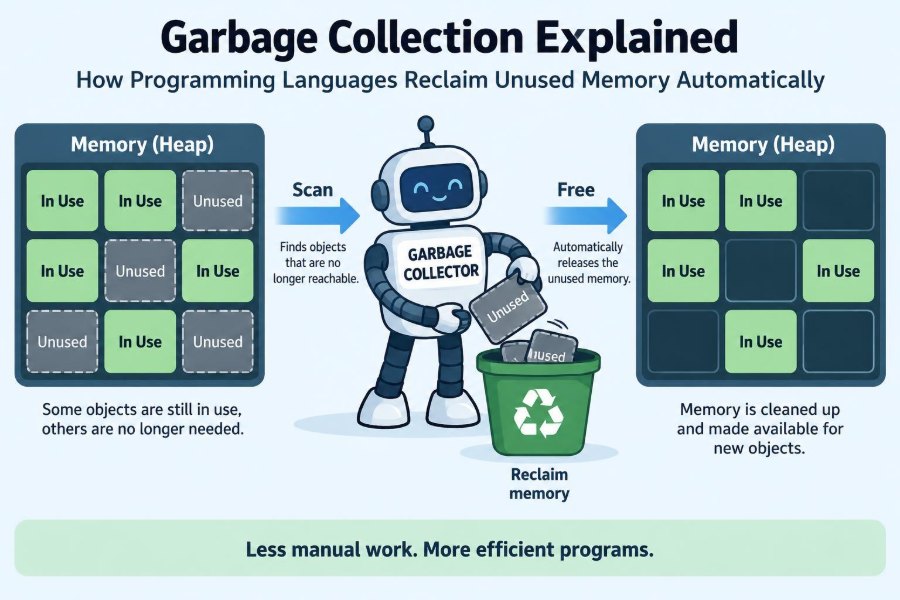
Some programming languages ask developers to release memory themselves. Others include a runtime system that finds unreachable data and reclaims its space automatically. That system is called garbage collection, often shortened to GC.
Automatic cleanup sounds simple, but it involves careful trade-offs between speed, memory use, pause times, and programming convenience. Understanding those trade-offs helps you write more reliable software and diagnose problems that GC cannot solve by itself.
🧠 What Garbage Collection Actually Does
Garbage collection is a process that recovers memory occupied by data a program can no longer use. Its central question is not “Was this object used recently?” but “Can the running program still reach this object?”
If no valid path remains from the program’s active data to an object, that object is unreachable. Its memory can be reused for future allocations. A garbage collector performs this work on behalf of the program.
📦 Memory Is a Program’s Working Space
When a program runs, it receives a region of memory called its address space. It uses that space to store instructions, active function calls, and dynamically created values.
Many values have a short, predictable lifetime. A calculation inside a function may disappear when the function returns. Other values, such as a user profile loaded into an application, may need to remain available much longer.
🏠 Stack Memory and Heap Memory
Two common areas are the stack and the heap. The stack typically holds function-call information and local variables with well-defined lifetimes. When a function returns, its stack frame is removed in an orderly way.
The heap is used for dynamically allocated data whose lifetime is less obvious. An object created in one function may be returned, stored in a collection, and used elsewhere. Garbage collection primarily manages heap memory.
🔗 References Create Reachability
A reference is a way for one part of a program to locate an object in memory. In Java, C#, JavaScript, Python, and many other environments, variables and object fields commonly hold references.
Imagine a playlist object that refers to song objects, and each song refers to album artwork. As long as the application can reach the playlist, it can also reach the songs and artwork through that chain.
🌳 The Root Set: Where Collection Begins
Collectors start from a set of locations called roots or the root set. Roots generally include live local variables on active stacks, static fields, CPU registers, and runtime-managed references.
From those roots, the collector follows every reference it can find. Anything discovered along the way is considered live. Anything not discovered is a candidate for reclamation.
🗺️ A Simple Reachability Example
Suppose a web service creates an Order object, places it in a processing queue, and then completes the request. While the queue refers to the order, the order remains reachable.
After processing, if the queue removes the order and no other live object refers to it, the next collection can reclaim it. The collector does not need a special “delete this order” instruction; it relies on reachability.
🏷️ Why “Garbage” Is Not the Same as Bad Data
The word garbage can be misleading. An object may contain perfectly valid information and still be garbage because the program has no remaining route to access it.
Conversely, an object can be logically useless to the user but remain live if a reference still exists. A forgotten entry in a cache is not garbage to the collector; it is still reachable data.
🔍 Mark-and-Sweep Collection
One foundational approach is mark-and-sweep. During the marking phase, the collector begins at the roots and marks every reachable object.
During the sweep phase, it examines heap regions and makes unmarked objects available again. This approach is conceptually clear, but freed spaces may be scattered throughout memory.
🧩 Fragmentation and Why It Matters
When free memory is split into many small gaps between live objects, the heap is fragmented. The total free memory may be large, yet allocating one large contiguous block can become difficult or expensive.
Fragmentation can also make allocation bookkeeping more complex. Collectors often use additional strategies to reduce it rather than relying on sweeping alone.
📦 Copying Collectors Move Live Objects
A copying collector divides a memory region into areas. It copies reachable objects from the active area into a new area, then treats the old area as entirely free.
This naturally compacts live objects together and leaves one continuous free region. The cost is that objects move, so the runtime must update references or use techniques that preserve valid access while movement occurs.
🧹 Compacting Collectors Reduce Gaps
A compacting collector also relocates live objects so they sit together. Unlike a simple copying design, it may compact within the same general heap region.
Compaction improves locality: related live data may be stored closer together, which can help the processor’s cache. But moving objects requires bookkeeping and may add collection work.
👶 Why Generational Collection Is Common
Many managed runtimes use a generational hypothesis: most objects become unreachable soon after they are created. Temporary strings, intermediate collections, and request-local objects often fit this pattern.
A generational collector places newer objects in a young area and collects that area frequently. Objects that survive several collections may be promoted to an older area, which is collected less often.
⏱️ Minor and Major Collections
A minor collection usually focuses on young-generation memory. Since many new objects are already dead, it can often reclaim substantial space without examining the entire heap.
A major, old-generation, or full collection generally involves more memory and can cost more work. Exact terminology differs by runtime, so performance tools should be interpreted using the documentation for the specific language and collector.
🧷 Remembered Sets Track Cross-Generation References
Generations introduce a complication. An old object may refer to a young object, such as a long-lived session object holding a newly created request result.
The collector cannot ignore those references during a young collection. Runtimes track relevant writes using mechanisms often called write barriers and remembered sets, allowing the collector to find young objects referenced from older memory efficiently.
⏸️ Stop-the-World Pauses
Some collection phases require application threads to pause. These are commonly called stop-the-world pauses because normal program execution briefly stops while the runtime performs a coordinated task.
A short pause may be unnoticeable in a command-line utility. In an interactive game, payment service, or user interface, unpredictable pauses can affect responsiveness. Low pause time is therefore a design goal, not a universal guarantee.
🚦 Concurrent and Parallel Collection
Parallel collection uses multiple processor cores to do collection work faster. It may still pause the application while that work happens.
Concurrent collection performs some work while application threads continue running. This can reduce long pauses, but coordination is harder because the program may change references while the collector is tracing them.
🔄 Safe Points and Consistent Views
To inspect memory safely, a runtime needs to know where references are located and what each thread is doing. Many runtimes coordinate this at safe points: controlled locations where threads can be paused or examined reliably.
Concurrent algorithms use barriers and carefully designed phases to maintain a consistent enough view of object reachability. The implementation details vary greatly, but the underlying challenge is shared: the application and collector are active at nearly the same time.
⚖️ Reference Counting Is a Different Strategy
Reference counting stores a count of how many references point to an object. When the count reaches zero, the object can often be released immediately.
This can make reclamation prompt and predictable in some cases. However, it struggles with cycles: if object A refers to B and B refers to A, both counts can remain nonzero even after the rest of the program has abandoned them.
🔁 Cycles and Tracing Collectors
Tracing collectors, such as mark-and-sweep collectors, do not care whether objects refer to one another in a cycle. They start from roots; if no root reaches the cycle, the entire cycle is unreachable.
This is a major practical advantage for object graphs. Some reference-counted systems add a separate cycle detector, while others rely on programming patterns that avoid or explicitly break cycles.
🧰 Languages and Runtimes Use Different Designs
Java and .NET provide managed runtimes with sophisticated garbage collectors. JavaScript engines also collect objects automatically, though their implementations are tuned for browser and server workloads.
Python commonly uses reference counting along with cyclic garbage collection in its standard implementation. Languages such as C and traditional C++ often expose manual memory management, while Rust emphasizes ownership rules that free memory deterministically without a tracing GC.
| Approach | Typical strength | Typical challenge |
|---|---|---|
| Tracing garbage collection | Handles unreachable cycles naturally | Can introduce runtime overhead or pauses |
| Reference counting | Often reclaims objects promptly | Needs help with cycles; updates counts frequently |
| Manual management | Precise control over lifetime | Leaks and invalid memory access are easier to create |
| Ownership-based management | Deterministic cleanup with compile-time checks | Lifetime and borrowing rules require design discipline |
🧪 Allocation Is Usually Cheap—Until It Isn’t
Managed runtimes are often optimized for rapid allocation. Creating a small object may simply advance a pointer into an available memory region.
But allocation eventually triggers collection when space runs low. Code that creates huge volumes of short-lived objects may still be acceptable, or it may increase collector activity enough to become a performance concern. Measurement is more useful than guesswork.
📈 Memory Use Is Not Automatically a Leak
Programs often reserve heap space from the operating system and keep it for future allocations. Therefore, a process’s reported memory usage may stay high even after a collection has freed many internal objects.
A memory leak is better described as memory that should no longer be needed but remains reachable or is otherwise never released. A stable, intentionally sized heap is not by itself evidence of a leak.
🕳️ How Memory Leaks Happen in Garbage-Collected Code
Garbage collection prevents one class of leak: unreachable heap objects left behind by forgotten cleanup. It cannot reclaim reachable objects, even if retaining them is a design mistake.
Common examples include:
- an unbounded cache that never evicts old entries;
- a global collection that accumulates completed tasks;
- event listeners that are registered but never removed;
- background timers or callbacks that keep objects alive;
- thread-local values that outlive the request that created them.
In each case, an unexpected reference chain tells the collector that the object is still live.
📚 Caches Need Explicit Limits
Caching is useful because it avoids repeated computation or retrieval. Yet every cache is also a deliberate decision to retain memory.
A production cache should usually have a policy: a maximum size, expiration rule, memory budget, or eviction strategy. “Keep it in case it is useful later” is not a lifecycle policy.
🔌 Garbage Collection Does Not Close External Resources
Memory is not the only resource a program uses. Files, database connections, sockets, locks, and operating-system handles may need prompt release even when the object representing them is still reachable.
Do not depend on garbage collection to close such resources. Use language-appropriate deterministic cleanup, such as scoped resource handling, try/finally, using, or structured concurrency patterns.
🧯 Finalizers Are Not Reliable Cleanup Plans
Some environments have offered finalizers or similar hooks that might run before an object’s memory is reclaimed. Their timing is generally unpredictable, and they may run late or not at all before process termination.
They can also complicate collection and delay reclamation. They are unsuitable for essential work such as committing data, releasing scarce connections, or maintaining application correctness.
🔧 Profiling Reveals Retention Paths
When memory growth looks suspicious, a heap profiler can show which object types occupy memory and which references keep them alive. The most useful question is often: “Why is this object still reachable?”
Compare snapshots taken at meaningful points, such as after repeated requests or after closing a workflow. Look for collections that grow without a corresponding business reason, then inspect their retaining paths rather than blaming the collector first.
🧭 Practical Habits for GC-Friendly Programs
Most application code does not need to micromanage every allocation. Clear ownership and bounded lifetimes do more good than premature attempts to outsmart the runtime.
- Let temporary local data fall out of scope naturally.
- Remove listeners, callbacks, and subscriptions when their owner is finished.
- Bound caches and queues.
- Release external resources deterministically.
- Reuse large buffers only when profiling shows allocation pressure and the reuse design is safe.
- Test long-running workflows, not only short successful runs.
🚫 Common Misunderstandings About GC
Calling a method that requests collection does not guarantee immediate cleanup. Runtimes may treat it as a hint, postpone the work, or choose a different collection strategy.
Similarly, setting a variable to null is not a universal performance technique. It is useful when it removes the final unwanted reference before a long period of continued work, but ordinary local variables generally become unreachable naturally when their scope ends.
🎯 Choosing the Right Performance Goal
There is no single best collector configuration. A batch data job may prioritize total throughput and tolerate occasional longer pauses. A live dashboard or real-time-adjacent service may prioritize predictable latency.
Heap size, allocation rate, object lifetime distribution, processor availability, and workload shape all influence the result. Tune only after collecting representative measurements, and validate changes under realistic load.
🧩 The Core Principle to Remember
Garbage collection is best understood as automatic reachability-based memory management. The runtime preserves objects that can still be reached from active program roots and reclaims those that cannot.
That automation removes much manual bookkeeping, but it does not replace sound design. References express ownership and lifetime, whether developers intend them to or not. Keeping unnecessary references means keeping unnecessary memory.
Write programs so that data becomes unreachable when its job is done, and use explicit cleanup for resources that memory collection cannot manage. That simple distinction explains both the power and the limits of garbage collection. 💻🧹🧠