
A delivery company wants to plan efficient routes for thousands of vehicles. A chemist wants to predict whether a candidate molecule could become a useful medicine. A security team needs to understand which encrypted information may remain protected as computers improve.
Each problem involves far more than fast arithmetic. It involves searching through an enormous number of possible arrangements, states, or answers. For many such tasks, a conventional computer is still the right tool—but its workload can grow so quickly that even powerful machines face difficult limits.
Quantum computing is being developed for a narrow but potentially significant set of these challenges. It does not promise a faster laptop for every task. Instead, it uses physical effects at the atomic scale to process certain mathematical structures in unusual ways.
The breakthrough is not simply the quantum machine. It is the design of quantum algorithms: procedures that turn quantum behavior into a useful computational advantage. Understanding where that advantage may appear, and where it will not, is essential for students, developers, and decision-makers.
🧩 The classical computing challenge
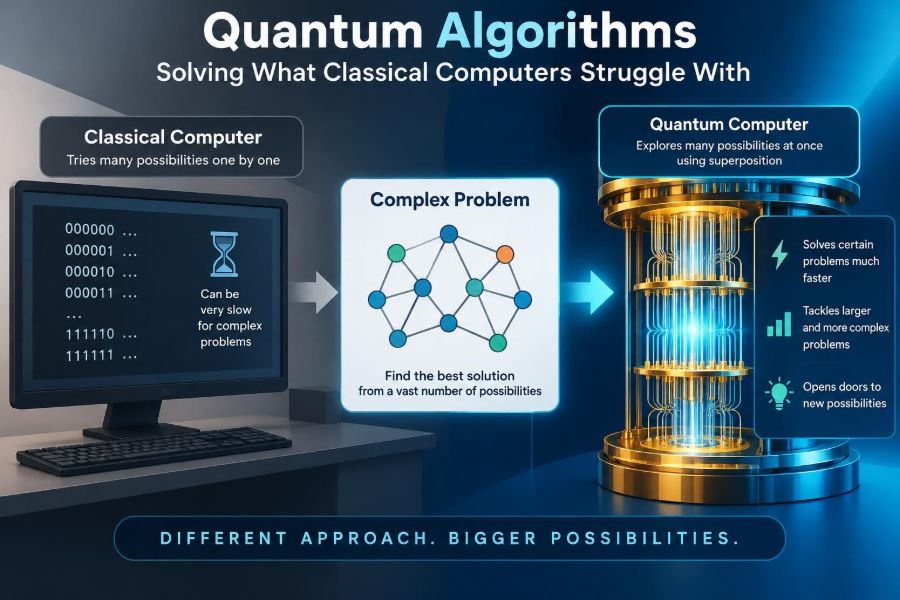
Classical computers represent information with bits, each of which is either 0 or 1. They solve problems by executing instructions, storing intermediate results, and checking possibilities according to carefully designed algorithms.
This model is extraordinarily capable. It powers databases, web applications, spreadsheets, simulations, graphics, and modern artificial intelligence. Yet some problems grow explosively as their input grows.
For example, arranging many items in an optimal order can require considering a huge number of permutations. Better classical algorithms, smart heuristics, and parallel hardware often help, but they do not always remove the underlying growth in complexity.
📈 Why “more powerful hardware” is not always enough
Adding processors can shorten many jobs, but it does not magically transform a hard problem into an easy one. If a calculation requires examining possibilities that multiply extremely rapidly, a modest increase in hardware may make little difference at larger scales.
Computer scientists describe this using computational complexity, which studies how resource requirements grow with problem size. Time, memory, communication between processors, and energy can all become bottlenecks.
Quantum algorithms matter because some aim to change the growth pattern of a computation, rather than merely making the same steps run faster.
⚛️ What makes a computer quantum
A quantum computer uses quantum systems—such as trapped ions, superconducting circuits, neutral atoms, or other carefully controlled physical devices—to store and manipulate information. Its basic unit is the quantum bit, or qubit.
A qubit can be prepared in a state that has components associated with both 0 and 1. This is not the same as a classical bit rapidly switching between values, nor does it mean a user can read both answers from one qubit.
When measured, a qubit produces an ordinary classical outcome. The power comes from arranging operations before measurement so that desired outcomes become more likely.
🌊 Superposition without the common myth
Superposition means a quantum state can be described as a combination of basis states. With multiple qubits, a system can be represented using amplitudes associated with many possible bit strings.
A tempting but inaccurate shortcut is: “a quantum computer tries every answer at once.” Measurement does not reveal every answer. If a poorly designed quantum program creates many possibilities and then measures them, it may return only a random-looking result.
The algorithm must use interference to amplify information about useful answers and suppress information about unhelpful ones. Superposition supplies a mathematical workspace; it is not a free answer generator.
🔗 Entanglement creates nonclassical correlations
Entanglement is a correlation between quantum systems that cannot be fully explained by assigning each qubit an independent local state. Operations on entangled qubits can create relationships that are difficult to represent directly with simple classical descriptions.
Entanglement is one ingredient that can make quantum computation distinctive. It lets an algorithm coordinate amplitudes across several qubits, which is useful in tasks such as simulation and certain structured mathematical calculations.
It is also fragile. Unwanted interaction with the environment can damage entanglement and reduce a computation to unreliable noise.
🎵 Interference is the algorithmic lever
Quantum amplitudes behave somewhat like waves. Waves can reinforce one another or cancel one another. Quantum algorithms are designed to exploit this interference.
Imagine several routes leading toward the same final answer. If an algorithm makes the amplitudes for a correct structure reinforce while incorrect structures cancel, measuring the system can reveal a useful result with higher probability.
This is why quantum programming is less like writing many simultaneous checks and more like carefully choreographing a wave pattern. The hard work lies in finding the choreography.
🧱 Qubits are not just “quantum bits”
Qubits can differ sharply in quality. Relevant properties include how long they preserve quantum information, how accurately operations can be performed, how easily qubits connect to one another, and how reliably they can be measured.
A device with more qubits is not automatically more useful. If errors accumulate faster than the machine can control them, a larger system may produce less trustworthy results than a smaller, better-calibrated one.
This is why hardware announcements should be read alongside information about error rates, connectivity, operational stability, and the task being attempted.
🧮 Quantum gates and circuits
Quantum software is often described as a circuit. A circuit applies a sequence of quantum gates—controlled physical operations—to qubits, then measures selected qubits to produce conventional bits.
Some gates alter the probability pattern of one qubit. Others create conditional relationships between qubits and can generate entanglement. A classical program typically controls when these operations occur, collects measurements, and may repeat the circuit many times.
Because individual measurements are probabilistic, useful quantum programs commonly run repeatedly. The final answer may be estimated from a distribution of observed outcomes rather than obtained in one perfect run.
🧭 What an algorithm actually improves
An algorithm is a repeatable method for solving a class of problems. A quantum algorithm is valuable only when it reduces a meaningful resource: perhaps the number of function evaluations, the memory required, or the runtime for sufficiently large inputs.
There are several kinds of potential improvement:
- Polynomial speedup: a large-input problem needs dramatically fewer steps as it grows.
- Quadratic speedup: a search requiring roughly N checks may need roughly the square root of N quantum queries under specific assumptions.
- Constant-factor improvement: potentially helpful, but often less transformative and harder to separate from ordinary engineering advances.
Whether a theoretical speedup becomes practical depends on data preparation, error correction, output requirements, and the best competing classical method.
🔐 Shor’s algorithm and public-key cryptography
One of the best-known quantum algorithms, Shor’s algorithm, can factor large integers and solve a related mathematical problem called the discrete logarithm efficiently on a sufficiently capable fault-tolerant quantum computer.
These problems underpin widely used forms of public-key cryptography. A cryptographically relevant quantum machine could therefore threaten systems based on vulnerable mathematical assumptions, including some approaches used for encrypted connections and digital signatures.
This does not mean present-day quantum devices can break commonly deployed large cryptographic keys. The required reliable, error-corrected scale is far beyond today’s noisy hardware. However, long-lived confidential data creates a planning concern: information captured now might be decrypted later if protection is not upgraded.
🛡️ Post-quantum cryptography is a practical response
Post-quantum cryptography refers to classical cryptographic algorithms designed to resist known attacks from both classical and quantum computers. They run on ordinary systems; they are not encryption performed by quantum hardware.
Organizations handling long-retention secrets should inventory where cryptography is used, identify systems that cannot be easily updated, and plan for cryptographic agility—the ability to replace algorithms without rebuilding everything.
Migration requires care. Security depends on correct protocols, sound implementations, key management, and interoperability, not merely selecting a new mathematical primitive.
🔎 Grover’s algorithm and unstructured search
Grover’s algorithm provides a quadratic query advantage for searching an unstructured collection when an operation can recognize a valid answer. In a simplified example, finding one marked record among N possibilities can require on the order of square root of N checks rather than on the order of N checks.
Quadratic is meaningful, but it is not magic. Searching a billion completely unstructured possibilities still involves substantial work, and building the required quantum “oracle” that recognizes a solution can itself be difficult.
Grover’s result also informs security planning: symmetric cryptographic keys can often retain strong protection against generic quantum search by using appropriately larger key sizes.
🧪 Simulating molecules and materials
Quantum systems are notoriously difficult to simulate exactly on a classical computer because the information needed to describe their states can grow rapidly. Since molecules are quantum systems, a controllable quantum processor may eventually model certain molecular behaviors more naturally.
Possible applications include studying catalysts, battery materials, industrial chemicals, and molecular interactions relevant to drug discovery. The realistic goal is not automatically to discover a finished product, but to improve predictions that guide laboratory experiments.
Chemistry remains a demanding target. Useful models must represent relevant interactions accurately, and results must be validated against physical experiments. A quantum calculation can support scientific work; it cannot replace experimental judgment.
🧬 Drug discovery needs more than a quantum simulation
A medicine must satisfy many constraints: it must interact with a biological target in a helpful way, reach the right tissue, remain safe at suitable doses, and be manufacturable. Molecular simulation addresses only parts of this larger process.
Quantum methods could potentially help evaluate particular chemical properties, but biological systems are complex and noisy. Data quality, classical modeling, laboratory testing, and clinical evaluation remain indispensable.
A responsible claim is that quantum computing may improve selected stages of molecular research—not that it will make drug development simple or guaranteed.
🚚 Optimization is promising but complicated
Scheduling workers, assigning aircraft gates, routing trucks, placing assets in a portfolio, and balancing energy resources all resemble optimization problems. They ask for the best solution under constraints.
Quantum approaches for optimization include specialized methods and hybrid algorithms. They are appealing because practical businesses often face huge option spaces, but proving that a quantum method consistently beats excellent classical optimization software is difficult.
Many real operations problems contain changing data, soft preferences, legal rules, and incomplete information. A solution that is mathematically optimal but arrives too late or uses incorrect input is not operationally useful.
📊 Machine learning is not automatically faster
Quantum machine learning explores whether quantum circuits can help with specific learning, sampling, feature mapping, or linear-algebra tasks. It is an active research area, not a settled replacement for conventional machine learning.
One major obstacle is data loading. If a large classical dataset must be encoded into qubits at great cost, a theoretical speedup later in the computation may disappear.
Classical machine learning hardware and methods are advancing rapidly too. Any quantum learning claim should be compared against strong, task-specific classical baselines rather than against an outdated or simplistic implementation.
🧠 Hybrid computing is the likely working pattern
Near-term quantum systems are expected to operate alongside classical computers. Classical software prepares inputs, chooses circuit parameters, processes measurements, handles error mitigation, and decides what to do next.
In a hybrid workflow, a quantum processor might evaluate a specialized subproblem while a conventional system manages the broader application. This resembles how GPUs accelerate certain graphics and numerical workloads without replacing the CPU.
The division of labor matters. Moving too much data back and forth, or calling a quantum device for a poorly matched task, can erase any possible benefit.
🌩️ Noise is the central engineering obstacle
Qubits are sensitive to heat, electromagnetic disturbance, imperfect controls, material defects, and unwanted interactions with their surroundings. These effects cause noise: deviations from the intended computation.
Every gate and measurement introduces some chance of error. A deep circuit with many operations can accumulate enough error that its output no longer reflects the ideal algorithm.
This is why present machines are often called noisy intermediate-scale quantum devices. They are valuable experimental platforms, but their limited reliability constrains the depth and complexity of calculations they can perform.
🧰 Error mitigation versus error correction
Error mitigation uses statistical and calibration techniques to reduce the visible impact of errors in a particular experiment. It can be useful, but it does not fully prevent errors from building up.
Quantum error correction is more ambitious. It encodes one reliable logical qubit across many physical qubits, repeatedly detects certain errors without directly reading the protected quantum information, and applies corrective action.
Fault-tolerant computing requires error rates and architectures that support this process at scale. The number of physical qubits needed for a useful logical computation depends heavily on hardware quality, the algorithm, and the desired reliability.
📏 Logical qubits are the metric that matters
A physical qubit is an actual device component. A logical qubit is a protected unit of quantum information created from many physical qubits through error correction.
Comparing systems solely by physical-qubit counts can mislead readers. A smaller platform with improving gate fidelity and credible error-correction performance may be more relevant to long-term applications than a larger but unstable one.
For practical assessment, ask what circuit can run reliably, how errors are characterized, and whether the system can preserve and manipulate logical information.
🧾 Input and output can erase an advantage
A quantum computer ultimately receives instructions and returns classical measurement results. If an application requires loading a massive classical database into quantum states or reading an enormous output back, those steps can dominate the total cost.
This is sometimes called the input-output problem. A speedup inside a quantum circuit is only part of the end-to-end workflow.
The strongest candidates are often problems where data is naturally generated by a quantum process, where inputs have compact mathematical descriptions, or where a small but valuable property can be estimated from measurements.
🧪 How to judge a quantum advantage claim
A useful demonstration should specify the task, the comparison method, and the resource being measured. “Faster” is incomplete without saying faster than what, on which input, and with what accuracy.
- Was the classical baseline well optimized?
- Does the quantum task solve a problem anyone needs to solve?
- Are data preparation, repetitions, and post-processing included?
- Is the result exact, approximate, or a sample from a distribution?
- Will the advantage plausibly survive error correction?
A narrow experimental result can still be scientifically meaningful. It simply should not be confused with a broadly useful commercial capability.
🧑💻 Quantum programming requires a different mindset
Developers cannot inspect every intermediate quantum state as they might print variables in a conventional program. Measurement changes the state, and results are statistical.
Quantum programs are usually designed with linear algebra, probability, and reversible operations in mind. Debugging often involves simulators for small circuits, repeated runs, careful tests, and comparisons to known classical results.
Useful foundational skills include matrices and vectors, complex numbers, probability, algorithm analysis, and conventional software engineering. A strong classical background remains the best starting point.
📚 A sensible learning path for students
Start by understanding the problems quantum algorithms address, not by memorizing dramatic claims. Learn binary representation, complexity basics, and why some searches or simulations scale poorly.
- Build comfort with linear algebra and probability.
- Learn qubits, gates, measurement, and simple circuits.
- Study a few landmark algorithms conceptually, including Shor’s and Grover’s.
- Use a simulator to observe probabilities and interference in small examples.
- Read about noise, error correction, and classical alternatives.
This sequence helps prevent a common mistake: treating quantum computing as mysterious physics rather than a field that combines mathematics, algorithms, hardware, and systems engineering.
🏢 Practical guidance for working professionals
Most organizations do not need a quantum project simply because the technology is receiving attention. Begin with a business or scientific problem whose structure is genuinely difficult for existing methods.
Map the full workflow: data sources, constraints, acceptable approximation, decision deadlines, verification requirements, and the current classical baseline. Then ask whether a quantum subroutine has a credible theoretical reason to help.
For many teams, the immediate priority is cryptographic transition planning and quantum literacy. Small experiments can be valuable when they develop expertise without promising an unrealistic near-term payoff.
🚫 Common misconceptions to avoid
Several claims create unnecessary confusion:
- “Quantum computers replace classical computers.” They are specialized systems likely to complement conventional computing.
- “They solve every hard problem instantly.” Known speedups apply to particular problem structures and come with resource costs.
- “More qubits always means more capability.” Quality, connectivity, and error correction are crucial.
- “Quantum randomness is an answer.” Useful algorithms shape probability distributions through interference.
- “Current devices can broadly break encryption.” That is not an accurate description of present hardware capabilities.
⚖️ Energy, access, and responsible use
Quantum hardware can require complex supporting infrastructure, including precise control electronics and, for some platforms, extremely low temperatures. Its overall environmental impact depends on the technology, facility design, workload, and what conventional resources it might replace.
Access may also be concentrated among well-funded institutions and cloud providers. Education, open research, standards work, and careful security migration can help distribute benefits more broadly.
As with other powerful computational tools, applications should be evaluated for security, privacy, economic effects, and scientific integrity—not only for speed.
🗺️ What progress will probably look like
Progress is unlikely to arrive as one universal “quantum moment.” Different hardware approaches may become useful for different tasks, while advances in control, fabrication, compilers, networking, and error correction accumulate.
Some early value may come from research experiments, specialized simulations, and improved security preparation. Large fault-tolerant applications, if achieved, will require sustained engineering as well as new algorithmic ideas.
Timelines are uncertain because the remaining challenges are real scientific and systems problems. A balanced view is more useful than either dismissing the field or treating every prototype as a revolution.
🎯 The core takeaway: match the problem to the machine
Quantum algorithms could change computing because they use superposition, entanglement, and interference to process certain mathematical structures in ways classical algorithms cannot directly imitate efficiently. Their most compelling potential lies in carefully defined tasks such as cryptanalysis, quantum simulation, and some specialized search or optimization settings.
But quantum speedup is conditional. It must survive hardware noise, error-correction overhead, input-output costs, and comparison with continually improving classical methods. The question is never simply, “Is quantum faster?” It is, “For this task, at this scale, with these constraints, does quantum produce a verified advantage?”
Quantum computing’s real promise is not a universal shortcut; it is the possibility of solving a select group of important problems with a fundamentally different computational toolkit. Learning to recognize those problems is the most practical breakthrough of all. ⚛️💻🔍