
You sign up for a service, choose a password, and expect the service to keep it safe. You also upload a document, send a private message, or store a credit-card token. All of that data may be protected with cryptography, but not necessarily with the same cryptographic tool.
Two words appear constantly in security discussions: encryption and hashing. They can both turn readable input into something that looks scrambled, so they are often treated as interchangeable. That confusion leads to systems that cannot retrieve data they need—or, worse, systems that can retrieve secrets that should never have been recoverable.
The question is not which technique is “stronger.” The useful question is: will anyone need the original value again? The answer usually points directly to the right design.
Encryption protects information that must later be read by an authorized party. Hashing creates a fixed-size fingerprint that helps verify information without keeping the original value in usable form. Understanding that distinction makes everyday security decisions much clearer.
🧭 Start With the Retrieval Question
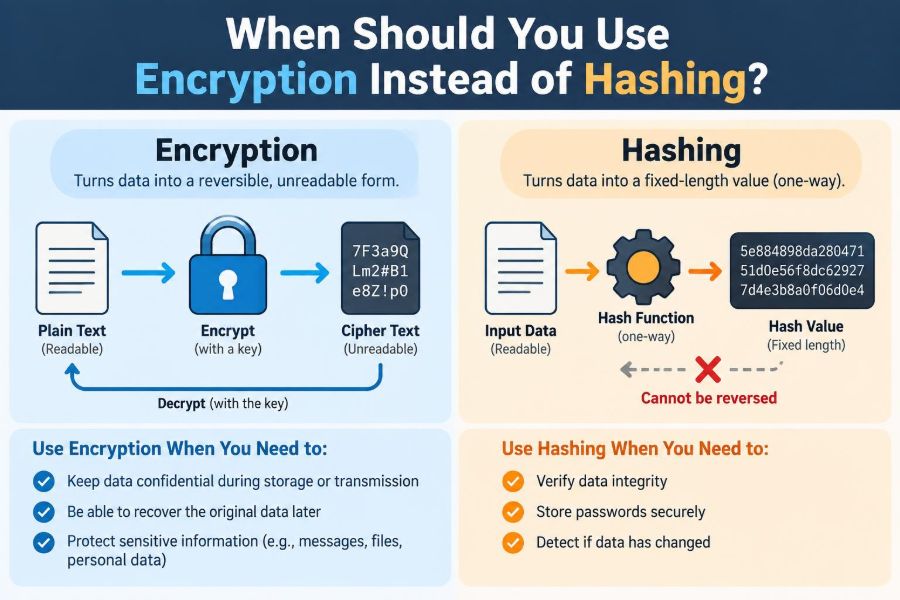
Use encryption when a trusted system or person must recover the original data later. A payroll application needs to display bank-account details to authorized staff; an encrypted database field can support that requirement.
Use hashing when you only need to check whether a supplied value matches an earlier value. A login system does not need to know a user’s password. It only needs to decide whether the password entered now is the same password chosen earlier.
This “retrieve versus verify” test is more reliable than judging by how sensitive the data seems. A password is highly sensitive, but it should normally be hashed, not encrypted, because the application should not need to read it back.
🔤 What Encryption Actually Does
Encryption transforms readable plaintext into unreadable-looking ciphertext using an algorithm and a key. With the appropriate key, authorized software can decrypt the ciphertext and recover the original plaintext.
Modern encryption is designed so that observing ciphertext alone should not reveal the protected content. Its security still depends on many operational details: sound algorithms, correct implementation, protected keys, and careful handling of access permissions.
Think of encryption as a locked container. The contents remain available, but only to someone who has a valid way to open it.
🧮 What Hashing Actually Does
A hash function takes input of almost any length and produces a value of a fixed length called a hash or digest. The same input supplied to the same hash function produces the same result.
Unlike normal encryption, a cryptographic hash is intended to be one-way. There is no decryption key and no supported process for reconstructing the original input from its digest.
Hashing is closer to producing a distinctive fingerprint than placing a document in a lockbox. A fingerprint can help compare items, but it is not a stored copy of the item.
↔️ The Core Difference: Reversible or One-Way
Encryption is deliberately reversible for authorized users. Hashing is deliberately non-reversible. This is the distinction behind almost every correct choice between them.
| Question | Encryption | Hashing |
|---|---|---|
| Can the original data be recovered? | Yes, with the required key | No, not through a reverse operation |
| What is the usual purpose? | Confidential storage or transfer | Verification and integrity checking |
| Does it use a secret key? | Yes, directly or through a key pair | Ordinary hashing does not |
| Will identical inputs match? | Not necessarily; secure encryption commonly adds randomness | Yes, unless a password salt changes the input |
A hash can be useful evidence that data has not changed. Encryption can keep the data itself confidential. A system often needs both properties, but they solve different problems.
🔑 Keys Are the Center of Encryption
An encryption algorithm is not meant to be secret. Its key is the secret material that controls decryption. Anyone with the relevant decryption key may be able to read the protected data.
That makes key management part of the security design, not an administrative afterthought. Keys must be generated properly, stored separately from protected data where possible, restricted to the right services, rotated when needed, and removed when access should end.
Encrypting a database while leaving its key in an openly readable configuration file provides much less protection than the word “encrypted” suggests.
🧂 Password Hashing Needs a Salt
Passwords deserve a specialized approach. A system should generally store a password hash made with a unique, random salt for each password. The salt is extra data combined with the password before hashing.
Salts mean two users with the same password will normally have different stored hashes. They also make large precomputed lookup tables far less useful to an attacker who obtains a password database.
The salt does not need to be secret. It must be stored with enough information for the application to repeat the same password-verification process later.
🐢 Why Fast Hashes Are Poor Password Storage
General-purpose hash functions are designed to be fast. That is useful for integrity checks, but speed helps an attacker try large numbers of guessed passwords after a database breach.
Password storage should use a dedicated password-hashing function that is intentionally expensive to compute, such as Argon2, bcrypt, scrypt, or PBKDF2. The appropriate configuration depends on the environment, available resources, and current security guidance.
A slow password check may seem inconvenient, but a small, acceptable delay for each login makes repeated password guessing more costly. Password hashing is therefore not merely “hash the password with a popular hash function.”
🔐 When Password Encryption Is the Wrong Design
Encrypting passwords means the application possesses a way to recover them. If an attacker gains both the encrypted password records and the decryption capability, every affected password may become readable.
That is unnecessary for ordinary authentication. At login, the system can hash the entered candidate password using the stored salt and compare the result with the stored password hash.
There are rare legacy or integration scenarios where a system handles credentials for another service, but that is a sensitive exception, not a reason to store ordinary user passwords reversibly.
📨 Encrypt Data That Must Be Read Later
Encryption is appropriate for customer records, private files, medical information, legal documents, messages, backups, and application secrets when the business process truly requires later access to their contents.
For example, a document-management service must retrieve an uploaded contract when its owner views it. Hashing the contract would allow a later comparison, but it would not allow the service to show the contract. Encryption fits the actual task.
Before encrypting, define who needs decryption access, from which systems, and under what conditions. Those answers shape the key-management design.
📦 Encrypt Data in Transit and at Rest
Data in transit is moving across a network. Encryption such as TLS helps protect a browser session or service-to-service request from unauthorized observers on the route.
Data at rest is stored on a device, disk, database, backup medium, or cloud service. Disk, database, file, or field-level encryption can reduce exposure if that stored medium is accessed without authorization.
These protections are complementary. A secure network connection does not automatically protect a database backup, and encrypted storage does not automatically protect data while it travels between systems.
🗃️ Choose the Right Encryption Scope
Full-disk encryption protects a lost or powered-off device, but an authenticated user or running application may still access the data normally. It is useful, but it does not replace application-level access controls.
Database or file encryption can protect stored collections. Field-level encryption protects particularly sensitive values inside a larger record, such as an identification number or account detail.
Smaller encryption scopes can limit exposure, but they often complicate querying, indexing, backups, and key management. Select the narrowest practical protection level that still supports the application’s real requirements.
🧾 Hash Files to Verify Integrity
Hashing is well suited to integrity checks. If you hash a downloaded software package and compare the result with a trusted published hash, a match provides evidence that the downloaded bytes match the expected bytes.
Similarly, a backup system can record hashes for files and later detect whether files have changed or become corrupted. The hash identifies a difference; it does not explain why the difference occurred.
A plain hash alone does not prove who created a file. If an attacker can replace both the file and the displayed hash, they can make them match. Trust in the source of the expected value still matters.
✍️ Use Digital Signatures for Authenticity
When you need to know both that content has not changed and that it came from a particular key holder, digital signatures are often the better tool. A signer uses a private key; others verify using the related public key.
Hashing is commonly part of the signing process because signing a compact digest is more practical than directly processing a large file. But a hash by itself is not a signature.
This distinction matters for software updates and official documents. Integrity answers “are these bytes unchanged?” Authenticity adds “was this approved by the expected signer?”
🤝 Use a MAC for Shared-Secret Integrity
A message authentication code, or MAC, lets parties sharing a secret verify that a message was not altered by someone without that secret. HMAC is a common construction built using a hash function and a secret key.
A MAC is not encryption: it does not hide the message. It is also not an ordinary unkeyed hash, because the secret key prevents an outsider from simply calculating a valid replacement value.
APIs often use MACs or other authenticated mechanisms to protect requests. The right mechanism depends on the protocol and threat model, so developers should use established libraries and protocol designs rather than inventing a format.
🛡️ Confidentiality Is Not Integrity
Encryption primarily provides confidentiality: it helps keep content secret. Hashing primarily supports integrity comparison: it helps identify whether inputs differ. Neither property automatically provides the other.
Some encryption modes can be vulnerable to manipulation if used without integrity protection. An attacker may be unable to read ciphertext yet still alter it in a way that causes harmful or confusing changes after decryption.
For most new designs, use authenticated encryption, commonly called AEAD, through a well-reviewed library. It combines confidentiality with a check that detects unauthorized modification.
🎲 Randomness Changes Encryption Output
Secure encryption commonly uses a random or unique value called a nonce or initialization vector, depending on the scheme. This prevents identical plaintexts encrypted under the same key from predictably producing identical ciphertexts.
That behavior can surprise people who expect encryption to work like a lookup function. If encrypting “approved” twice yields two different ciphertext values, that may be a sign that randomness is being used correctly.
Nonce requirements vary by algorithm and mode. Reusing values where uniqueness is required can seriously weaken protection, which is another reason to rely on mature cryptographic APIs.
🔍 Hashes Can Reveal Guessed Data
“One-way” does not mean a hash hides every kind of input equally well. If the input comes from a small, predictable set, an attacker can hash likely candidates and compare the results.
For example, a plain hash of a four-digit code, a common name, or a short identifier can often be matched by trying possibilities. The attacker is not reversing the hash mathematically; they are making guesses and testing them.
Do not treat a plain hash as anonymization for low-entropy data. A value has low entropy when there are relatively few plausible possibilities or when real-world patterns make guessing easy.
🏷️ Deterministic Needs Can Be Tricky
Sometimes an application needs to recognize that the same value appears in multiple records without showing the value itself. A search or duplicate-detection feature might seem to invite hashing.
Whether that is safe depends on the value’s guessability and on who can see the output. A hash of email addresses, for instance, may still be vulnerable to guessing from common address lists or known domains.
Consider alternatives such as minimizing collection, restricting access, using carefully designed keyed tokens, or separating the matching function from broadly accessible data. This is a design problem, not a shortcut solved by “just hash it.”
🔁 Password Verification Step by Step
A well-designed password login flow does not decrypt anything. It verifies a proposed password against a stored password-hash record.
- At account creation, the service generates a unique random salt.
- It runs the password and salt through its selected password-hashing function with chosen cost settings.
- It stores the resulting hash, the salt, and the information needed to verify with those settings.
- At login, it applies the same process to the password the user entered.
- It compares the calculated result with the stored result using an appropriate comparison routine.
The original password should not need to be stored. Systems can also rehash after a successful login when they need to upgrade older settings.
🧪 A Simple Data Classification Exercise
Before selecting a cryptographic control, list the data item and state what the system must do with it. “Sensitive” is not a complete requirement.
- User password: verify later, but never display it → password hashing.
- Private uploaded file: display or download later → encryption plus access control.
- Release archive: detect unexpected modification → hash comparison, preferably with an authenticated source.
- Software release from a vendor: confirm integrity and source → digital signature verification.
- API message: keep it private and detect tampering → authenticated encryption or a protocol that provides equivalent protection.
This exercise also reveals when a system should avoid collecting a value at all. The safest sensitive field is often one that never enters the database.
⚙️ Symmetric Encryption and Asymmetric Encryption
Symmetric encryption uses the same secret key, or closely related keys, to encrypt and decrypt. It is efficient and commonly used for bulk data such as files, database fields, and network sessions.
Asymmetric encryption uses a public and private key pair. The public key can be shared more widely; the private key must remain protected. It is useful when parties need to establish trust or share encrypted material without beginning with the same secret.
Real systems often combine them. Asymmetric cryptography helps establish or protect a temporary symmetric key, while symmetric encryption handles the larger volume of data.
🧰 Never Design Your Own Crypto Format
Cryptography fails surprisingly often at the boundaries: encoding, nonce handling, error responses, key storage, comparisons, protocol order, and recovery procedures. A correct mathematical primitive can still be unsafe when assembled incorrectly.
Use established, maintained libraries and their high-level interfaces. Prefer authenticated-encryption APIs and dedicated password-hashing APIs over low-level building blocks unless you have a compelling reason and appropriate expertise.
Avoid obsolete or weak approaches in new work, including reversible “encoding” presented as encryption, homegrown ciphers, and outdated password-storage patterns. Follow current guidance from the platform or security team responsible for the environment.
🧱 Encoding Is Neither Encryption Nor Hashing
Base64, hexadecimal, URL encoding, and similar transformations change representation so data can be transmitted or displayed safely in a particular context. They do not provide secrecy.
Anyone can decode Base64 without a key. It is often used to carry binary ciphertext as text, which can make ciphertext look more familiar, but the Base64 layer is not the protection.
Separating these ideas prevents a common and dangerous mistake: calling an easily decoded value “encrypted” simply because it is not immediately readable.
🧯 Encryption Cannot Fix Excessive Access
Encryption reduces risk from particular exposure paths, such as stolen storage media or unauthorized database copies. It does not stop an application from revealing plaintext to a user who is already permitted—or mistakenly permitted—to request it.
Strong protection includes authentication, authorization, logging, secure backups, patching, data minimization, and sensible retention rules. If every internal service can request decryption, the practical security boundary may be weak even when the encryption algorithm is excellent.
Ask not only “is this encrypted?” but also “who can cause it to be decrypted, and how is that action controlled?”
🗝️ Plan for Key Loss and Rotation
If an encryption key is permanently lost, the data encrypted only under that key may become unrecoverable. That can be desirable for some deletion goals, but it can also become an operational failure without recovery planning.
Organizations commonly separate encryption keys from application data and track which key protected which records. This supports rotation: encrypting new data under a new key and, where needed, gradually re-encrypting older data.
Key backups and recovery processes need their own protection. A recovery copy that is broadly accessible can undermine the whole design.
🧑💻 Practical Guidance for Developers
Start with the data flow, not a cryptographic function call. Identify where plaintext enters, where it must be available, which service needs it, and when it should be deleted.
- Use a password-hashing library for passwords and tune its cost to your environment.
- Use authenticated encryption for confidential application data that must be recovered.
- Keep keys out of source code, client-side applications, logs, and ordinary database columns.
- Use TLS for network communication rather than inventing application-layer encryption.
- Record only the information needed for operations; avoid logging secrets and plaintext personal data.
For high-impact systems, have the design reviewed by people with security expertise. Cryptographic choices interact with legal, operational, and product requirements that a code snippet cannot settle alone.
👥 Practical Guidance for Users and Teams
Users cannot inspect every storage design, but they can make safer choices. Use unique passwords with a password manager, enable multifactor authentication where available, and be cautious about sharing sensitive files through channels without clear access controls.
Teams should make secure defaults easy. Developers are more likely to protect data correctly when approved libraries, secret-management systems, code templates, and review practices are readily available.
Security also benefits from plain language. A product should not imply that data is “fully protected” without explaining whether it is encrypted, who holds the keys, and what authorized access remains possible.
⚠️ Common Mistakes to Avoid
Several errors recur because they seem convenient at first:
- Encrypting passwords rather than using purpose-built password hashing.
- Using a fast, unsalted digest for password storage.
- Calling Base64 or a simple substitution scheme encryption.
- Using a plain hash to conceal small or predictable identifiers.
- Encrypting data without protection against tampering.
- Storing encryption keys alongside data with the same unrestricted access path.
- Assuming encryption replaces permissions, monitoring, backups, or secure deletion practices.
Each mistake comes from treating cryptography as a label instead of a tool selected for a specific security property.
🧠 A Decision Checklist Before You Build
Use this short checklist when a field, file, message, or record needs protection:
- Must an authorized system recover the original value? If yes, consider encryption.
- Must the system only verify a user-provided secret? If yes, use a dedicated password-hashing function.
- Must you detect accidental or unauthorized changes? Consider hashes, MACs, or authenticated encryption depending on who must verify.
- Must recipients know who approved the data? Consider digital signatures.
- Could a guessed input be easily tested against the stored output? If yes, a plain hash may leak more than expected.
- Where are keys, salts, permissions, backups, and logs handled?
The final question is often the difference between a correct primitive and a dependable system.
🎯 The Core Principle: Protect the Needed Property
Encryption and hashing are not rivals. They answer different questions. Encryption says, “Only authorized parties should be able to read this later.” Hashing says, “I need a repeatable way to verify this value without retaining it in recoverable form.”
Use encryption for recoverable secrets, use password hashing for passwords, use hashes for integrity comparison, and add MACs or digital signatures when a trusted origin or tamper resistance is required. When confidentiality and integrity are both needed for stored or transmitted data, authenticated encryption is usually the practical starting point.
Choosing the right tool begins with a precise requirement, continues with sound key and access management, and ends with a design that limits how much sensitive information exists in the first place.
Use encryption when you must safely recover data; use hashing when you only need to verify it. That single distinction prevents many security design mistakes and gives every other cryptographic decision a clearer foundation. 🔐🧩