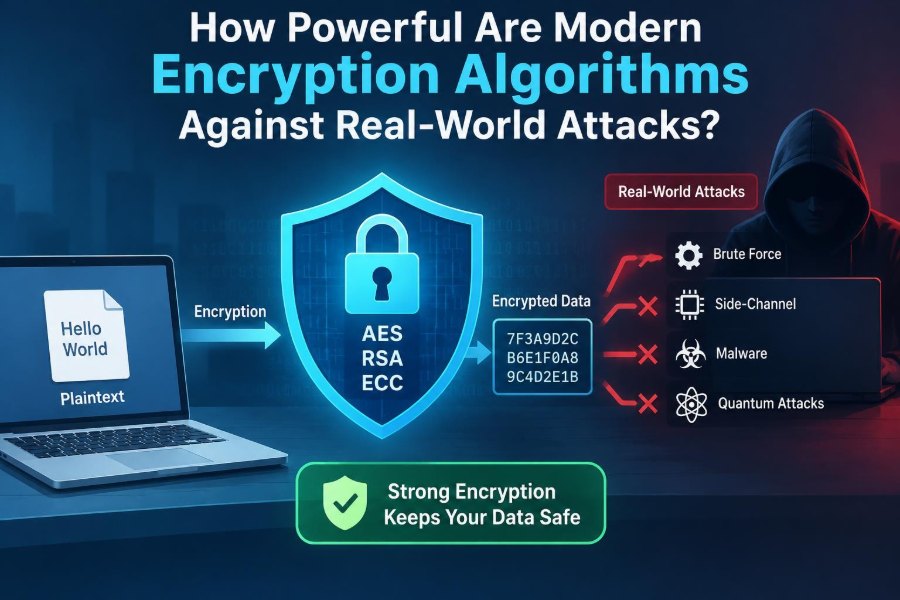

You send a message, unlock a phone, pay for coffee, sign in to work, and store photos in the cloud. In each case, encryption may be protecting information that would be embarrassing, expensive, or dangerous to expose.
That protection can feel almost magical: data becomes unreadable noise, and only the right key can restore it. But real attackers do not always try to “break the math.” They look for weaker routes around it.
A stolen password, a convincing phishing page, an unpatched server, or a backup left unprotected can defeat a system using excellent cryptography. This is why the question is not simply whether AES or RSA is strong.
The more useful question is where encryption fits in a complete security system—and what it can and cannot defend against.
🔐 Encryption Turns Meaning into Ciphertext
Encryption transforms readable plaintext into unreadable ciphertext using an algorithm and a key. A key is a secret value that controls the transformation; knowing the algorithm alone should not be enough to recover the original data.
For example, a file might contain the sentence “Project launch is Friday.” After encryption, it becomes a sequence that appears random. With the correct key, authorized software can decrypt it back into the original sentence.
🗝️ The Key Is More Important Than the Lock Design
Modern cryptography follows a principle associated with Auguste Kerckhoffs: a system should remain secure even if an attacker knows how it works. Security should depend on keeping the key secret, not on hiding the algorithm.
This is practical. Widely examined algorithms can be implemented by browsers, operating systems, and hardware from different vendors. A secret custom algorithm is harder to evaluate and can hide design errors until an attacker finds them.
🧮 Why Brute Force Is Usually Unrealistic
A brute-force attack tries possible keys until one works. The feasibility depends on the size of the key space: how many candidate keys exist.
A properly used 128-bit symmetric key has an unimaginably large number of possibilities. Trying all of them is beyond realistic computing capability. That does not mean a system is invulnerable; it means guessing the encryption key directly is usually the wrong strategy for an attacker.
Attackers instead search for a reused password, a leaked recovery code, a vulnerable endpoint, or a flawed implementation.
⚙️ Symmetric Encryption Protects Data Efficiently
Symmetric encryption uses the same secret key, or closely related keys, to encrypt and decrypt data. It is fast enough for large files, storage devices, database fields, and most of the traffic in an encrypted network connection.
AES, the Advanced Encryption Standard, is the best-known modern symmetric algorithm. When implemented and configured correctly, AES with an appropriately sized key remains a strong practical choice for ordinary commercial and personal uses.
The challenge is securely giving both parties access to the shared secret without exposing it.
📬 Public-Key Encryption Solves a Different Problem
Asymmetric, or public-key, cryptography uses a public key and a mathematically connected private key. You can share the public key widely, while the private key must remain secret.
Someone can encrypt a small secret for your public key, and only your private key can decrypt it. Public-key systems also support digital signatures, which help verify that a message or software update came from the holder of a private key.
RSA and elliptic-curve cryptography are common families. They are computationally heavier than symmetric encryption, so secure systems normally use them to establish or protect a temporary symmetric session key rather than to encrypt every byte of a large file.
🤝 Hybrid Encryption Combines Both Strengths
When you visit a secure website, the connection typically uses a hybrid design. Public-key methods authenticate parties and help establish shared secrets; symmetric encryption then protects the ongoing data exchange efficiently.
This division of labor is why public-key encryption does not need to be as fast as AES. Each method is used for the task where it is most suitable.
🌐 HTTPS Protects Data While It Travels
HTTPS uses TLS, the Transport Layer Security protocol, to encrypt traffic between a browser and a website. It can prevent people on the same Wi-Fi network, an internet provider, or an intermediate network from simply reading or changing traffic in transit.
However, HTTPS does not automatically make a website trustworthy. A phishing site can use HTTPS too. It proves that your browser has an encrypted connection to that site, not that the site deserves your login details.
🧱 Encryption at Rest Protects Stored Information
Encryption at rest protects data stored on a laptop, phone, drive, or server. Full-disk encryption is especially useful if a powered-off device is lost or stolen because the storage contents are inaccessible without the unlocking secret.
It has limits. If the device is already unlocked and a malicious program is running under your account, the program may access files in decrypted form. Disk encryption protects a stolen drive much better than it protects an active, compromised computer.
🚚 Encryption in Transit and at Rest Are Separate Needs
A service can protect data in transit but leave it exposed in a poorly secured database. Conversely, it can encrypt stored data but transmit it through an insecure connection. These are different threat scenarios.
| Protection | Main threat addressed | Typical example |
|---|---|---|
| In transit | Interception or alteration on a network | TLS in HTTPS |
| At rest | Theft of stored media or backups | Full-disk encryption |
| End-to-end | Access by an intermediary service | Encrypted private messaging |
Strong security often requires more than one layer. A company laptop, for instance, may need disk encryption, encrypted connections, protected backups, and access controls.
💬 End-to-End Encryption Changes Who Can Read Messages
With end-to-end encryption, the intended participants hold the keys needed to read message content. The messaging provider may carry or store encrypted messages but is designed not to have the ordinary ability to read them.
This is stronger than merely encrypting a connection to a service. It also creates trade-offs: account recovery, multi-device synchronization, reporting abusive content, and cloud backups require careful design and may introduce additional access paths.
🎲 Randomness Prevents Predictable Keys
Encryption is only as strong as the unpredictability of its keys and related values. A cryptographically secure random-number generator is designed to produce values attackers cannot feasibly predict.
Human choices are poor substitutes. A password like Summer2025! may look varied, but it follows familiar patterns that password-guessing tools try early. Predictable random values have also caused serious weaknesses in real systems because they shrink the attacker’s search problem.
🧂 Passwords Need Slow Hashing, Not Reversible Encryption
Services should generally not store a password in decryptable form. Instead, they store a password hash: the result of a one-way function designed to make guessing expensive.
A unique random salt is added to each password before hashing. Salts stop identical passwords from producing identical stored values and make large precomputed guessing databases far less useful.
Purpose-built password-hashing schemes such as Argon2, bcrypt, scrypt, or PBKDF2 deliberately cost more than fast general-purpose hashing. That cost is a feature: it slows offline password guessing after a database leak.
🔁 Password Reuse Lets One Breach Spread
Even perfect password hashing cannot protect a password that users reuse elsewhere. If one unrelated site leaks a password, criminals may test the same email-and-password combination against common email, shopping, finance, or workplace services.
This attack is called credential stuffing. It succeeds because people reuse credentials, not because attackers defeated the target site’s encryption.
A password manager makes unique, long passwords realistic. It is one of the most practical ways individuals can reduce this risk.
🎣 Phishing Bypasses Cryptography by Targeting People
Phishing messages imitate a bank, employer, delivery company, or colleague and try to persuade someone to reveal a password, approve a sign-in, or install software. The encrypted website connection can remain technically sound while the victim hands over valid access.
Warning signs include unexpected urgency, unfamiliar domains, unusual payment requests, and login pages reached from unsolicited links. When a request matters, opening the known app or typing the known address is safer than following the message link.
🦠 Malware Can See Data After Decryption
Encryption protects data in particular states: while stored or while moving across a network. Programs must eventually decrypt information to display it, edit it, or process it.
Malware running with sufficient privileges may capture keystrokes, take screenshots, steal browser sessions, read accessible files, or copy data before encryption and after decryption. This is why device updates, careful software installation, and endpoint protection remain relevant.
🛠️ Implementation Errors Can Undermine Strong Algorithms
Using a respected algorithm does not guarantee a secure product. Developers can accidentally reuse a nonce, mishandle an error condition, choose unsafe defaults, or expose keys in logs, source repositories, or backups.
A nonce is a value intended to be used only once in a given cryptographic context. Some encryption modes require nonce uniqueness; violating that requirement can reveal relationships between messages or, in severe cases, compromise confidentiality or integrity.
Cryptographic code is difficult to write safely from scratch. Mature libraries, established protocols, code review, and secure defaults are usually safer than inventing a new scheme.
🧩 Authentication Is Not the Same as Encryption
Encryption hides content, but it does not always prove who created it or whether it was modified. Authentication verifies an identity or message origin; integrity helps detect unwanted changes.
Modern applications often use authenticated encryption, which provides confidentiality and integrity together. A secure design should reject altered ciphertext rather than attempting to decrypt and use it as though nothing happened.
✍️ Digital Signatures Protect Trust in Software and Messages
A digital signature is created with a private key and verified using the corresponding public key. If the signed content changes, verification should fail.
This supports signed software updates, document workflows, and secure communications. It does not tell you whether the signer is ethical or whether the signed code is harmless; it tells you that the content matches what the signing key approved.
🪪 Certificates Help Bind Keys to Identities
When a browser connects to a website, it needs more than a public key. It needs evidence that the key is associated with the domain it intended to visit. Certificates and certificate authorities support that binding.
The system has practical complexities: certificates expire, domain ownership can change, and organizations must protect certificate-management accounts. Still, the certificate model enables browsers to warn users when a connection cannot be authenticated normally.
⏳ Forward Secrecy Limits the Value of Future Key Theft
Forward secrecy is a property of many modern TLS configurations. It uses temporary session secrets so that obtaining a server’s long-term private key later does not automatically reveal every previously recorded encrypted session.
This matters against an attacker who records encrypted traffic now in the hope of decrypting it later. Forward secrecy does not protect a session if the endpoint is compromised while that session is active, but it reduces the consequences of certain later key exposures.
🔓 Key Management Is Often the Hardest Part
Organizations must generate keys securely, decide who can use them, store them separately from data when appropriate, rotate them when needed, and destroy them safely when access must end. This collection of tasks is key management.
Consider an encrypted database whose decryption key is stored in a readable configuration file on the same exposed server. The database is encrypted, but an attacker who steals both may have everything required to decrypt it.
Hardware security modules, dedicated key-management services, access auditing, and separation of duties can reduce this concentration of risk. They are not magic tools; their value depends on sound permissions and operational practices.
👥 Access Control Decides Who May Use Decrypted Data
Encryption can protect a file from outsiders while it is locked, but access control governs what happens after authorized decryption. A worker who legitimately opens a customer record might still be allowed to copy it somewhere inappropriate if permissions are too broad.
Least privilege means granting only the access necessary for a role and task. It reduces harm when an account is compromised and limits accidental exposure by legitimate users.
🗄️ Backups and Recovery Can Become the Weak Link
Backups are essential for resilience against deletion, device failure, and ransomware. They can also contain a complete historical copy of sensitive information, sometimes with weaker protections than the production system.
Backup encryption requires a recovery plan. If every recovery key is lost, encrypted backups may be permanently unusable. If recovery keys are available too easily, attackers may use them. Organizations need documented, tested procedures that balance availability and control.
📱 Multi-Factor Authentication Protects Keys to Accounts
Multi-factor authentication, or MFA, requires more than one type of proof, such as a password plus an authenticator-app code, a security key, or a device confirmation. It makes a stolen password less useful.
Not all MFA methods resist phishing equally. Security keys based on modern phishing-resistant standards can verify the legitimate site during sign-in, while a one-time code can sometimes be entered into a convincing fake page. The best option depends on the service and the user’s risk level.
⚖️ Encryption Has Limits Against Compelled or Authorized Access
Encryption cannot settle every privacy question by itself. If a person is required to unlock a device, if a company administrator controls a managed endpoint, or if a service holds the relevant keys, data may be accessible through authority or policy rather than through cryptographic attack.
The details vary by location, employment arrangement, contract, and system design. From a technical perspective, the central question remains simple: who controls the keys, and under what conditions can they be used?
🧠 Quantum Computing Is a Long-Term Design Concern
Large-scale fault-tolerant quantum computers could threaten many widely used public-key systems, including common RSA and elliptic-curve approaches. Symmetric encryption is affected differently; larger key sizes can provide a substantial safety margin against known quantum search techniques.
Current discussion should be practical rather than alarmist. Migrating large systems takes time, so organizations with data that must remain secret for many years should track post-quantum cryptography and plan for cryptographic agility: the ability to replace algorithms without rebuilding everything.
📏 Algorithm Strength Depends on Correct Parameters
“We use encryption” is incomplete. Security depends on the algorithm, key length, operating mode, nonce rules, protocol version, library behavior, and how keys are protected.
Older algorithms or protocols may still appear in legacy systems because replacement is difficult, not because they remain good choices. Security teams should inventory cryptographic uses, retire deprecated options, and rely on current platform guidance instead of selecting settings by familiarity.
🏢 Real-World Attacks Usually Target the Cheapest Path
An attacker assessing a business may choose between an infeasible mathematical attack on modern encryption and a phishing email that reaches hundreds of employees. The second path is usually more attractive.
This does not make encryption unimportant. It explains why defenses must be layered: secure cryptography protects a core boundary, while training, patching, monitoring, backups, MFA, and incident response protect the surrounding system.
✅ Practical Steps for Individuals
- Use a password manager to create a unique password for every important account.
- Enable MFA, prioritizing phishing-resistant methods where services support them.
- Keep phones, computers, browsers, and routers updated.
- Turn on device encryption and use a strong screen lock.
- Verify unexpected requests through a known contact method before sharing codes, files, or money.
- Maintain backups for valuable data and periodically test whether they can be restored.
These habits do not require understanding every mathematical detail. They reduce the common attacks that strong encryption alone cannot stop.
🧑💻 Practical Steps for Developers and Teams
- Use well-maintained cryptographic libraries and established protocols rather than custom cryptography.
- Choose authenticated encryption where appropriate, and follow nonce and key-handling requirements exactly.
- Store passwords with a modern salted password-hashing scheme, never reversible encryption.
- Keep secrets out of source code, logs, chat messages, and unprotected configuration files.
- Apply least privilege, audit sensitive key use, and test backup recovery.
- Design for upgrades so algorithms, certificates, and keys can be replaced without disruptive rewrites.
For high-value systems, independent security review and threat modeling are valuable because cryptographic failures often occur at the interfaces between components.
🧭 The Core Principle: Strong Math Needs Strong Systems
Modern encryption algorithms are remarkably powerful against direct attacks when they are current, correctly implemented, and paired with well-protected keys. For many realistic threats, attackers cannot feasibly recover the plaintext by merely staring at properly encrypted ciphertext.
But encryption is not a force field around an organization or a person. It cannot fix a deceived user, an infected endpoint, an overprivileged account, or a recovery key left exposed.
The most accurate view is layered: cryptography provides a reliable technical foundation, while people, software, devices, policies, and operations determine whether that foundation is actually used safely.
Modern encryption is extraordinarily strong at protecting data from direct cryptographic attack; real-world security depends on protecting the keys, endpoints, and humans around it. Treat encryption as a vital layer, then build the rest of the defenses that let it do its job. 🔐🛡️💻