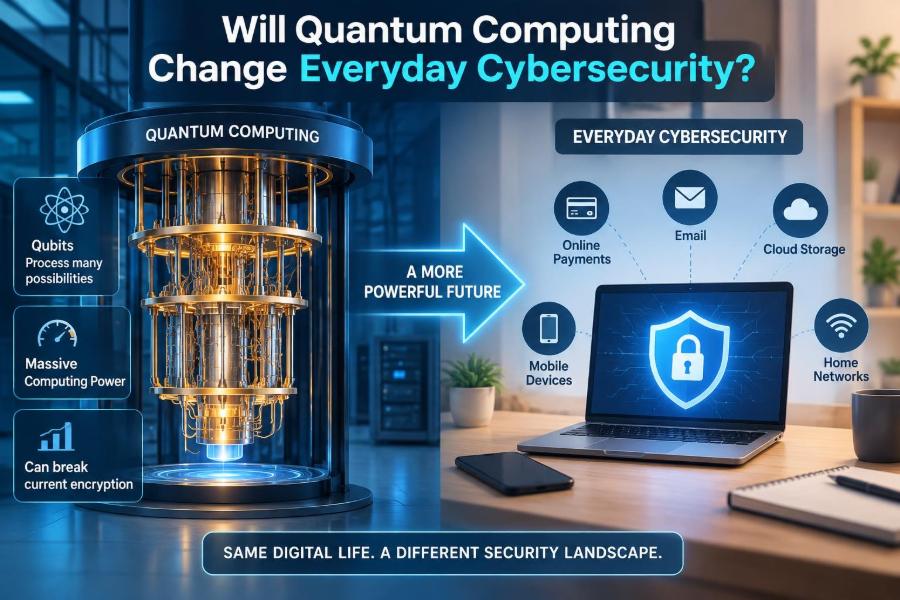

You sign in to a bank account, send a private message, install a software update, or connect to public Wi-Fi. In each case, encryption is working quietly in the background. It helps verify who you are talking to and keeps outsiders from reading or altering data in transit.
Quantum computing raises an unsettling question: could a new kind of computer eventually break the mathematical protections that make these ordinary activities safe? The short answer is that it could disrupt some widely used encryption systems, but it will not make all cybersecurity disappear overnight.
The practical story is less about a single dramatic breakthrough and more about a long transition. Organizations must identify vulnerable systems, replace certain cryptographic algorithms, and keep doing the security basics that prevent most real-world incidents.
Understanding that transition helps students, professionals, and everyday users separate a genuine long-term risk from misleading claims about an instant “encryption apocalypse.”
🔐 Cybersecurity Depends on Trust at a Distance
Modern computing constantly needs to answer two questions: is this party really who it claims to be? and can anyone else read or change this information? Cryptography supplies the tools for both.
When a browser shows a secure connection, it is using cryptography to establish a protected session with a website. Digital signatures help verify software publishers, while encrypted storage helps protect data on a lost device.
These protections are not all based on the same mathematics. That distinction is the key to understanding where quantum computing matters most.
⚛️ What Makes a Quantum Computer Different
A conventional computer represents information with bits that are either 0 or 1. A quantum computer uses quantum bits, or qubits, which can be prepared in states that combine possibilities and can influence one another through a property called entanglement.
This does not mean a quantum computer simply tries every answer at once. That popular shorthand misses the difficulty: quantum algorithms must be designed so that useful answers become more likely when measured.
For particular mathematical tasks, however, this model can offer a major advantage. Factoring large numbers and searching some mathematical spaces are especially relevant to cryptography.
🧩 Quantum Computing Is Not a Faster Laptop
Quantum computers are specialized machines, not expected replacements for ordinary computers. A spreadsheet, video call, or word processor gains little from a device optimized for quantum operations.
Current quantum hardware also faces substantial engineering limits. Qubits are fragile, errors occur easily, and useful computations often require error correction built from many physical qubits working together.
As a result, cybersecurity planning should not assume that today’s available quantum machines can break commonly deployed public-key encryption. The concern is about machines that may be built in the future, and about data that must remain secret until then.
🔑 The Two Broad Families of Encryption
Cryptography is often divided into symmetric and asymmetric systems. Symmetric encryption uses the same secret key to encrypt and decrypt data. Asymmetric, or public-key, cryptography uses a public key that can be shared and a private key that must remain secret.
Public-key systems solve a practical problem: two strangers can establish trust or protect information without first meeting to exchange a shared secret. They underpin much of secure web browsing, remote access, email encryption, code signing, and digital certificates.
Quantum computing affects these families differently, so “quantum-safe” cannot be reduced to a single yes-or-no label.
🧮 Why Public-Key Cryptography Faces the Largest Change
Many public-key systems rely on mathematical problems that are difficult for conventional computers. Two major examples are factoring the product of very large prime numbers and solving the discrete logarithm problem.
Widely used systems such as RSA, Diffie-Hellman, and elliptic-curve cryptography rely on these kinds of problems. Their security comes from the practical difficulty of deriving a private secret from public information.
A sufficiently capable, error-corrected quantum computer could change that calculation dramatically. It could use a quantum method to solve the relevant mathematical problems far more efficiently than known classical approaches.
📐 Shor’s Algorithm Explains the Concern
In 1994, mathematician Peter Shor described a quantum algorithm that can factor large integers and solve discrete logarithms efficiently in principle. Those are precisely the problems protecting several major public-key systems.
“In principle” is an essential qualifier. Running Shor’s algorithm at a scale that defeats real deployment keys would require quantum hardware far beyond what has been publicly demonstrated for this purpose.
Still, the algorithm means the risk is not speculative in the same way as an unknown future attack. The cryptographic weakness is understood; the uncertain part is the timeline and practical capability of the hardware.
🔒 Symmetric Encryption Has a Different Outlook
Symmetric encryption, including the Advanced Encryption Standard (AES), is not broken by Shor’s algorithm. A quantum search technique called Grover’s algorithm can reduce the effective work needed to guess a key, but it does not create the same kind of collapse.
A common response is to use larger symmetric keys. For example, a system designed around a 256-bit symmetric key has a much larger security margin than one using a shorter key.
This is why quantum planning is not about abandoning encryption. It is largely about replacing vulnerable public-key mechanisms and choosing sensible key sizes for symmetric protection.
📊 A Simple View of the Cryptographic Impact
| Cryptographic task | Typical current approach | Quantum planning implication |
|---|---|---|
| Key exchange | Diffie-Hellman or elliptic-curve methods | Move to post-quantum key-establishment methods |
| Digital signatures | RSA or elliptic-curve signatures | Move to post-quantum signature methods |
| Bulk data encryption | Symmetric encryption such as AES | Use strong key sizes; no wholesale replacement is implied |
| Data integrity checks | Cryptographic hash functions | Review output lengths and protocol design where long-term strength matters |
The table is deliberately broad. A real system may combine several algorithms, certificates, hardware devices, and older protocols, which is why migration takes careful inventory work.
🕰️ The “Harvest Now, Decrypt Later” Problem
An attacker does not need a quantum computer today to create a future privacy risk. They can collect encrypted traffic or stolen encrypted files now and keep them, hoping to decrypt them later if capable technology becomes available.
This is called harvest now, decrypt later. It matters most when information has a long useful lifetime: government records, health information, intellectual property, sensitive research, legal material, or long-term financial data.
A casual message that loses value quickly presents a different risk from a trade secret that remains valuable for decades. Good planning begins by asking how long data truly needs to stay confidential.
📦 Stored Data and Moving Data Need Separate Decisions
Data at rest is stored in databases, backups, archives, and devices. Data in transit moves across networks. Both can be encrypted, but their migration challenges differ.
For stored data, an organization may need to protect old archives, rotate encryption keys, and preserve access to historical records. For moving data, it must update secure connection protocols, servers, client applications, and devices that communicate with them.
Replacing one protocol does not automatically fix previously captured traffic or old encrypted backups. Security teams must map where sensitive information lives and how it travels.
🌐 Web Browsing Will Change Mostly Behind the Scenes
Secure web connections use protocols such as TLS, which combine authentication, key establishment, and symmetric encryption. The public-key parts are candidates for post-quantum replacement; the bulk encryption portion remains conceptually familiar.
For an everyday user, the experience may eventually look much the same: a browser connects securely, a lock indicator appears, and data is protected. The algorithms negotiated under the hood may be different.
The difficult work falls on browser makers, web platforms, certificate systems, network appliances, and organizations operating older applications. Compatibility and performance testing matter because secure connections are used everywhere.
✍️ Digital Signatures Need Careful Replacement
A digital signature provides authenticity and integrity. It can show that a software update came from the expected publisher and that it was not altered after signing.
Quantum-vulnerable signatures are particularly significant because signed objects can last a long time. A signed document, firmware image, or certificate may need verification years after it was created.
Migration plans therefore consider both new signatures and historical verification. Some environments may use more than one signature during a transition so that old and new systems can validate the same object.
🛡️ Post-Quantum Cryptography Is the Main Defense
Post-quantum cryptography, often abbreviated PQC, refers to cryptographic algorithms designed to run on ordinary computers while resisting known attacks from both classical and sufficiently powerful quantum computers.
These algorithms do not require users to own quantum hardware. They are software and protocol changes based on different mathematical foundations, such as lattice-based problems, code-based constructions, and hash-based signatures.
The objective is practical continuity: preserve secure communication and identity checks even if quantum computing eventually becomes powerful enough to threaten older public-key designs.
🏛️ Standards Matter More Than Novel Algorithms
Security cannot safely depend on an organization choosing a fashionable new algorithm alone. Cryptographic algorithms need public analysis, implementation guidance, testing, and standardized ways to use them in real protocols.
Standards bodies and national cybersecurity organizations have been evaluating and publishing post-quantum algorithms and guidance. Their work gives vendors and system owners common building blocks instead of a patchwork of incompatible designs.
Standardization is not a promise that every implementation is flawless. It is a structured process for selecting, scrutinizing, and deploying algorithms with a clearer security and interoperability foundation.
🔄 Hybrid Cryptography Reduces Transition Risk
A hybrid approach combines a conventional algorithm with a post-quantum algorithm. For key establishment, a system can derive protection from both components rather than betting everything on one new method immediately.
If implemented correctly, an attacker generally needs to defeat the protection that remains secure. This can provide resilience while post-quantum techniques gain operational experience.
Hybrids add complexity, however. More data, more code paths, and more integration testing can introduce mistakes. They are useful engineering tools, not magic shields.
📏 Bigger Keys Are Not Always the Answer
A frequent misunderstanding is that organizations can protect RSA or elliptic-curve cryptography simply by selecting much bigger keys. Larger classical keys make classical attacks harder, but Shor’s algorithm targets the underlying mathematical problem.
Increasing the key size may change the resource requirement for an attacker, yet it does not restore the original security assumption against a capable quantum computer. A different algorithm family is needed for public-key tasks.
By contrast, larger keys can be a sensible response for symmetric encryption. The correct action depends on the cryptographic primitive, not on a universal “use bigger keys” rule.
📱 Everyday Devices Will Feel the Constraints
Post-quantum algorithms can have different key sizes, signature sizes, memory needs, and processing costs from the algorithms they replace. A modern server may handle those changes easily, while a small sensor or old smart device may not.
Think of a door lock, industrial controller, medical device, or vehicle component that receives signed updates. Its storage, battery life, network bandwidth, and update mechanism can limit which cryptographic upgrade is practical.
This is one reason the transition will be gradual. Security design must work in the physical constraints of real devices, not only in a laboratory benchmark.
🏭 Legacy Systems Are Often the Hardest Part
Many organizations rely on systems that have been in place for years: internal business software, factory equipment, building controls, payment terminals, and specialized appliances. Their cryptography may be hidden in vendor products or hard-coded firmware.
Some systems cannot be upgraded remotely. Others use certificates, libraries, or hardware modules that were designed around older algorithms. Replacing them can require scheduled downtime, vendor support, and extensive validation.
The biggest obstacle is frequently not finding a new algorithm. It is discovering every place where the old one is embedded.
🗺️ Cryptographic Inventory Is the Sensible First Step
Organizations need cryptographic inventory: a record of where cryptography is used, which algorithms and key sizes appear, what data is protected, and who owns each system.
A useful inventory distinguishes high-value and long-lived data from routine data, and identifies internet-facing services separately from isolated internal tools. It should also record third-party dependencies, including cloud services and vendors.
- Locate certificates, key-exchange methods, signature schemes, and encryption libraries.
- Identify products that cannot be patched or cannot support new algorithms.
- Classify information by confidentiality lifetime and business impact.
- Document upgrade paths, support contracts, and retirement dates.
This work improves security even before a post-quantum migration begins, because it exposes outdated cryptography and unmanaged dependencies.
🧱 Crypto Agility Makes Future Changes Easier
Crypto agility is the ability to replace or reconfigure cryptographic algorithms without rebuilding an entire system. It does not mean switching algorithms casually; it means designing systems so that a reviewed change is possible when needed.
A rigid application might assume one signature format, one fixed key length, and one certificate type. An agile application separates these choices from its core business logic and supports planned negotiation or versioning.
Agility also needs governance. Allowing any algorithm at any time can create downgrade attacks, where an attacker pushes two systems toward weaker protection. Secure choices must be explicit and controlled.
🚨 Quantum Risk Does Not Replace Current Threats
Phishing, stolen passwords, unpatched software, ransomware, exposed cloud storage, and insecure application design remain immediate security problems. Quantum computing does not prevent an attacker from exploiting any of them.
An organization that spends heavily on post-quantum planning while ignoring multifactor authentication or critical updates may become less safe in practice. Security budgets must reflect both present likelihood and future impact.
The right mindset is not “quantum versus ordinary cybersecurity.” It is a layered strategy that improves current defenses while preparing long-lived systems for a known cryptographic transition.
🎣 Social Engineering Still Bypasses Strong Math
Encryption protects data and helps authenticate systems, but it cannot fully protect a person tricked into approving a fraudulent login or installing malicious software. If an attacker controls an endpoint, they may read data before it is encrypted or after it is decrypted.
For example, replacing a vulnerable key exchange does not stop a fake invoice email from persuading an employee to disclose credentials. Nor does it repair an application that grants too many permissions.
Training, phishing-resistant sign-in methods, least-privilege access, backups, and monitoring remain essential alongside cryptographic upgrades.
🧪 Implementation Errors Can Defeat Good Algorithms
Cryptography is more than a mathematical formula. Software must generate random values correctly, protect private keys, validate inputs, handle errors safely, and avoid leaking secrets through timing or memory behavior.
A post-quantum algorithm can be sound on paper yet deployed insecurely if developers use an unreviewed library, skip signature checks, or mishandle protocol negotiation. New algorithms also need careful testing in the systems where they will run.
For most teams, using mature, maintained cryptographic libraries and following established protocol guidance is safer than implementing cryptography from scratch.
💾 Backups, Archives, and Certificates Need a Timeline
Long-lived assets deserve early review. A backup containing sensitive records may outlive the encryption scheme used to protect it. A root certificate or signed archive may remain part of a trust chain long after its original deployment.
Organizations should define retention periods and decide which older material needs re-encryption, re-signing, or additional protective controls. The answer depends on the data’s sensitivity, legal obligations, operational value, and ability to migrate it safely.
There is no universal deadline that fits every system. A short-lived session key and a decades-long archive create fundamentally different planning priorities.
☁️ Cloud Services Shift Some Work, Not All Responsibility
Cloud providers operate much of the infrastructure beneath a service, and many are introducing post-quantum capabilities in selected products. That can reduce the burden of maintaining low-level cryptographic implementations.
Customers still need to know what is protected, which service modes use which protocols, and whether their own applications, identities, client devices, or stored data introduce separate exposure. Shared responsibility applies to cryptography as well as access control.
When evaluating a provider, ask about algorithm support, migration options, certificate handling, key management, compatibility, and the ability to document configuration choices.
👩💻 What Developers Should Do Now
Developers do not need to become quantum physicists to prepare responsibly. They should avoid embedding algorithm assumptions deep in application code and should keep cryptographic dependencies current.
- Use well-maintained platform security features and established libraries.
- Avoid deprecated protocols, weak key sizes, and custom cryptographic designs.
- Store algorithm identifiers and key formats in ways that can evolve.
- Test whether applications tolerate larger keys, signatures, and handshake messages.
- Track vendor roadmaps for operating systems, databases, devices, and network tools.
A design that is easy to update is valuable regardless of the exact quantum timeline.
👤 What Everyday Users Should Do Now
Most individuals cannot choose the encryption algorithms used by their bank, browser, or messaging service. Their best contribution is strong everyday account and device security.
Use a password manager to create unique passwords, enable multifactor authentication where available, install updates, verify unexpected requests, and keep recoverable backups. These measures address threats that are far more likely to affect a person today.
For people handling particularly sensitive, long-lived information, it is reasonable to ask service providers about encryption practices and future migration plans. But there is no need to abandon normal online activity because of quantum headlines.
📚 What Students and Security Professionals Should Learn
The transition makes foundational knowledge more valuable, not less. Learn the difference between encryption, hashing, key exchange, and digital signatures; they solve different problems and fail in different ways.
It is also useful to understand threat modeling: identifying what must be protected, from whom, for how long, and under which constraints. That approach prevents a technology trend from becoming a vague source of fear.
Security professionals will increasingly need skills in asset discovery, protocol migration, vendor assessment, testing, and risk communication. Quantum knowledge is helpful, but operational discipline is what turns it into safer systems.
⏳ No One Can Reliably Promise a Break Date
Predictions about when a cryptographically relevant quantum computer will arrive vary because the task requires advances in hardware quality, scaling, error correction, control systems, and reliable operation. Progress in one area does not guarantee the others.
Responsible planning avoids two opposite errors: assuming the threat is so distant that no preparation is needed, or claiming that ordinary encryption is already broken. Neither statement supports good decisions.
Migration itself can take many years in large environments. That long lead time is the practical reason to start preparation before there is an emergency.
⚖️ The Cost of Moving Too Fast or Too Slowly
Moving too fast can create outages, compatibility failures, poorly tested implementations, and unnecessary expense. New cryptographic options must be integrated with existing protocols and devices carefully.
Moving too slowly can leave long-lived data exposed to harvest-now-decrypt-later risk and make a later migration rushed and expensive. It can also trap an organization in equipment that cannot be upgraded.
A measured program uses risk ranking, standards-based choices, pilot deployments, and clear rollback plans. The goal is deliberate progress rather than panic or denial.
🧭 A Practical Post-Quantum Migration Path
A mature plan usually unfolds in stages rather than one giant replacement project.
- Identify cryptographic assets, sensitive data, owners, and dependencies.
- Prioritize systems by data lifetime, exposure, and upgrade difficulty.
- Follow recognized standards and supplier support rather than untested claims.
- Test post-quantum or hybrid approaches in controlled environments.
- Deploy in phases, monitor interoperability and performance, then retire vulnerable methods according to policy.
The details will differ between a small business, a hospital, a software company, and a public agency. The sequence remains useful because it connects technical choices to real operational risk.
🌱 Quantum Computing May Also Improve Defense
Quantum computing is not solely an attacker’s tool. In the longer term, quantum methods may assist certain scientific, optimization, or simulation tasks that could support security research and engineering.
Quantum communication concepts, such as quantum key distribution, are also sometimes discussed in security contexts. They are specialized technologies with infrastructure and deployment constraints; they are not a universal replacement for post-quantum cryptography on everyday networks.
The more immediate defensive opportunity is simpler: use the transition to modernize cryptographic practices, retire weak legacy systems, and improve visibility into how data is protected.
🧠 The Core Takeaway: Prepare Without Panic
Quantum computing could eventually break important public-key cryptography that supports everyday online trust. That is a real architectural challenge, especially for sensitive data that must remain confidential for many years.
It does not mean that all encryption is about to fail, that quantum computers can currently read everyone’s messages, or that ordinary security practices no longer matter. Symmetric encryption remains useful with appropriate strength, and post-quantum cryptography provides a practical path for replacing vulnerable public-key functions.
The central principle is cryptographic readiness: know where encryption is used, understand how long the protected information matters, adopt reviewed standards, and build systems that can change safely.
Quantum computing is likely to change everyday cybersecurity gradually, through planned upgrades to the invisible trust systems behind digital life—not through a single overnight collapse. Sensible preparation now gives organizations time to make those upgrades carefully. 🔐⚛️🛡️