
A hospital may need to analyze patient records with a cloud-based machine-learning service. A bank may want to detect fraud across several systems. A company may need to process payroll, customer data, or engineering plans on infrastructure it does not physically own.
Encryption helps protect those records while they are stored and while they move across a network. But ordinary software usually decrypts data before using it. For at least a moment, the valuable information exists in working memory in a readable form.
That gap matters because memory can be exposed through a compromised operating system, privileged administrator access, malicious software, or certain hardware-level attacks. The risk is not that every cloud operator is untrustworthy; it is that traditional designs ask many layers of software and infrastructure to be trusted.
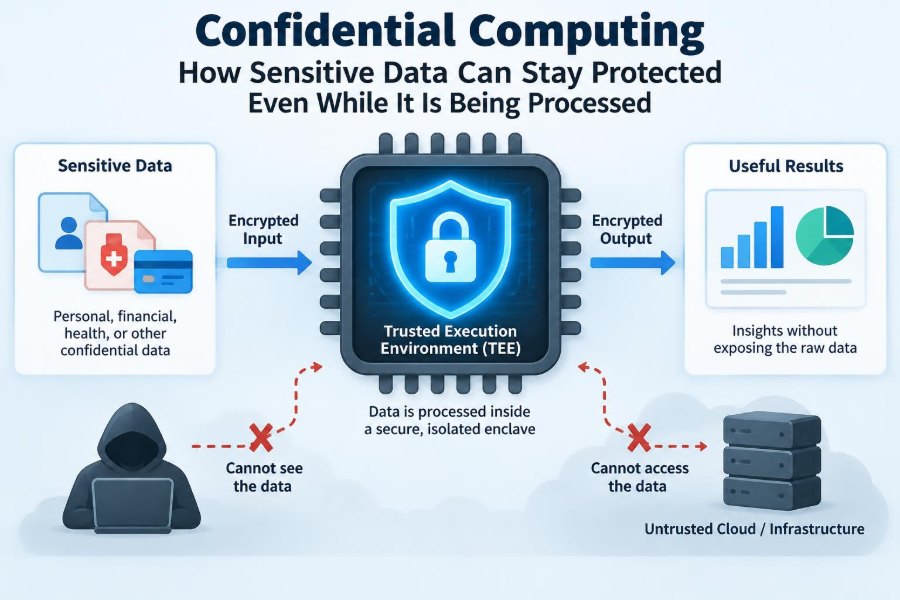
Confidential computing is an approach designed to reduce that trust requirement. It aims to protect data while it is actively being processed, not only before and after computation.
🧩 The overlooked state of data in use
People often describe data as being in one of three states: at rest in storage, in transit across a network, and in use inside a running program. Disk encryption addresses the first state, while protocols such as TLS protect the second.
The third state is harder. A program must normally load data into random-access memory, or RAM, so that a processor can calculate with it. In conventional systems, highly privileged software can often inspect that memory.
🔒 What confidential computing means
Confidential computing is a collection of hardware-assisted techniques that create an isolated execution environment for code and data. The protected environment is commonly called a trusted execution environment, or TEE.
Inside a properly configured TEE, selected memory is encrypted and access is restricted, even from software that would ordinarily have broad control over a machine. The goal is not to make every component trustworthy. It is to shrink the set of components that must be trusted for a particular computation.
🏠 A simple room-and-envelope analogy
Imagine encrypted storage as a locked envelope in a filing cabinet. Encryption in transit is like sending that envelope through a locked courier box. Traditional processing means opening the envelope on a desk so work can be done.
A TEE is closer to doing the work in a controlled room. The information is opened only inside that room, and outsiders can receive the result without freely seeing the papers on the desk. The analogy is imperfect, but it captures the key difference: protection continues during computation.
⚙️ Why ordinary processing creates exposure
Operating systems schedule programs, manage memory, load drivers, and handle input and output. Hypervisors, which allow several virtual machines to share a server, perform similarly powerful work at a lower level.
These layers are essential, but their privileges create a large attack surface. A vulnerability, harmful administrator action, or compromised management tool may provide a path to a running workload’s memory. Confidential computing tries to make that path less useful for protected data.
🧠 The role of trusted execution environments
A TEE is not simply a password-protected application. It is an execution boundary supported by processor features and firmware, with rules for isolating memory and controlling entry to the protected code.
Different TEEs offer different sizes and trust models. Some protect a small, carefully designed part of an application; others can protect an entire virtual machine. This distinction affects performance, engineering effort, and the amount of code inside the trusted boundary.
🧱 Enclaves: protected areas within an application
An enclave is typically a protected region used by part of a program. Sensitive operations, such as handling a cryptographic key or comparing private records, happen inside it while less sensitive work remains outside.
This model can reduce exposure, but it asks developers to divide their application carefully. Data crossing the enclave boundary must be validated, because an isolated calculation can still be misled by untrusted input.
🖥️ Confidential virtual machines
A confidential virtual machine, or confidential VM, protects a broader workload: an operating system, its applications, and their memory. This can make existing server software easier to move into a protected environment than an enclave-based redesign.
The trade-off is a larger trusted computing base. More code runs inside the protected VM, so there is more software whose behavior and security matter to the workload.
🔑 Memory encryption is only one piece
Many confidential-computing systems encrypt memory when it leaves the processor package or moves through parts of the memory subsystem. This helps prevent straightforward reading of protected memory by other platform components.
Encryption alone does not answer every question. A system also needs secure key handling, restrictions on access, safe interfaces with devices, and a way for a remote party to verify what environment is running. Security comes from the design as a whole.
🪪 Remote attestation builds evidence
Remote attestation lets a protected environment provide cryptographic evidence about itself to another system. For example, a customer may want evidence that a specific approved application is running in a genuine protected environment before sending it a decryption key.
Attestation is best understood as evidence, not magic trust. The receiving party must decide which hardware, firmware versions, configurations, and application measurements it accepts. Poor policy can weaken a technically sound attestation process.
📏 Measurements identify approved software
Before or during startup, a protected environment can calculate a cryptographic measurement of code and configuration. A small change produces a different measurement, making it useful for identifying an expected build.
A practical deployment keeps an allowlist of approved measurements or verifies signed software identities. Teams must also plan for updates: a security patch may legitimately change the measurement and should not accidentally lock out a healthy workload.
🔐 Releasing keys only after verification
A common pattern is called attestation-based key release. A key-management service checks attestation evidence and releases a secret only if policy requirements are satisfied.
For example, an analytics program might receive a dataset decryption key only when it is running an approved version in an approved confidential VM. This creates a useful control point: the cloud environment can host the workload without automatically receiving the dataset key.
☁️ Why cloud workloads are a natural fit
Cloud services are attractive because they scale quickly and remove much of the operational burden of running hardware. They also place workloads on infrastructure managed by someone else, sometimes across shared physical systems.
Confidential computing can help organizations use that flexibility while reducing dependence on the cloud operator’s ordinary administrative plane. It does not eliminate the need for contracts, access controls, auditing, or careful provider evaluation.
🏥 Healthcare and research examples
Medical data is sensitive, yet it can be valuable for finding patterns, testing models, and coordinating care. A research workflow might process approved, de-identified records inside a protected environment and export only aggregated results.
That example is hypothetical, and technical isolation does not itself determine whether a use is ethical or lawful. Consent, governance, data-minimization rules, and re-identification risk remain central questions.
🏦 Financial-services use cases
Financial organizations may use protected processing for fraud detection, risk analysis, confidential reporting, or collaboration across internal boundaries. A TEE can reduce the exposure of account identifiers, transaction attributes, and proprietary models while calculations run.
It is not a substitute for fraud controls. Bad inputs, stolen credentials, and flawed business rules can still produce harmful outcomes even when the memory holding those inputs is protected.
🤝 Privacy-preserving collaboration
Several organizations may wish to compute a shared result without broadly handing over their raw data. Confidential computing can provide a controlled place where approved code evaluates combined inputs.
Consider two businesses checking whether their customer lists overlap for an authorized campaign. The system should be designed to reveal only the permitted result, not a complete copy of either list. Output controls are as important as input protection.
🧪 Protecting machine-learning workflows
Machine-learning pipelines may contain sensitive training data, private prompts, proprietary model weights, or valuable inference results. A TEE can protect selected stages, such as model loading and inference, from some infrastructure-level threats.
However, it does not automatically prevent model inversion, prompt injection, biased outputs, or data leakage through an application’s responses. Those are different problems and require model, application, and policy safeguards.
📊 What confidential computing protects—and what it does not
| Concern | How confidential computing can help | What still needs attention |
|---|---|---|
| Memory exposure | Isolates and often encrypts protected memory | Hardware and implementation limitations |
| Cloud administrator access | Reduces direct visibility into protected workloads | Identity, policy, audit, and operational controls |
| Network interception | Can complement secure channels | TLS, authentication, endpoint security |
| Malicious application logic | Does not fix it | Secure development, review, testing |
| Data misuse in outputs | May constrain processing location | Authorization, privacy rules, output filtering |
The table highlights a crucial idea: confidential computing is a layer in a security architecture, not a replacement for that architecture.
🕵️ Side-channel attacks remain a challenge
A side channel reveals information indirectly, perhaps through timing, cache behavior, page access patterns, power use, or observable resource activity. Instead of reading a secret directly, an attacker looks for clues about how a program handled it.
TEE designs include mitigations, and vendors continue to improve them, but no general claim of complete side-channel immunity is justified. Threat models should identify which attackers and observations matter for a particular deployment.
🧷 Input and output are security boundaries
A protected program can still receive malicious input. If it has a software flaw, an attacker may exploit the program inside the protected environment or manipulate its decisions.
Likewise, a perfectly protected calculation can expose sensitive data through its output. A useful design asks: who can submit data, what can the program return, and can repeated queries reveal more than intended?
🧰 The trusted computing base matters
The trusted computing base, or TCB, is the collection of components that must work correctly for a security property to hold. It may include processor hardware, firmware, the TEE implementation, boot components, and application code.
Smaller is often easier to reason about, but smaller is not automatically better. A tiny enclave with a complicated and unsafe interface may be riskier in practice than a well-managed confidential VM suited to the workload.
🧑💻 Secure coding still matters
Buffer overflows, unsafe deserialization, injection flaws, weak authorization, and exposed secrets do not disappear inside a TEE. The protected environment limits certain observers; it does not transform vulnerable code into secure code.
Teams should retain familiar disciplines: code review, dependency management, patching, least privilege, secret rotation, testing, and incident response. Confidential computing works best when it strengthens these habits rather than replacing them.
📦 Designing the data path carefully
Before adopting a TEE, map the entire data path: collection, upload, identity verification, key release, processing, logging, output storage, and deletion. Sensitive data often leaks through an overlooked temporary file, debug log, or monitoring system rather than the central computation.
- Classify the data and identify its most sensitive fields.
- Define which code genuinely needs plaintext access.
- Encrypt data before it reaches the hosting environment where possible.
- Separate operational logs from sensitive application content.
- Define retention and deletion behavior for inputs and outputs.
🗝️ Key management determines real control
If a hosting environment can obtain every decryption key without meaningful checks, memory isolation provides less value. Key ownership, authorization rules, rotation, backup, and recovery procedures deserve the same design attention as the TEE itself.
Organizations should also prepare for failures. A secure system that permanently loses essential keys can become unavailable, while a recovery process that releases keys too easily can defeat the security goal.
🔄 Updates, patches, and lifecycle planning
Protected workloads need updates just like ordinary workloads. Firmware advisories, TEE software updates, operating-system patches, and application releases can affect security and attestation measurements.
A mature rollout tests updates, records expected measurements, defines rollback procedures, and avoids treating the confidential environment as an untouchable black box. Security depends on maintaining the system over time.
⚖️ Performance and usability trade-offs
Isolation can add overhead, especially where data frequently crosses protected boundaries or where applications rely on complex input/output behavior. Attestation and key-release workflows can also complicate startup and troubleshooting.
Performance should be measured with the real workload rather than assumed from a product description. Some workloads fit naturally; others may require redesign, different partitioning, or a conventional environment with strong encryption and access controls.
🧭 Choosing between enclaves and confidential VMs
Choose based on the problem, not on the newest feature. Enclaves can suit a small high-value operation, while confidential VMs can suit a broader workload that would be expensive to refactor.
- Use an enclave approach when a narrow function handles the most sensitive secret and a small TCB is valuable.
- Use a confidential VM approach when compatibility with an existing server stack matters more than minimizing application scope.
- Use neither by default when the threat model does not justify added complexity or when simpler controls adequately manage the risk.
🚫 Common misconceptions to avoid
One misconception is that confidential computing makes a cloud workload anonymous. It does not; identities, network metadata, billing information, and access patterns may still exist elsewhere in the system.
Another is that it solves every privacy requirement. Privacy involves purpose limitation, consent, retention, disclosure, and human decisions. A TEE can enforce part of a technical boundary, but it cannot decide whether a data use should occur.
📝 Questions to ask before adoption
A useful evaluation starts with a precise threat model. Ask what data is sensitive, who should not be able to see it, when it becomes plaintext, and what compromise scenario the design is meant to reduce.
- Can the workload identify and attest to approved code?
- Who controls the encryption keys, and under what conditions are they released?
- Which components are in the trusted computing base?
- How are side-channel, input, output, and logging risks addressed?
- What is the operational plan for patches, failures, and incident investigation?
🌱 A practical path to getting started
Start with one narrow, meaningful workload rather than moving every system at once. A good candidate has high-value data, a clear boundary, and a reason to reduce infrastructure-level trust.
Build a proof of concept that includes attestation and key management, not merely a protected runtime. Then test failure cases: rejected attestation, expired credentials, unavailable keys, patched software, unexpected outputs, and performance under realistic load.
🎯 The core principle: reduce unnecessary trust
Confidential computing changes an important assumption in system design. Instead of assuming that every administrator, host operating system, hypervisor, and management layer can safely observe a workload, it creates a stronger boundary around selected computation.
Its value is greatest when paired with clear data governance, careful software design, encryption, identity controls, and operational discipline. It narrows some risks while leaving others visible enough to manage honestly.
Confidential computing is most useful not because it makes processing risk-free, but because it lets organizations keep sensitive data protected during processing while trusting fewer parts of the surrounding system. Used with realistic threat modeling and sound engineering, it can make sensitive workloads more practical to run in shared and cloud-based environments. 🔐☁️🧠