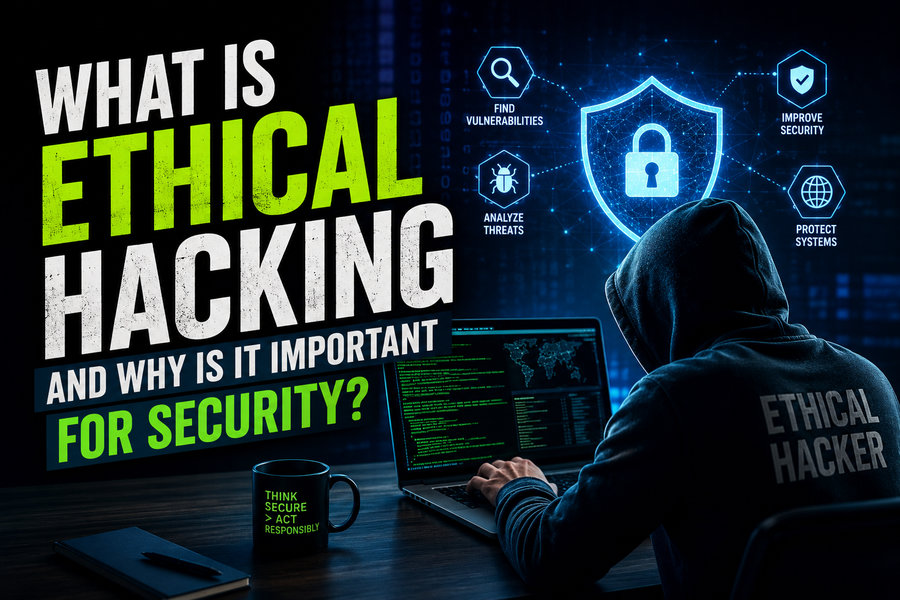

Modern organizations depend on digital systems for nearly everything: banking, healthcare, transportation, communication, manufacturing, education, government services, and everyday business operations. As these systems become more connected, the number of opportunities for cyberattacks also increases. 🌐⚠️
Attackers may attempt to steal passwords, access confidential databases, disrupt services, exploit software vulnerabilities, or deceive employees into revealing sensitive information. Defending against these threats requires more than installing antivirus software or configuring a firewall.
Organizations also need to understand how an attacker might try to break in.
That is where ethical hacking becomes valuable.
Ethical hacking is the authorized practice of testing computer systems, networks, applications, and security controls to identify weaknesses before malicious attackers can exploit them. Ethical hackers use many of the same problem-solving techniques as cybercriminals, but they operate with permission, defined rules, and the goal of improving security. 🧑💻🛡️
Rather than asking, “Can our security system theoretically work?”, ethical hacking asks a more practical question:
“What could an attacker actually accomplish against this system?”
🧑💻 What Is Ethical Hacking?
Ethical hacking is a form of authorized security testing.
An ethical hacker, sometimes called a white-hat hacker, examines an organization’s technology for vulnerabilities and reports those weaknesses so they can be fixed.
Testing may involve areas such as:
- Web applications 🌐
- Corporate networks
- Cloud infrastructure ☁️
- Mobile applications 📱
- Wireless systems 📡
- Servers and endpoints
- Authentication systems 🔑
- Security configurations
- Employee security processes
The key distinction is authorization.
A person probing a system without permission may be committing an illegal or harmful act, even if they claim they were merely curious.
An ethical hacker works within an agreed scope and follows legal, contractual, and professional requirements.
⚖️ Ethical Hacking vs. Malicious Hacking
Ethical hackers and cybercriminals may both study vulnerabilities, but their purpose and authorization are completely different.
| Ethical Hacking 🛡️ | Malicious Hacking 🚨 |
|---|---|
| Performed with authorization | Performed without permission |
| Intended to improve security | Intended to exploit or damage |
| Works within defined scope | Ignores organizational boundaries |
| Reports discovered vulnerabilities | Often hides activity |
| Protects data | May steal or destroy data |
| Follows legal agreements | May violate laws |
This distinction is crucial.
Security knowledge itself is not inherently good or bad. Its impact depends heavily on how and why that knowledge is used.
🔍 Why Organizations Need Ethical Hackers
Cybersecurity systems can look secure on paper while still containing unexpected weaknesses.
A company might have:
🔐 Strong passwords
🧱 Firewalls
🛡️ Endpoint protection
☁️ Cloud security tools
📡 Network monitoring
Yet a single forgotten server, exposed configuration, outdated application, or weak access control could create an opening.
Ethical hackers search for these gaps.
Their role is similar to hiring someone to test whether a building’s security measures actually work.
Instead of simply checking whether doors have locks, the tester asks whether the locks, alarms, access cards, cameras, and security procedures can collectively prevent unauthorized entry.
🧩 1. Finding Vulnerabilities Before Criminals Do
One of the primary goals of ethical hacking is vulnerability discovery.
Software is extremely complex.
Modern applications may contain millions of lines of code and depend on:
- Operating systems
- Cloud services
- Open-source libraries
- Databases
- APIs
- Third-party services
A weakness in any of these components could potentially create security problems.
Ethical hackers help identify issues such as:
- Incorrect access controls
- Weak authentication
- Poor security configuration
- Unpatched software
- Insecure application logic
- Excessive permissions
Finding these problems before criminals discover them gives organizations time to fix the issue.
This is sometimes described as reducing the attack surface. 🛡️
🧱 2. Testing Whether Security Controls Actually Work
Organizations invest heavily in security technology.
But installing security tools does not automatically guarantee protection.
For example, a company may have a firewall configured incorrectly.
A monitoring system may generate alerts that nobody investigates.
An identity system may provide users with more privileges than they need.
Ethical testing evaluates whether the organization’s defenses work together effectively.
This might reveal that:
⚠️ A security control is misconfigured
⚠️ An alerting system misses important activity
⚠️ Access permissions are excessive
⚠️ A process can be bypassed
The result allows defenders to strengthen the overall security architecture.
🎯 3. Penetration Testing
One common form of ethical hacking is penetration testing, often called a pen test.
A penetration test is a controlled attempt to determine whether identified weaknesses could realistically create security consequences.
Rather than simply listing vulnerabilities, the tester evaluates what those weaknesses could mean to the organization.
For example, a security assessment may determine whether a weakness could potentially expose:
📂 Sensitive files
👤 User accounts
💳 Financial information
🧾 Customer records
Penetration tests are performed within carefully defined boundaries.
Organizations typically establish:
- Which systems may be tested
- When testing can occur
- Which techniques are permitted
- Which systems are off-limits
- How sensitive data must be handled
- Who should be contacted during emergencies
This agreement is often known as the rules of engagement.
🗺️ 4. Understanding the Ethical Hacking Process
Although individual assessments differ, ethical hacking generally follows several broad stages.
📋 Planning and Authorization
Before testing begins, the organization defines the purpose and scope.
This stage is critical because ethical hacking without clear permission can create legal and operational problems.
🔎 Security Assessment
The tester examines the permitted environment for potential weaknesses.
This may include reviewing configurations, applications, network architecture, authentication controls, and exposed services.
🧪 Controlled Validation
Potential weaknesses may be carefully validated to determine whether they represent genuine security risks.
Testing should avoid unnecessary damage or disruption.
📊 Risk Analysis
The ethical hacker evaluates the possible consequences.
A small technical issue may have little practical impact, while another could potentially expose critical business information.
📝 Reporting
The tester produces a report explaining:
- What vulnerabilities were discovered
- Why they matter
- How serious they are
- What systems are affected
- How they can be fixed
The reporting stage is one of the most important parts of professional ethical hacking.
Finding a weakness is useful only if defenders understand how to address it.
🚦 5. Vulnerability Scanning vs. Ethical Hacking
Automated vulnerability scanners are valuable cybersecurity tools.
They can identify known software vulnerabilities, configuration problems, and missing security patches.
However, automated scanning and ethical hacking are not identical.
A scanner might say:
“This system appears to contain a known vulnerability.”
An experienced security tester may ask:
“Does this weakness actually create meaningful risk in this particular environment?”
Human judgment is especially valuable for identifying:
🧠 Logical security weaknesses
🔗 Combinations of small vulnerabilities
👥 Permission problems
📋 Process failures
Automation can analyze enormous quantities of information quickly, while humans can understand context.
Modern cybersecurity usually benefits from both.
🌐 6. Web Application Security Testing
Web applications are common targets for attackers because they are often publicly accessible.
Online banking platforms, shopping sites, customer portals, and business applications all process valuable information.
Ethical hackers evaluate web applications for common categories of security weakness such as:
- Poor authentication
- Incorrect authorization
- Weak session management
- Unsafe input handling
- Sensitive data exposure
- Insecure configurations
The goal is to determine whether unauthorized users could access information or functionality they should not have.
Because web applications constantly change, security testing is often performed repeatedly throughout the software development lifecycle.
☁️ 7. Cloud Security Testing
Modern companies increasingly run systems on cloud platforms.
Cloud computing provides flexibility and scalability, but configuration mistakes can expose sensitive data.
For example, organizations may accidentally create:
📂 Publicly accessible storage
🔑 Excessive account permissions
🌐 Unnecessary internet exposure
🛡️ Weak identity controls
Ethical cloud-security testing examines whether an organization’s cloud environment follows appropriate security principles.
One particularly important principle is least privilege.
Least privilege means users and systems should receive only the permissions necessary to perform their tasks.
Reducing unnecessary privileges limits what an attacker could do if an account becomes compromised.
📱 8. Mobile Application Security
Smartphones contain enormous amounts of sensitive information.
Mobile apps may handle:
💳 Payments
🏦 Banking
🩺 Medical information
📍 Location data
💬 Private communications
Ethical security testing can evaluate how mobile applications store data, communicate with servers, manage user authentication, and protect sensitive information.
Security becomes particularly important when applications interact with financial or healthcare systems.
📡 9. Wireless Security
Wireless networks allow devices to communicate without physical cables.
That convenience introduces additional security considerations.
Organizations need to protect:
- Wi-Fi networks
- Wireless authentication
- Connected devices
- Guest networks
- Internet of Things systems
Ethical testing can help determine whether unauthorized devices could gain access to systems or whether wireless infrastructure is configured according to security best practices.
🧠 10. Social Engineering Assessments
Not every cyberattack targets software.
Attackers frequently target people.
This is known as social engineering.
A criminal might impersonate:
🏦 A bank
🧑💼 An executive
🛠️ IT support
📦 A delivery company
and attempt to persuade someone to reveal confidential information.
Organizations sometimes conduct carefully controlled social-engineering simulations to test employee awareness.
For example, a company may run an authorized phishing simulation to measure whether employees recognize suspicious messages.
The objective should be education and security improvement—not humiliation or punishment.
Successful programs use the results to improve:
📚 Training
📧 Email defenses
🚨 Reporting procedures
🔐 Authentication controls
🔑 11. Password Security and Authentication
Passwords remain a frequent security weakness.
Users may reuse passwords across multiple services or choose credentials that are easy to guess.
Ethical security assessments can evaluate whether authentication controls are strong enough.
Modern organizations increasingly use multi-factor authentication (MFA).
MFA requires more than one form of verification.
For example:
Password + security key
or:
Password + authenticator application
Even if an attacker obtains the password, the additional authentication factor can make account takeover much more difficult. 🔐
🔴 12. Red Teams and Blue Teams
Cybersecurity exercises sometimes divide participants into different roles.
🔴 Red Team
The red team simulates realistic adversarial behavior within an authorized environment.
Its goal is to test whether the organization can detect and respond to sophisticated attacks.
🔵 Blue Team
The blue team is responsible for defense.
It may monitor:
- Security alerts
- Network activity
- Authentication logs
- Endpoint events
- Incident reports
The blue team’s objective is to identify, contain, and respond to suspicious activity.
🟣 Purple Team
A purple team approach encourages collaboration between offensive and defensive teams.
Instead of simply trying to defeat one another, participants share knowledge.
This allows the organization to improve detection and response much faster.
🚨 13. Ethical Hacking Helps Improve Incident Response
Preventing every cyberattack is unrealistic.
Organizations also need to know what to do when a breach occurs.
Ethical hacking exercises can expose weaknesses in incident-response processes.
For example:
How quickly does the security team detect suspicious activity?
Who receives the alert?
Can compromised accounts be disabled quickly?
Are backups available?
Can affected systems be isolated?
These exercises allow organizations to improve emergency procedures before a real attack occurs. 🚨
💰 14. Data Breaches Can Be Extremely Expensive
A major cybersecurity incident can cause significant financial damage.
Potential costs include:
💰 Incident investigation
⚖️ Legal expenses
📉 Business interruption
🛠️ System restoration
👥 Customer notification
🏛️ Regulatory penalties
There may also be reputational consequences.
Customers may lose trust in a company that fails to protect their information.
Ethical hacking can help organizations reduce these risks by discovering weaknesses before they turn into costly security incidents.
🏥 15. Ethical Hacking Protects Critical Infrastructure
Cybersecurity is not only about websites and business databases.
Modern infrastructure increasingly depends on digital control systems.
Examples include:
⚡ Electrical grids
🚰 Water systems
🏥 Hospitals
🚆 Transportation
🏭 Manufacturing
📡 Telecommunications
A successful cyberattack against these systems could affect physical operations.
Security testing for critical infrastructure therefore requires exceptional caution.
Testing must be carefully coordinated because disruption could have serious real-world consequences.
🐞 Bug Bounty Programs
Some organizations invite independent researchers to report security vulnerabilities through bug bounty programs.
A company defines which systems researchers are permitted to test and establishes rules for responsible reporting.
Researchers who identify valid vulnerabilities may receive:
💰 Financial rewards
🏆 Recognition
📜 Professional reputation
Bug bounty programs allow organizations to benefit from the knowledge of a large global community of security researchers.
However, participants must follow the program’s defined scope and legal requirements.
🧑⚖️ Responsible Disclosure
Imagine a researcher discovers a serious vulnerability.
Publishing every technical detail immediately could give criminals an opportunity to exploit the problem before the organization fixes it.
Responsible disclosure generally involves notifying the affected organization and giving defenders an opportunity to address the vulnerability.
Coordinated disclosure helps balance:
🔍 Security research
🛡️ User protection
📢 Public transparency
The exact process depends on the organization and vulnerability.
📜 Legal and Ethical Boundaries
Ethical hacking depends heavily on boundaries.
Professional testers should understand:
⚖️ Authorization
📋 Scope
🔐 Confidentiality
🧾 Documentation
🌍 Applicable law
Permission to test one system does not automatically grant permission to test connected systems.
Similarly, gaining access to sensitive information during an authorized assessment does not mean the tester is free to use or distribute that information.
Trust is fundamental to professional security testing.
🎓 Skills Ethical Hackers Need
Ethical hacking is a multidisciplinary field.
Professionals often study:
🌐 Networking
💻 Operating systems
🧑💻 Programming
☁️ Cloud computing
🔐 Cryptography
🌍 Web technologies
📡 Wireless systems
🛡️ Defensive security
They also need nontechnical skills.
A highly skilled tester who cannot clearly explain risks may not provide much value to business leaders.
Strong ethical hackers therefore also develop:
📝 Reporting skills
🧠 Analytical thinking
🗣️ Communication
⚖️ Professional judgment
🤖 Artificial Intelligence and Ethical Hacking
Artificial intelligence is increasingly influencing cybersecurity.
Defenders can use AI to analyze large amounts of security information and identify unusual behavior.
Security professionals may use AI-assisted tools for:
📊 Log analysis
🔎 Pattern detection
🧩 Vulnerability prioritization
🚨 Threat detection
Attackers may also use AI to automate scams, generate convincing phishing messages, or analyze exposed systems.
This creates an ongoing competition between offensive and defensive technologies.
Human expertise remains important because cybersecurity involves context, judgment, and rapidly changing threats.
🧠 Why Ethical Hacking Is So Important
The basic philosophy behind ethical hacking is straightforward:
It is better to discover a weakness during an authorized test than during a real cyberattack.
Ethical hacking gives organizations evidence about how well their defenses actually perform.
It can reveal weaknesses that automated tools, compliance checklists, or routine audits may overlook.
More importantly, it helps organizations improve before an incident occurs.
Security becomes proactive rather than purely reactive.
🏁 Final Thoughts
Ethical hacking is the authorized practice of examining digital systems from an attacker’s perspective in order to make those systems safer. 🛡️💻
Ethical hackers test networks, applications, cloud environments, authentication systems, and security processes to identify weaknesses before malicious attackers can take advantage of them.
Their work can help organizations:
✅ Discover vulnerabilities
✅ Validate security controls
✅ Improve incident response
✅ Protect sensitive data
✅ Strengthen employee awareness
✅ Reduce financial and operational risk
✅ Improve overall cyber resilience
Ethical hacking does not guarantee perfect security. No organization can completely eliminate cyber risk.
Instead, it provides something extremely valuable: a realistic way to test assumptions.
A company may believe its defenses are strong. Ethical security testing helps determine whether that belief is supported by evidence.
As businesses, governments, hospitals, transportation networks, and critical infrastructure become increasingly digital, ethical hackers will continue to play an important role in protecting the systems society depends on every day. 🔐🌐🛡️