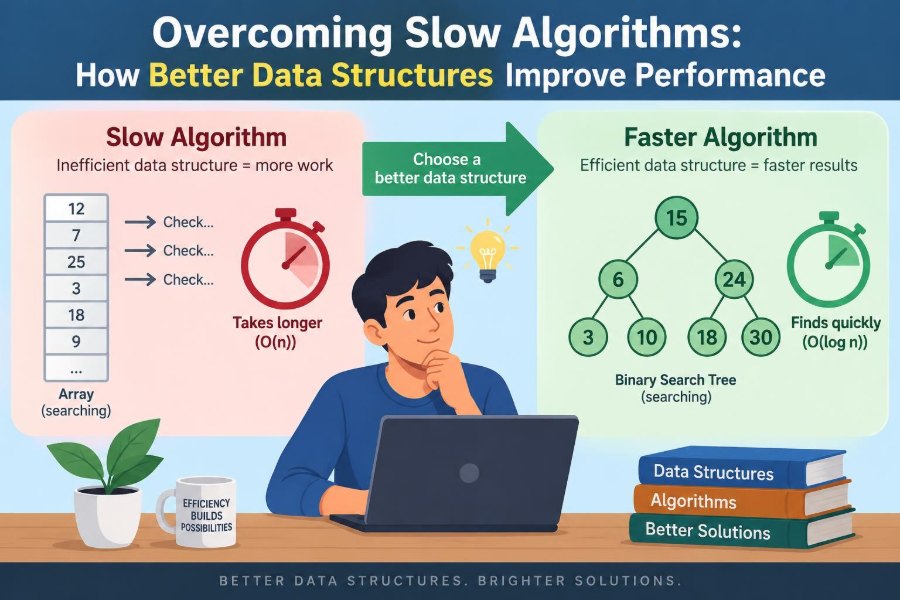

A program can feel perfectly fine with a few hundred records. Then the dataset grows, a feature becomes popular, or several people use the system at once—and a once-instant search starts pausing.
This is a familiar moment for students building projects and professionals maintaining real software. The first instinct is often to blame the language, database, server, or computer. Sometimes that diagnosis is right. Often, though, the program is spending time doing avoidable work.
The work may be hidden inside an innocent-looking loop: repeatedly searching a list, inserting at its beginning, checking for duplicates, or sorting data that only needs a single answer. A better data structure can change the amount of work required before any hardware upgrade is considered.
Learning to connect algorithms with data structures is therefore less about memorizing definitions and more about recognizing patterns. It helps you design programs that continue to behave well as their inputs grow.
🐢 When “Fast Enough” Stops Being Fast
Performance problems commonly appear at a scale boundary: more users, more files, more events, or more requests than the original code anticipated. An operation that takes a tiny amount of time once can become costly when repeated thousands or millions of times.
Imagine a contact application that stores names in an unsorted list. Finding one name requires checking entries one by one in the worst case. That is acceptable for a small personal list; it is a poor fit for a large directory queried repeatedly.
🧩 Algorithms and Data Structures Work Together
An algorithm is a procedure for solving a problem. A data structure is a way of organizing data so operations can be performed efficiently. They are inseparable in practice.
Searching is not just “searching.” Searching an unsorted array, a sorted array, a hash table, and a balanced tree involves different procedures and costs. Choosing a data structure determines which algorithms are practical.
📏 Measuring Growth with Big O
Big O notation describes how an algorithm’s work grows as input size, usually written as n, grows. It does not predict an exact runtime in seconds; machine speed, implementation details, and input shape still matter.
Its value is comparative. If one approach grows linearly and another grows logarithmically, the difference becomes increasingly meaningful for large inputs, even when the smaller input makes both appear quick.
🔢 The Most Useful Complexity Patterns
| Complexity | Typical meaning | Example |
|---|---|---|
O(1) |
Does not grow with the number of items | Looking up a key in a well-functioning hash table |
O(log n) |
Growth is very gradual | Binary search in sorted data |
O(n) |
Work grows roughly with the input | Scanning a list once |
O(n log n) |
Common efficient sorting cost | Merge sort or heap sort |
O(n²) |
Often comes from comparing many pairs | Nested duplicate checks |
These categories are models, not verdicts. An O(n) scan over a tiny array may outperform a more elaborate structure because it has low overhead and good memory locality.
🔍 Linear Search and Its Hidden Repetition
Linear search checks items in sequence until it finds a match or reaches the end. It is simple, requires no preparation, and is often the right choice for short collections or one-off work.
The trouble begins when a linear search is placed inside another loop. If 10,000 incoming records each search a 10,000-item list, the program may make on the order of 100 million comparisons. The individual search is understandable; the repeated pattern is expensive.
📚 Arrays Are Excellent at Indexed Access
An array stores elements in an ordered, contiguous sequence in many common implementations. Accessing the item at a known position, such as scores[500], is typically O(1).
Arrays are a strong choice when order matters, positions are known, and most work involves reading or appending. They are less attractive when a program frequently inserts or removes near the front or middle, because later elements may need to shift.
↔️ The Cost of Shifting Array Elements
Suppose a task queue is represented by an array and the program removes the first task each time. Every remaining task may need to move one position left. One removal can cost O(n).
For an occasional removal this may not matter. For a busy queue, use a structure designed for both ends, such as a deque, or keep a moving front index when the language and memory-management rules make that approach safe.
🔗 Linked Lists Trade Access for Flexible Links
A linked list stores each element as a node that points to another node. Given the node at the insertion point, adding or removing a nearby node can be efficient because values do not need to shift.
But finding the 500th node requires following links from the beginning, making indexed access O(n). Linked lists also carry pointer overhead and may use memory less predictably. They are a tool for particular update patterns, not a universal array replacement.
📦 Stacks Simplify Last-In, First-Out Work
A stack follows last in, first out order. The latest item added is the first item removed. Common examples include undo histories, expression evaluation, and tracking function calls.
When the problem naturally asks for “the most recent unfinished item,” a stack avoids searching or reordering a general list. Push and pop operations are commonly constant time.
🚶 Queues Match First-In, First-Out Workflows
A queue processes the oldest waiting item first. Print jobs, customer support tasks, breadth-first graph traversal, and background work often have this shape.
Using a proper queue communicates intent and prevents inefficient front removals from a plain array. Some standard libraries provide a queue directly; others offer a deque, which supports efficient operations at both ends.
🗂️ Hash Tables Turn Keys into Direct Access
A hash table stores values under keys such as a user ID, email address, or product code. A hash function maps the key to a location, allowing lookup, insertion, and deletion to be expected O(1) in typical conditions.
For example, checking whether an email has already appeared is much better expressed as membership in a set than as a repeated scan through prior emails. A dictionary or map similarly makes “find the record for this ID” explicit.
🎯 Sets Eliminate Repeated Duplicate Checks
A set stores unique values. It is ideal when the key question is membership: has this visitor been seen, is this permission present, or does this word already occur?
Consider deduplicating a list of tags. A nested-loop approach compares each tag against many earlier tags. Inserting into a hash-based set as you read the list usually reduces the task from quadratic behavior to expected linear behavior overall.
⚠️ Hash Tables Have Assumptions
Hash table performance depends on a suitable hash function, sensible resizing, and reasonably distributed keys. Different keys can map to the same location; this is called a collision, and implementations resolve it using techniques such as chaining or probing.
In pathological cases, lookup can degrade. Also, hash tables generally do not keep keys in sorted order. Choose them for rapid keyed access, not when ordered traversal or range queries are the primary need.
🌳 Trees Preserve Order While Supporting Search
A binary search tree stores smaller keys on one side of a node and larger keys on the other. This ordering supports searching, insertion, and ordered traversal without sorting the entire collection after every change.
If the tree remains balanced, its height is proportional to log n, so major operations are typically O(log n). Balanced-tree variants are useful when you need ordered keys, nearest values, or ranges such as all timestamps within an interval.
🌲 Why Balance Matters in a Tree
A plain binary search tree can become lopsided. Inserting already sorted values into an unlucky implementation may create a chain of nodes, which behaves much like a list and loses logarithmic performance.
Self-balancing trees perform controlled restructuring to prevent this extreme shape. They add implementation complexity, but many language libraries expose ordered maps or sets that provide balancing internally.
🧭 Heaps Prioritize the Next Best Item
A heap is a partially ordered tree structure designed to quickly reveal its smallest or largest item. It is not fully sorted, and it does not need to be.
A priority queue built on a heap is useful for scheduling: process the most urgent task, the earliest deadline, or the lowest-cost next route. Adding an item and removing the top priority are commonly O(log n), while inspecting the top is commonly O(1).
🕸️ Graphs Model Relationships, Not Just Lists
A graph represents entities as vertices and connections as edges. Roads between places, dependencies between tasks, and follows between accounts are all relationship problems that fit this model.
For a sparse graph, an adjacency list records only existing connections and is often memory-efficient. An adjacency matrix makes checking a possible edge very fast, but can consume substantial space when most possible connections do not exist.
🛣️ Breadth-First Search Needs a Queue
Breadth-first search explores a graph level by level. Starting from one vertex, it visits all immediate neighbors before moving farther away. In an unweighted graph, this makes it suitable for finding a path with the fewest edges.
The queue is central: discovered vertices wait in first-in, first-out order. Replacing it with an arbitrary list and repeatedly searching for the next item can undermine both clarity and performance.
🔤 Sorting Once Can Improve Many Searches
When data is sorted, binary search repeatedly discards half of the remaining search range. Its search cost is O(log n), far better than scanning a large static collection.
Sorting itself costs work, commonly O(n log n). The trade-off makes sense when the data changes rarely and will be searched many times. If records change constantly, maintaining a sorted array may cost more than a hash table or tree alternative.
🧮 Avoid Sorting When You Need Only One Answer
Sorting is often used out of habit. To find the smallest value, scan once and retain the best value seen so far: O(n), not the higher cost of sorting first.
To find the largest few items, a bounded heap can be preferable to sorting every item. The question should guide the operation: complete order, a single extreme, membership, or top priorities are different requirements.
🔁 Nested Loops Are a Signal, Not a Crime
Two loops do not automatically mean bad performance. A small image grid, a fixed-size table, or a problem that genuinely requires examining pairs may need nested iteration.
They are a useful review signal. Ask whether the inner loop is doing a lookup that could be replaced by a set, map, index, or precomputed result. This question often reveals the most valuable redesign.
🧠 Memoization Avoids Solving the Same Subproblem
Memoization stores the result of a function call so later calls with the same inputs can reuse it. It is especially useful in recursive algorithms with overlapping subproblems, such as calculating values from many repeated smaller states.
The cache itself is usually a map. Memoization trades memory for time, so it needs boundaries: cache keys must be correct, stale data must not be reused, and unbounded caches can create memory pressure.
🧾 Indexes Are Data Structures for Retrieval
Databases use indexes for the same reason programs use maps and trees: scanning every row for every query does not scale well. An index stores an additional access path for selected columns.
Indexes speed appropriate reads but make writes more expensive because the index must also be updated. Creating an index for every column is not a free improvement; it should reflect real query patterns and be validated with the database’s query tools.
💾 Memory Locality Can Change the Practical Result
Big O intentionally ignores many machine-level details. One major detail is memory locality: data stored close together is often faster for modern processors to read because it works well with caches.
That is why an array scan can be impressively fast and why a theoretically elegant pointer-heavy structure can disappoint in a real benchmark. Complexity narrows the choices; measurement resolves close calls.
⏱️ Measure the Real Bottleneck First
Do not optimize based only on a suspicion. Profile the program, inspect request traces, or time representative operations to identify where time and memory are actually spent.
Use realistic input sizes and shapes. A test with random data may miss a slow case caused by sorted input, repeated keys, long strings, or a highly connected graph. Measure before and after a change, and verify that behavior remains correct.
🧪 Build Small Experiments Before a Rewrite
If a data structure change is uncertain, isolate the operation in a small experiment. Generate representative data, run the old and proposed approaches, and compare runtime, memory use, and code complexity.
This is not merely about finding a winner. It exposes assumptions: perhaps lookups are rare, perhaps order is essential, or perhaps the new structure’s setup cost outweighs its advantage at the actual scale.
🧰 A Practical Selection Checklist
Before selecting a structure, describe the operations rather than naming a favorite container. Useful questions include:
- Do you mostly access by position, by key, or by priority?
- Must items remain in insertion order or sorted order?
- Are reads far more common than updates?
- Do you need uniqueness, range queries, or fast membership checks?
- How large can the collection become, and what inputs are realistic?
- What memory budget and library guarantees apply?
A clear answer often points directly to an array, queue, hash-based collection, ordered tree, heap, or graph representation.
🚫 Common “Fixes” That Miss the Problem
Upgrading hardware can reduce elapsed time, but it does not repair an algorithm whose work grows too quickly. The same applies to micro-optimizing syntax while leaving an accidental quadratic loop untouched.
Another mistake is replacing every list with a hash table. You may lose ordering, add memory overhead, or make iteration less predictable. Better performance comes from matching operations to structure, not from treating one structure as inherently superior.
🧱 Keep Correctness and Maintainability in View
A faster structure is only an improvement if the program still produces correct results. Mutable keys, duplicate definitions, ordering expectations, thread safety, and error handling can all affect the choice.
Prefer well-tested standard-library collections unless there is a demonstrated need for a custom implementation. Clear names and small interfaces also help future maintainers understand why a queue, set, or priority queue was chosen.
📈 Design for Likely Growth, Not Imaginary Extremes
Premature complexity can make a simple program harder to test and change. A linear scan over a small, bounded collection may be completely appropriate.
At the same time, know which dimensions can grow without a firm limit: users, transactions, events, files, or graph connections. Put attention where repeated operations meet unbounded growth, and document assumptions that make a simpler approach safe.
🎯 The Core Principle: Reduce Unnecessary Work
Better performance usually comes from asking less of the computer, not merely asking it to work faster. A set avoids rescanning for membership, a map avoids hunting for a known key, a heap avoids fully sorting priorities, and an index avoids reading irrelevant records.
The best choice depends on the operations, data size, update frequency, ordering requirements, memory behavior, and the guarantees offered by your platform. Big O provides a vocabulary for reasoning; profiling and realistic tests keep that reasoning grounded.
When a program slows down, look for repeated work and choose a data structure that makes the required operation natural, direct, and proportionate to the problem. That habit turns performance tuning from guesswork into design. 💻⚙️📈