
You open a banking app, transfer money, and expect the new balance to appear everywhere immediately. A customer in another city refreshes an online store and expects to see the same inventory count your warehouse sees. A team edits a shared document and assumes nobody’s changes will disappear.
These expectations feel ordinary because modern software hides an enormous amount of coordination. Behind a familiar screen, the same data may be stored on machines in different buildings, regions, or continents.
Most of the time, those machines communicate quickly enough that the system feels like one database. But networks can slow down, drop messages, or split groups of machines apart. When that happens, a distributed database has to make a difficult choice.
The CAP theorem gives us a compact way to understand that choice. It does not tell engineers that databases are unreliable; it explains why no distributed system can promise every desirable behavior during a network partition.
🧭 The problem CAP helps us describe
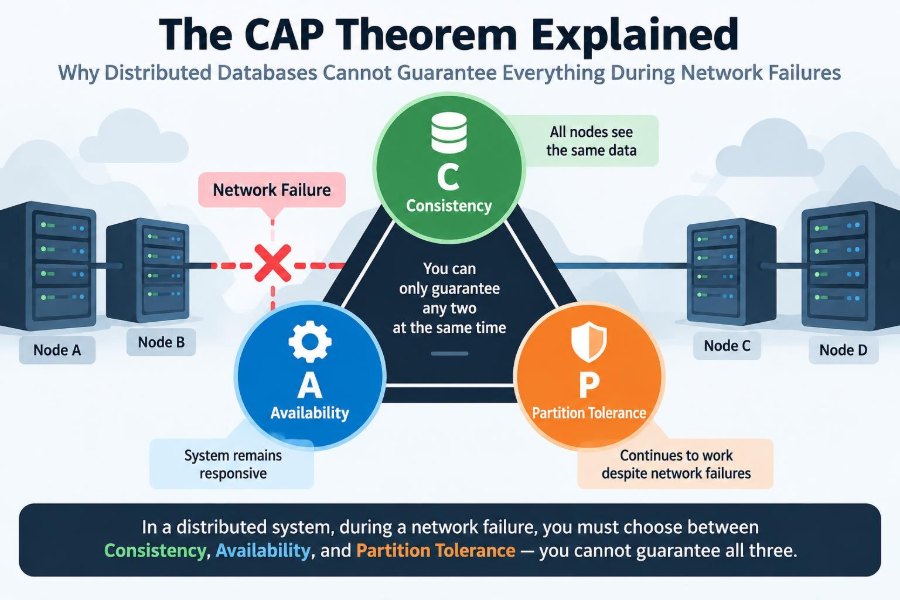
CAP stands for Consistency, Availability, and Partition tolerance. It is a theorem about distributed data systems: systems where multiple computers store or process related data and communicate over a network.
The key word is during. CAP is specifically concerned with what a system can guarantee when communication between parts of the system fails. It is not a general scorecard saying a database permanently has only two of three properties.
When a partition occurs, a system cannot simultaneously guarantee both perfectly consistent answers and an available response to every request. It must favor one of those goals for the affected operations.
🌐 What makes a database distributed?
A single database server can still have bugs, disk failures, and overload. But it does not need to coordinate its latest state with another server before answering a request.
A distributed database keeps copies of data, divides data among machines, or both. This arrangement can improve performance, scale capacity, and keep a service running if one machine or location fails.
Distribution also creates a coordination problem. If two replicas hold the same customer record, how do they agree on a new address, order status, or account balance when messages may be delayed or lost?
📦 Replication creates both resilience and coordination work
Replication means maintaining copies of data on multiple nodes. For example, a service might store an order record in several locations so readers can use a nearby copy and a single machine failure does not erase access to the record.
Copies are useful only if the system has rules for updating them. A write accepted by one replica must eventually reach others, and concurrent writes may need a conflict-resolution process.
This is the underlying tension behind CAP. The very mechanism that improves fault tolerance—multiple independent machines—requires communication to preserve a single shared view of data.
✅ Consistency means one coherent view of data
In CAP, consistency means that every successful read receives the most recent successful write, or an error. A client should not read an older value from one replica after another client has already completed a newer write.
Consider a profile name changed from “Sam Lee” to “Sam Patel.” Under strong consistency, once the update is acknowledged, later reads that the system accepts will not return “Sam Lee.”
This definition differs from “data is valid” or “the database follows constraints.” Those are also important ideas, but they are not what the C in CAP specifically means.
🧾 CAP consistency is not ACID consistency
Students often confuse CAP consistency with the C in ACID, a set of transaction properties. ACID consistency generally concerns whether a transaction moves data between valid states according to rules such as uniqueness checks, foreign keys, or balance constraints.
CAP consistency concerns the visibility and ordering of writes across replicas. A system can enforce some business rules while allowing a replica to temporarily return an older value, depending on its design.
When evaluating a product or architecture, ask which meaning is being used. “Consistent” without context is too vague to guide a design decision.
📬 Availability means every reachable node responds
In CAP, availability means that every request received by a non-failing node gets a non-error response. The response may not contain the newest globally known value, but the system does not simply refuse the request while waiting forever for an unreachable peer.
This is narrower than everyday claims such as “99.9% uptime.” Operational uptime measures can include planned maintenance, application bugs, capacity limits, and many other causes of failed requests.
CAP availability is about a system’s behavior when parts of it cannot communicate. A node on one side of a split must decide whether to serve a request using the information it currently has.
✂️ Partition tolerance means surviving a communication split
A network partition occurs when nodes cannot reliably exchange messages even though they may still be running. The network may be physically broken, routers may be misconfigured, packets may be dropped, or a cloud connectivity path may fail.
Imagine two data centers, East and West, each serving users. If East and West can no longer talk to each other, each may still receive requests from its local users. That is a partition.
Partition tolerance means the system continues operating according to a defined policy despite that lost communication. It does not mean the partition is harmless or that every function remains available.
🔺 Why the familiar “pick any two” slogan misleads
CAP is often summarized as “pick two of three.” That shortcut is memorable, but it leads people to believe a distributed database can simply choose Consistency and Availability while ignoring partitions.
Real networks can partition. Engineers cannot vote network failures out of existence. For a system spread across unreliable communication paths, partition tolerance is usually a condition it must handle, not an optional feature.
The meaningful choice during a partition is usually between consistency and availability. Either reject or delay some requests to avoid returning conflicting information, or answer requests despite the risk that answers are temporarily stale or conflicting.
🚦 The central trade-off during a partition
Suppose an inventory item has one remaining unit. During a network split, the East site and West site both receive an order request. Neither can ask the other whether the item has already been sold.
A consistency-oriented design may refuse one or both orders until communication returns or a quorum can be reached. This avoids confirming two sales of the final unit, but some customers receive an error or delay.
An availability-oriented design may accept orders in both places. Customers get responses, but the business may later need to resolve an oversell. Neither answer is universally right; the acceptable cost depends on the operation.
🧱 A CP system protects agreement first
A system described as CP prioritizes consistency and partition tolerance. When it cannot safely confirm that replicas agree, it may reject, redirect, or time out requests rather than risk acknowledging conflicting state.
For example, a strongly coordinated service may require a majority of replicas to participate before committing a write. If too few replicas are reachable, it stops accepting certain changes.
CP behavior is often appropriate when an incorrect answer is more harmful than a temporary refusal. Leadership election, account ownership, and unique identifier assignment are common examples where conflicting decisions can cause serious trouble.
📣 An AP system keeps answering requests
A system described as AP prioritizes availability and partition tolerance. Nodes on both sides of a split continue serving requests using their local state.
Different replicas can therefore temporarily diverge. After communication returns, the system exchanges changes and applies a conflict-resolution rule, automated merge process, or manual workflow.
This can work well when temporary disagreement is tolerable. A social feed showing a post a little late, a product catalog update reaching regions gradually, or a “like” count briefly differing across screens may be acceptable.
⏳ Why CA is not a practical partition strategy
A CA description can make sense for a system that assumes reliable communication within a tightly controlled setting, or for a non-distributed database. It can offer consistency and availability while no partition exists.
But if a genuine partition happens in a distributed system, it cannot preserve both guarantees. If it continues answering independently everywhere, it can lose CAP consistency; if it waits for unreachable peers, it loses CAP availability.
So “CA database” is not a useful promise that a multi-node service will remain consistent and available through network failure. The failure case is exactly where the theorem applies.
🗳️ Quorums provide a practical coordination pattern
Many distributed systems use quorums: a required number of replicas that must participate in a read or write. A common arrangement requires acknowledgments from a majority before a write is considered committed.
Majorities overlap. If more than half of replicas confirm a write, another majority cannot be completely separate from the first. That overlapping node can help preserve knowledge of the latest committed value.
Quorums do not eliminate failures or make latency free. They are a technique for making coordination possible while tolerating some node failures, often at the cost of waiting for multiple machines.
👑 Leader-based replication narrows the write path
Some systems appoint one replica as a leader for a group of records. Clients send writes to that leader, which orders changes and replicates them to followers.
This reduces the chance that two nodes independently make incompatible decisions under normal conditions. However, a partition can separate the leader from enough followers, or make nodes uncertain about who the current leader is.
Safe systems use election and quorum rules to prevent two legitimate leaders from committing conflicting histories. During uncertainty, they may temporarily stop writes, an example of consistency taking priority over availability.
🔄 Eventual consistency is a convergence promise
Eventual consistency means that if updates stop and replicas can communicate again, they will converge toward the same value. It does not mean every read immediately sees every write.
That delay can be tiny under normal conditions or longer during disruption. Applications must be designed with the possibility that a user writes data and then briefly reads an older replica.
Eventual consistency is not automatically careless design. It is a deliberate model that can deliver responsiveness and geographic reach when the domain can tolerate temporary differences.
🧩 Conflict resolution needs a business rule
When independent nodes accept conflicting changes, a system needs a way to reconcile them. A simple rule might select the update with the latest timestamp, though clocks and network timing make “latest” less straightforward than it sounds.
Other approaches merge fields, preserve multiple versions, or use data structures designed for concurrent edits. For a shopping cart, combining independently added items may be sensible. For a bank transfer, blindly merging competing debits is not.
The database cannot infer the business meaning of every conflict. Conflict resolution is partly a product decision: which outcome is least harmful, visible, and recoverable for users?
🧠 A helpful analogy: teams with a broken phone line
Picture two branch offices sharing a paper ledger, but their phone line fails. A customer visits each office and asks whether a scarce reservation slot is available.
If each office must give the same answer, one office may have to stop making reservations until the line is restored. If each office must keep serving customers, both may make reservations based on incomplete information.
CAP does not say one office is poorly run. It says the broken line prevents them from instantly coordinating, so the organization must choose a policy for that situation.
💳 Not every operation needs the same guarantee
A common mistake is choosing one consistency model for an entire application because one table or feature needs strong coordination. Real systems often classify operations by risk.
A payment authorization, a seat assignment, and a password reset may require strict handling. A view counter, cached recommendation, or presence indicator can often tolerate delayed propagation.
This approach avoids paying the latency and availability cost of strong coordination for data where temporary staleness has little practical consequence.
🛒 Example: inventory has more than one correct policy
Inventory sounds like an obvious CP case, but the right design depends on the promise being made. A retailer might reserve stock only after a coordinated checkout step, while allowing product pages to show a slightly delayed approximate count.
Another business may accept orders beyond immediate stock knowledge and fulfill them later, substituting items or notifying customers of a delay. In that case, availability may be more valuable than exact real-time display.
The technical choice follows the operational policy. CAP cannot decide whether an oversell, a delayed order, or a rejected checkout is least costly for a particular business.
🧑🤝🧑 Example: collaborative editing uses layered design
A shared document editor often needs fast local feedback. Waiting for every participant’s device to confirm every keystroke would make typing unpleasant or impossible offline.
Such systems may allow local changes first and later merge concurrent edits using carefully designed synchronization methods. At the same time, they may use stronger coordination for permissions, document ownership, or billing.
This illustrates a broader lesson: a single product can contain several distributed systems with different CAP-related choices.
📡 Latency matters even before a partition
CAP is about partitions, but the same trade-offs influence ordinary performance. A strongly consistent write across distant regions often waits for network round trips, adding delay compared with accepting a local write.
Engineers therefore consider geography, expected traffic, failure modes, and user expectations together. A policy that is correct but noticeably slow can still create a poor experience.
There is no free setting that delivers zero-latency global coordination. Physics and network distance matter even when nothing has failed.
🧪 Network failures are often ambiguous
A difficult fact of distributed computing is that silence has multiple meanings. If node A does not hear from node B, B may have crashed, the message may be delayed, or the network path may be broken.
Timeouts help systems make progress, but a timeout is not proof of failure. A slow response can arrive after another node has already made a decision based on its absence.
This uncertainty explains why partitions are challenging. Nodes must make decisions without a perfect, instantaneous view of which other nodes are alive and what they know.
🧰 CAP is not the whole design conversation
CAP is valuable, but it does not answer every architecture question. It does not directly measure normal-case latency, throughput, storage cost, developer ergonomics, query flexibility, or recovery time.
It also does not say a system is either completely consistent or completely available in every feature. Guarantees can vary by operation, configuration, deployment topology, and the specific type of failure.
Use CAP as a lens for failure behavior, then examine the database’s actual documentation and the application’s required semantics.
📏 PACELC adds a useful second question
A related model, often summarized as PACELC, asks two questions: if there is a partition, choose availability or consistency; else, when the network is healthy, choose between latency and consistency.
The model is useful because everyday operation matters. Some systems offer tunable reads or writes, allowing teams to select faster local responses for some requests and stronger coordination for others.
PACELC is not a replacement for understanding CAP’s formal guarantees. It is a reminder that architecture involves trade-offs both during failure and during normal operation.
🔍 Read database claims with precise questions
Marketing terms such as “highly available,” “globally consistent,” and “conflict-free” can be meaningful, but only with details. Ask what operations receive which guarantees and what happens when replicas cannot communicate.
- Does a successful write require one replica, a quorum, or all replicas?
- Can reads return stale data, and can a client request a stronger read?
- What happens when a region loses connectivity?
- How are concurrent writes detected and resolved?
- Which requests fail or block when a leader or quorum is unavailable?
Specific answers reveal far more than a broad CP or AP label.
🧱 Design around failure boundaries
Good distributed design identifies the boundaries where coordination is truly necessary. Keep tightly coupled invariants small: perhaps one reservation record, one account transfer workflow, or one ownership lease rather than an entire global application state.
Then make less critical information asynchronous where appropriate. Caches, search indexes, analytics pipelines, notification feeds, and reporting views often do not need to block a core transaction.
This separation can reduce both the frequency and the impact of hard CAP choices. It does not remove trade-offs, but it places them where they provide the most value.
🧯 Plan the user experience for degraded mode
A technically correct response is not always a good user experience. If a consistency-first operation cannot proceed, the application should explain that the action could not be confirmed rather than implying success.
If the system serves possibly stale data, label or design around that uncertainty when it matters. For example, a reservation screen may say that availability will be confirmed at the next step instead of presenting a tentative result as final.
Idempotency keys, retry-safe APIs, audit logs, and reconciliation workflows also help when clients retry requests after timeouts. A timeout does not always reveal whether the original operation succeeded.
⚠️ Common misunderstandings to avoid
- “CAP means two properties are always missing.” The forced trade-off appears when a partition occurs.
- “Availability means no downtime ever.” CAP availability is a technical response guarantee for reachable nodes.
- “Eventual consistency means data loss.” It means visibility can lag; durable replication and conflict handling still matter.
- “CP is safer for every feature.” Rejecting requests can create its own business and user costs.
- “AP means no rules.” AP systems require careful merge, validation, and repair strategies.
Precise vocabulary prevents teams from arguing past one another during architecture discussions.
🧭 A practical decision process
Start with the consequence of being wrong. What happens if two locations temporarily disagree: inconvenience, duplicated work, financial loss, safety risk, or a recoverable support task?
Next, ask about the consequence of refusing service. Can users wait, save work locally, try again later, or use a fallback process? The cost of unavailability is as real as the cost of inconsistency.
- Define the invariant or promise users rely on.
- Identify where independent writes could conflict.
- Choose whether the failure policy should reject, queue, accept, or reconcile.
- Test that policy with simulated delays, lost connectivity, retries, and regional failures.
- Document the behavior for developers, operators, and support teams.
🎯 The core takeaway: promises must survive failure
The CAP theorem is not a warning against distributed databases. It is a discipline for describing what a system can honestly promise when its machines cannot communicate.
During a network partition, a distributed system must choose whether to preserve one current, coordinated view of data or continue responding independently to every request. Strong consistency may require refusing some work; high availability may require temporary divergence and later reconciliation.
The best choice depends on the meaning of the data, the harm caused by a wrong answer, the harm caused by a delayed answer, and the recovery process available afterward. CAP becomes useful when it turns vague claims about reliability into explicit, testable behavior.
Distributed systems cannot make communication failures disappear, but thoughtful design can make their trade-offs predictable, appropriate, and understandable to users. 💻🌐🔺