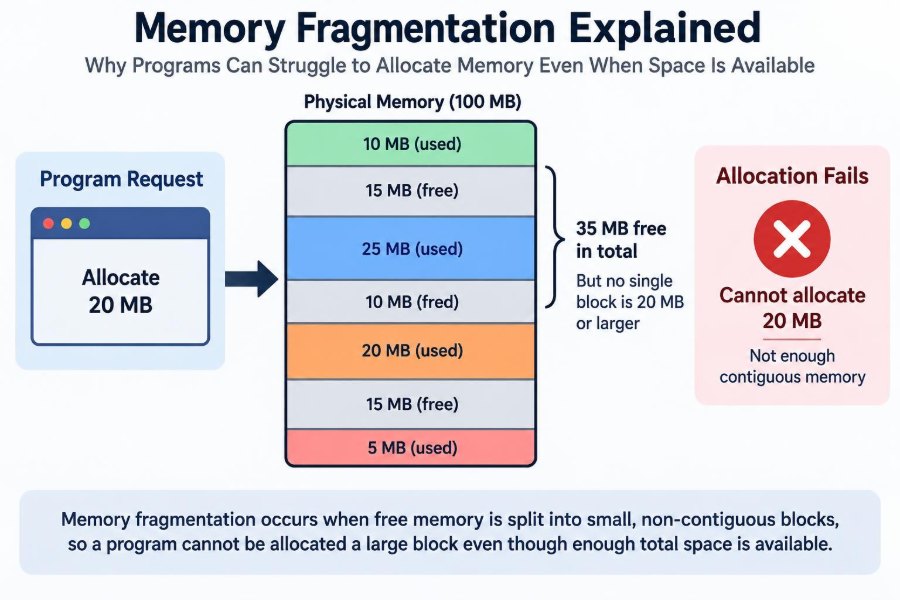

You close a few browser tabs, stop an old application, and check the system monitor. Plenty of memory appears to be free. Yet the program you are using still reports an “out of memory” error or refuses to create a large object.
That situation seems contradictory only if memory is imagined as one undivided pool. In practice, programs constantly request and release chunks of different sizes. Over time, the remaining free space can become scattered in ways that limit what the system can do with it.
This is the central idea behind memory fragmentation. It affects operating systems, language runtimes, embedded devices, databases, graphics software, and long-running services.
Understanding fragmentation helps explain a class of failures that raw “free memory” numbers cannot explain. It also reveals why allocation strategy, object lifetime, and memory layout matter as much as total capacity.
🧩 The Basic Idea of Memory Fragmentation
Memory fragmentation occurs when usable free memory is divided into many separate pieces rather than being available as one suitably sized region. A program may have enough free memory in total, yet lack a block that meets one specific allocation request.
Imagine an apartment building with ten vacant rooms scattered across different floors. That may be enough space for ten individuals, but it cannot house a group that needs four adjoining rooms. Memory has a similar contiguity problem: some requests need neighboring addresses.
🗺️ Memory Is Organized by Addresses
Computer memory is a sequence of addressable locations. Each byte has an address, and a block of memory occupies a range of consecutive addresses.
When a program requests a block, an allocator—the component that manages memory—finds a suitable address range and returns a pointer or reference to it. When the block is released, that range may become available for later requests.
📦 What an Allocation Request Really Asks For
An allocation request is not merely asking, “Do you have this many bytes free?” It may be asking, “Can you provide this many bytes together, aligned in a particular way, from an allowed memory region?”
Alignment means some data must begin at addresses that are multiples of a chosen boundary. Hardware, compilers, and performance conventions can impose alignment requirements, making a requested block slightly larger in practice than its visible payload.
🔢 Total Free Memory Versus Largest Free Block
Two measurements answer different questions. Total free memory is the sum of all unused blocks. The largest free block is the size of the biggest single contiguous region currently available.
A system could have 500 MB free across hundreds of holes while its largest available hole is only 8 MB. A request for 20 MB then fails even though the total free amount looks generous.
| Measurement | What it indicates | What it cannot guarantee |
|---|---|---|
| Total free memory | Overall unused capacity | That one large allocation will fit |
| Largest free block | Largest contiguous request likely to fit | That future allocations will fit |
| Allocation count | How active memory management is | How fragmented the layout is |
🧱 External Fragmentation: Gaps Between Allocations
External fragmentation describes free gaps that exist between allocated blocks. The wasted opportunity is outside the live allocations: the available pieces are too separated to satisfy a larger contiguous request.
Consider a hypothetical layout with allocated blocks A, B, and C. If B is released, its space becomes a hole. If a smaller allocation later uses only part of that hole, the leftover portion may remain too small for useful future requests.
[ A ][ free ][ C ][ free ][ D ][ free ]
The free regions add up, but they are not adjacent. This is the fragmentation people usually mean in discussions of heap allocation.
🪆 Internal Fragmentation: Waste Inside Allocations
Internal fragmentation is different. It is unused space inside a block that was allocated, often because the allocator rounds a request up to a convenient size class or page boundary.
For example, an allocator may place a 33-byte request in a 48-byte block. The unused bytes belong to the allocation and cannot be used by another object, even though the program did not request them.
⚖️ Why the Two Forms Are Easy to Confuse
Both types reduce effective memory utilization, but their remedies differ. External fragmentation is primarily about placement and separated holes; internal fragmentation is often the cost of predictable block sizes, alignment, or simpler bookkeeping.
Reducing one can increase the other. Allocating only exact sizes may reduce internal waste but create more varied holes. Rounding many requests into a few size classes may waste some bytes within blocks while making reuse faster and more reliable.
🏠 The Heap Is Where Fragmentation Often Appears
The heap is memory used for dynamically sized or dynamically timed allocations. Objects placed on the heap can outlive the function that created them, so their release order is often unpredictable.
That unpredictability creates the pattern that produces holes: objects are allocated at different times, live for different durations, and are freed in a different order from the one in which they were created.
📚 Stack Memory Usually Has a Simpler Pattern
Many programs also use a call stack for local variables and function bookkeeping. Stack allocation commonly follows a last-in, first-out pattern: entering a function grows the stack, and returning from it releases its recent frame.
Because releases tend to occur in reverse order, the stack can often reuse space without leaving scattered holes. This does not make stacks unlimited or universally suitable, but it explains why ordinary stack use is less prone to classic external fragmentation.
🔄 Different Lifetimes Create Problematic Holes
Fragmentation becomes more likely when short-lived and long-lived allocations are mixed together. A long-lived object can remain in the middle while many short-lived neighboring objects come and go.
Over time, the spaces around that long-lived object may be repeatedly split and reused. Allocators often try to group objects with similar expected lifetimes, but they cannot always predict application behavior.
🧪 A Small Allocation Example
Suppose a program allocates a 12 MB image buffer, a 2 MB temporary buffer, and another 12 MB image buffer. It later frees the 2 MB temporary buffer but keeps both images.
If it now needs a new 10 MB contiguous buffer, the 2 MB gap is not enough. Even if several other small gaps elsewhere raise the total free memory above 10 MB, the request can still fail because no single gap is large enough.
🧹 Freeing Memory Does Not Automatically Make It Adjacent
Releasing an object returns its block to an allocator, but that action alone cannot move the neighboring live objects. The newly free range only becomes a larger region if it touches other free ranges.
This joining process is called coalescing. A good allocator checks whether the blocks immediately before or after a released block are free and merges compatible neighbors into a larger free block.
🤝 Coalescing Helps, but It Has Limits
Coalescing can repair adjacent holes, so it is a core defense against external fragmentation. Without it, even sequentially freed blocks might remain artificially separate.
It cannot merge across a live allocation. If an active object sits between two free blocks, those blocks remain separate unless the active object can be moved—which is not always possible.
🚚 Compaction Means Moving Live Data
Compaction reduces fragmentation by relocating live allocations so that free space is collected into larger contiguous areas. It resembles moving occupied boxes to one side of a storage room to create one clear open area.
Compaction requires every reference to moved data to remain valid. This is manageable in systems that use indirect references or update references during garbage collection, but much harder when programs hold raw pointers whose addresses cannot safely change.
🗑️ Garbage Collection Is Not the Same as Defragmentation
Garbage collection finds objects that are no longer reachable and reclaims their memory. That solves a memory leak problem: memory that should be reusable but remains allocated.
Some garbage collectors also compact memory, while others mainly sweep dead objects and leave live ones in place. Therefore, a managed language can reclaim unused objects successfully and still experience fragmentation in certain heaps, allocation regions, or native libraries.
🧭 Moving and Non-Moving Collectors Make Different Trades
A moving collector can copy live objects into a compact layout and reclaim large contiguous regions. It often needs pauses or carefully coordinated concurrent work, and it relies on the runtime being able to update references.
A non-moving collector avoids changing object addresses, which can simplify interaction with native code and pinned objects. In exchange, it generally has fewer options for repairing external fragmentation after it appears.
📌 Pinned Memory Restricts Movement
An allocation is pinned when its address must not change for a period of time. This can occur when hardware, operating-system interfaces, or native code is using that address directly.
Pinning is sometimes necessary, especially for input/output buffers. Excessive or long-lived pinning can constrain compaction and leave fixed obstacles in an otherwise movable heap.
🧮 Allocator Policies Shape the Layout
When several holes could satisfy a request, the allocator needs a selection policy. Common approaches include first fit, which uses an early suitable gap; best fit, which seeks the smallest suitable gap; and segregated allocation, which maintains separate pools for common sizes.
No simple policy wins in every workload. A policy that preserves large regions in one pattern may create many unusable leftovers in another. Real allocators also balance fragmentation against speed, concurrency, cache behavior, and metadata overhead.
🪜 Size Classes Trade Some Space for Speed
Many modern allocators group requests into size classes, such as categories for small, medium, and large blocks. A request receives a block from its category, allowing quick reuse without searching through every free block.
This approach can introduce internal fragmentation because the assigned block may be larger than requested. Its practical benefit is that repeated allocations of similar sizes can be served predictably and often reused efficiently.
🧵 Threads Can Have Separate Allocation Arenas
In multithreaded software, a single global allocator can become a bottleneck. Allocators may use per-thread caches or multiple arenas so threads can allocate with less locking.
The trade-off is that free memory retained by one arena may not be immediately useful to another. This can make a process appear to hold more memory than its currently active work seems to require, even without a conventional leak.
📄 Pages Add Another Layer of Fragmentation
Operating systems manage physical memory in fixed-size units called pages. Programs usually see virtual addresses, while the operating system maps those virtual pages to physical memory.
A process may have a contiguous virtual range even when its physical pages are located in different places. This separation reduces many physical-contiguity concerns for ordinary applications, but page-level allocation and reclamation can still introduce their own overheads and constraints.
🌐 Virtual Memory Changes, but Does Not Eliminate, the Problem
Virtual memory gives each process a broad address space and can map nonadjacent physical pages into adjacent virtual addresses. That is why ordinary large allocations often do not require one uninterrupted chunk of physical RAM.
However, the process still needs an appropriate contiguous virtual address range for allocations that require it. Fragmentation within a process address space, allocator heap, or specialized memory pool can therefore remain relevant.
🖥️ 32-Bit Address Spaces Are Especially Constrained
In a 32-bit process, the usable virtual address space is much smaller than in a typical 64-bit process. Large mappings, shared libraries, thread stacks, and previous allocations can divide that limited range into pieces.
As a result, a large allocation can fail despite substantial total available memory. Moving to 64-bit software often provides far more virtual address room, though it does not remove fragmentation inside all allocators or fixed-capacity environments.
🎮 Graphics and Specialized Memory Pools Have Their Own Rules
Graphics systems, game engines, device drivers, and media pipelines often allocate textures, buffers, or memory regions with strict size, alignment, and placement requirements. Their pools may be more limited than ordinary application memory.
A graphics allocation can fail because the relevant GPU memory pool is fragmented or exhausted even while system RAM is available. “Free memory” must always be interpreted in the context of the specific allocator and memory domain involved.
🔧 Embedded Systems Feel Fragmentation More Sharply
Embedded devices may have fixed RAM, no swap space, and long uptimes. A fragmented heap can be more serious there because the system has fewer ways to obtain additional memory or restart a large service without interrupting its job.
For that reason, embedded software often avoids unrestricted dynamic allocation after startup. It may use fixed block pools, preallocated buffers, region allocators, or designs with carefully bounded memory usage.
📈 Long-Running Services Can Develop Allocation History
A server process may handle many different request shapes over days or weeks. Caches grow and shrink, connections open and close, and temporary work buffers vary in size. The resulting memory layout reflects that history.
High memory use alone does not prove harmful fragmentation. The useful diagnostic question is whether allocation failures, rising resident memory, poor reuse, or inability to return unused memory occur in a pattern consistent with scattered free space.
🔍 Symptoms Are Clues, Not Proof
Possible signs include failure to allocate a large buffer, gradual growth in a process’s footprint after bursty work, or a large gap between total free memory and the largest allocatable block. These symptoms can also arise from caches, leaks, allocator retention, limits, or memory pressure elsewhere.
Fragmentation should be measured where possible rather than assumed. Heap profilers, allocator statistics, runtime diagnostics, and operating-system tools can reveal allocation sizes, object lifetimes, retained blocks, and free-region distributions.
🩺 Diagnose the Relevant Memory Layer
Before changing code, identify the layer reporting the failure. Is it a language runtime heap, a native allocator, a graphics API, an operating-system mapping request, a container limit, or a device-specific pool?
- Record the failed allocation size and frequency.
- Compare total free memory with the largest available block when the tool exposes both.
- Inspect allocation lifetimes and unusually large or variable requests.
- Check for leaks and retained caches before labeling the issue fragmentation.
- Reproduce the workload over time; a startup-only test may miss the pattern.
🛠️ Reduce Allocation Churn Where It Matters
Frequent creation and disposal of temporary objects can add allocator work and contribute to unfavorable layouts, particularly when sizes vary widely. The answer is not to avoid every allocation; clear, ordinary code is often the best choice.
Focus on hot paths that profiling identifies. Reusing a buffer for repeated processing, batching work, or choosing a stable representation can reduce churn without turning the program into a complicated manual memory-management exercise.
♻️ Object Pools Are Useful but Not Free
An object pool retains objects for reuse instead of repeatedly allocating and freeing them. Pools can help when objects are expensive to create, have bounded concurrency, and are used in a predictable high-frequency path.
They can also increase memory retention, create contention, return stale state, and make lifetime bugs harder to find. A pool is a targeted design tool, not an automatic cure for fragmentation.
🧺 Arenas and Regions Match Group Lifetimes
Arena or region allocation places many related objects into one larger area. Instead of freeing each object individually, the program releases the entire area when the associated task, request, frame, or phase ends.
This can be highly effective when objects truly share a lifetime. It is a poor match when a few objects must survive much longer than the group, because those survivors can keep the whole region alive.
📏 Prefer Predictable Buffer Sizes When Practical
Applications that repeatedly allocate wildly different buffer sizes can be difficult for any allocator to optimize. When a workload allows it, using a small set of sensible capacity tiers can improve reuse.
This does not mean rounding every request carelessly. Oversized buffers consume memory and may increase internal fragmentation. The goal is to choose sizes based on observed workload boundaries rather than guesswork.
🚫 Common Mistakes When Investigating Fragmentation
A common mistake is treating every increase in process memory as a leak. Allocators may keep released blocks for later reuse instead of immediately returning them to the operating system, and that behavior can be intentional.
Another mistake is forcing garbage collection, restarting services, or adding pools without measurement. Those actions may temporarily change symptoms while hiding the workload pattern or introducing latency and complexity.
- Do not equate total free memory with a guaranteed large allocation.
- Do not equate garbage collection with compaction.
- Do not assume a 64-bit process cannot fragment.
- Do not optimize allocation patterns before finding the actual pressure point.
🧠 Designing With Lifetime in Mind
The most durable prevention strategy is to think about lifetime early. Data created together and discarded together is easier to allocate and release efficiently than objects with tangled, unpredictable ownership.
Separate long-lived state from short-lived scratch work where the architecture permits. This can help allocators reuse temporary regions while preventing durable objects from becoming obstacles amid constantly changing allocations.
✅ The Core Principle: Free Space Must Be Usable Space
Memory fragmentation is not simply a shortage of bytes. It is a mismatch between the shape, location, and constraints of available memory and the shape of the next request.
Total capacity still matters, but allocation success depends on more: contiguous range size, alignment, allocator policy, object movement rules, memory domain, and the history of prior allocations. Good diagnostics examine those conditions together rather than relying on one headline number.
A program can have free memory and still be unable to use it for the allocation it needs; fragmentation is the reason that “available” and “allocatable” are not always the same thing. Once that distinction is clear, memory errors become much easier to investigate and design around. 💻🧩🔍