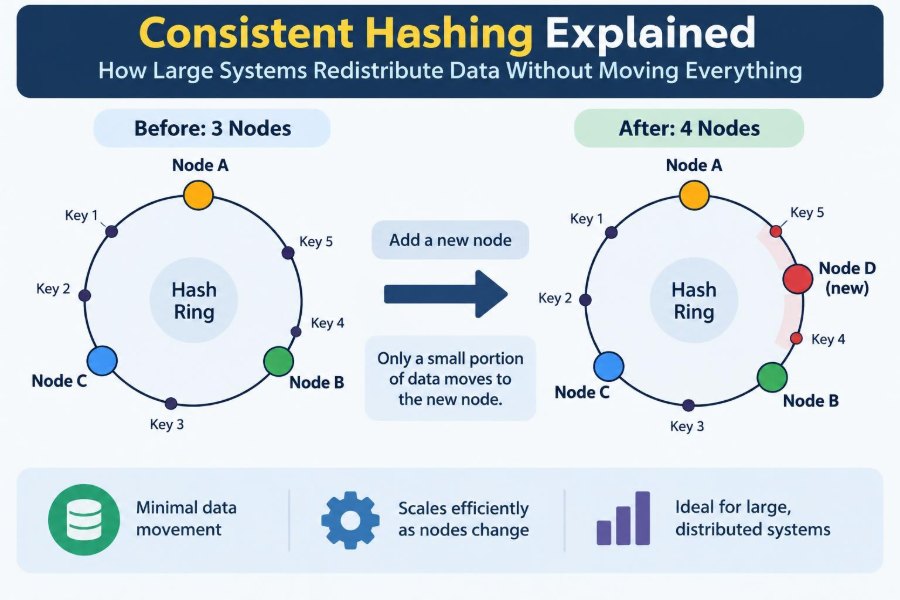

Imagine a popular online store adding new servers before a major sale. Its product images, shopping carts, and session data are already spread across several machines. The new capacity should help quickly, but there is a hidden problem: where should all the existing data go?
A simple redistribution rule can turn that upgrade into a flood of copying. Servers become busy moving data instead of answering requests, caches go cold, and users may suddenly experience slower pages. Removing a failed server can create the same disruption at the worst possible moment.
Large distributed systems need a way to decide which machine owns a piece of data while keeping that decision stable as machines come and go. Consistent hashing is one of the most widely used ideas for solving that problem.
It does not eliminate data movement, and it does not make a system automatically reliable. What it does is make membership changes affect a small, predictable portion of the key space rather than reshuffling nearly everything.
🧭 The Distribution Problem
Distributed applications often store data across many nodes, where a node is a server or process capable of storing and serving data. Before reading or writing a value, the application needs a routing rule: given a key such as user:4821, which node should receive the request?
The rule must be deterministic. Two application servers receiving the same key should reach the same destination without asking every node where the data lives.
📦 What Is a Key?
A key is an identifier used to locate a value. In a cache, it might be a page URL; in a database, it could be an account ID; in object storage, it may be a file name or object ID.
Consistent hashing distributes keys, not necessarily physical files or database rows directly. A system may use the resulting node choice as one input to a more involved storage, replication, and routing design.
🔢 The Familiar Modulo Approach
A basic scheme hashes each key into a number, then uses the remainder after division by the number of nodes. With four nodes, the rule could be hash(key) mod 4, producing positions 0 through 3.
This is easy to understand and can distribute keys reasonably well when the node count stays fixed. For a small, stable set of workers, it may be entirely appropriate.
💥 Why Adding One Node Causes a Shuffle
Suppose a key hashes to 14. With four nodes, 14 mod 4 is 2. With five nodes, 14 mod 5 is 4. Many keys change owners because the divisor has changed.
This is not merely an administrative inconvenience. If the mapping controls a cache, most requests may suddenly miss because the new owner has no cached value. If it controls stored data, a large migration may be required before requests can succeed reliably.
🎯 The Core Promise of Consistent Hashing
Consistent hashing is designed so that when one node is added or removed, only a limited neighboring range of keys changes assignment. Under the usual idealized assumptions, adding one node to a balanced ring changes ownership for roughly the share that node will ultimately hold, rather than changing nearly every key.
The word consistent here means the mapping remains relatively stable as the set of nodes changes. It does not mean the data is automatically identical on every machine or that requests are strongly consistent in the database sense.
⭕ Visualizing the Hash Ring
Instead of treating hash values as a straight line, consistent hashing arranges the full hash range as a circle. The end wraps around to the beginning, much like positions on a clock.
Each server is hashed onto one or more positions on this circle. Each data key is hashed using the same numeric space, so a key and a node can be compared by their positions around the ring.
➡️ Finding a Key’s Owner
The standard rule is simple: hash the key, move clockwise around the ring, and choose the first node encountered. That node is often called the key’s successor.
For example, imagine nodes at positions 15, 40, and 80 on a ring from 0 to 99. A key at 47 belongs to the node at 80. A key at 90 wraps around and belongs to the node at 15.
🗺️ Why the Ring Localizes Change
Now add a node at position 60. Only keys between 40 and 60, which previously moved clockwise to 80, are reassigned to the newcomer. Keys elsewhere still encounter the same first node.
That local boundary change is the central insight. A node takes responsibility from its clockwise successor, rather than forcing every node to reinterpret every key based on a new total count.
🔐 Hash Functions Make Placement Practical
A hash function turns input data of arbitrary length into a fixed-size numeric value. Good placement hashes aim to spread typical inputs broadly and make it difficult to predict patterns from the original names.
The choice depends on the system’s needs. A non-cryptographic hash may be suitable for fast internal routing, while some designs prefer a stronger hash to reduce concerns about deliberately chosen keys concentrating traffic. The important requirement is that all participants calculate placement the same way.
🎲 Random-Looking Does Not Always Mean Even
Placing each physical server on the ring only once can create uneven gaps. A server that happens to follow a large empty interval owns many more keys than another server following a short interval.
This is a property of random placement, not necessarily a broken hash function. With few nodes, the imbalance can be noticeable enough to overload a server while others have spare capacity.
👥 Virtual Nodes Smooth the Distribution
Most practical consistent-hashing designs address uneven gaps with virtual nodes, also called vnodes. One physical server appears at many positions on the ring rather than only one.
Each small range is assigned to a virtual node, and every virtual node maps back to a real server. With many positions per server, unusually large and small ranges tend to average out, producing a more even distribution of keys and requests.
⚖️ Weighted Nodes Handle Unequal Hardware
Not every machine has the same capacity. One node may have more memory, faster disks, or a larger network allowance than another. Giving all machines identical numbers of virtual nodes can leave powerful machines underused or smaller ones overloaded.
Weighted consistent hashing assigns more virtual positions to nodes with greater intended capacity. This remains a target rather than a guarantee: actual load also depends on key sizes, request rates, and access patterns.
📈 Data Balance Is Not Load Balance
Evenly distributing the number of keys does not necessarily distribute work evenly. One key may represent a tiny profile record, while another is a frequently requested feed or a multi-gigabyte object.
This distinction matters for so-called hot keys. A perfectly placed but extremely popular key can overwhelm its owner. Replication, caching, request coalescing, and application-specific sharding are often needed in addition to consistent hashing.
🧊 A Cache Cluster Example
Consider an application using several cache servers for rendered product pages. The page key is hashed onto the ring, and every web server independently routes requests to the chosen cache node.
When a cache node joins, it receives only the key ranges adjacent to its ring positions. Those newly assigned entries will initially miss and refill, but unaffected ranges retain their ownership and can remain warm. That is often much less disruptive than changing a modulo divisor.
🗃️ A Storage System Example
For durable storage, assignment is more involved. A node joining the ring may need to copy the ranges it is now responsible for from existing nodes, then begin serving them after verification.
During this handoff, a real system must decide which version is current and how writes are handled. Consistent hashing identifies the relevant range; it does not by itself provide transfer protocols, durability, or conflict resolution.
🪞 Replication Requires Multiple Owners
Important data is often stored on more than one node. A common ring-based approach selects the primary owner and then continues clockwise to choose additional distinct nodes as replicas.
The details matter. A system should avoid placing every replica on machines that share the same rack, availability zone, or failure domain when that information is available. Multiple copies on closely related infrastructure may not protect against a shared outage.
🔄 Reads and Writes During Movement
Rebalancing is rarely instantaneous. A range may be copied while clients are still reading and writing it, creating a period in which old and new owners both participate.
Systems use different strategies: temporarily forwarding requests, writing to both locations, reading from more than one replica, or marking a range as moving. The appropriate choice depends on the consistency guarantees the application needs and the failure cases it can tolerate.
🚑 Node Failure Is Also a Membership Change
When a node fails, the ring has a missing position. Its neighboring successor or replicas can take over the affected ranges, while repair processes create replacement copies elsewhere.
Failure detection is difficult because a slow node can look unavailable during a network problem. If different parts of the system disagree about whether a node is alive, they may route requests differently. Membership decisions therefore need careful coordination or well-defined convergence rules.
🧠 The Membership View Must Be Trustworthy
Every router needs a view of the ring: node identities, their virtual positions, and sometimes capacity weights and health status. If that metadata is stale, two clients may choose different owners for the same key.
Some systems distribute membership through a control plane; others use decentralized gossip, where nodes gradually exchange state. Neither approach removes the need to define versioning, failure handling, and what clients should do while their view is changing.
📚 Consistency Has Two Different Meanings Here
The name can confuse newcomers. Consistent hashing concerns stable key placement when membership changes. Database consistency concerns what values readers may observe after writes.
A ring can be perfectly implemented while the data layer still offers eventual consistency, strong consistency, or another model. Always ask both questions: “Which node should own this key?” and “What value is safe to return?”
🧩 Partitioning Is Not the Same as Sharding
These terms overlap in everyday conversation but point to different levels of design. Partitioning divides a data set into pieces; sharding usually means distributing those pieces across independent database instances; consistent hashing is one method for choosing a partition or shard.
A database may also shard by customer region, date range, or an explicit tenant ID. Those choices can be better when queries need locality or when business rules require certain data to stay together.
🆚 Range Partitioning Can Be Better for Some Queries
Hash-based placement scatters nearby values, which helps spread writes but makes ordered scans harder. If an application regularly asks for all events from a time interval, a time-range partition may support that query more naturally.
The trade-off is that range partitions can create hotspots, such as a single newest-time partition receiving all current writes. The right method follows the access pattern, not the popularity of a particular algorithm.
⚠️ Common Misconceptions
- “It means no data moves.” Data still moves when ownership changes; the goal is to limit the affected portion.
- “It automatically balances traffic.” Virtual nodes help balance key ranges, but hot keys and unequal values can still skew load.
- “It provides replication.” Replication is a separate policy layered onto placement.
- “One hash ring solves every distributed problem.” It does not replace health checks, metadata management, backup, authorization, or observability.
🛠️ A Simple Placement Algorithm
At a high level, a client or coordinator maintains an ordered list of virtual-node tokens. To locate a key, it hashes the key and finds the first token equal to or greater than that hash; if none exists, it wraps to the first token.
keyPosition = hash(key)
ownerToken = first token where token >= keyPosition
if no ownerToken exists:
    ownerToken = first token in sorted ring
return ownerToken.physicalNode
Production implementations need details this sketch omits, including token collisions, membership versions, replica selection, and efficient search. A sorted array with binary search works well for a static or moderately changing ring; other structures may be chosen for different update patterns.
🔍 Observability Reveals Whether the Ring Works
Operators should measure more than the count of keys per node. Useful signals include storage used, request rate, latency, error rate, network transfer during rebalancing, replication health, and the age of membership information.
A node can look balanced by key count while serving far more reads than its peers. Looking at several dimensions helps distinguish a placement issue from a hot-key issue, a hardware bottleneck, or a client-routing fault.
🚧 Rebalancing Should Be Deliberate
Adding capacity in a rush can create avoidable pressure. Copying large ranges consumes disk, network, and CPU resources precisely when the system may already be busy.
Safer designs throttle transfers, verify copied data, preserve enough replicas throughout the move, and expose progress. Teams should also plan rollback behavior if a joining node is unhealthy or the migration falls behind.
🧪 Test Changes Beyond the Happy Path
A useful test does more than confirm that keys are evenly placed at startup. Simulate nodes joining and leaving, interrupted transfers, stale ring metadata, overloaded replicas, and requests that arrive during ownership changes.
For a cache, measure the temporary miss rate after membership changes. For durable data, test whether acknowledged writes remain readable under the promised failure conditions. These checks connect a placement algorithm to the behavior users actually experience.
🏗️ When You Probably Do Not Need It
Consistent hashing adds concepts and operational work. A single database, a managed service with built-in partitioning, or a small fixed worker pool may not benefit from implementing a custom ring.
It becomes attractive when many independent clients must route keys across a changing fleet, or when a distributed storage or cache layer needs controlled rebalancing. Use the simplest design that satisfies the scaling and availability requirements you genuinely have.
🧭 A Practical Decision Checklist
- Does the set of serving nodes change often enough that full reshuffles are costly?
- Can requests be routed from a deterministic key without centralized lookup on every operation?
- Are virtual nodes or weights needed because nodes differ in capacity?
- How will replicas be selected across failure domains?
- What happens to reads and writes while a range is moving?
- How will the system detect hot keys, stale membership, and incomplete repair?
Clear answers to these questions matter more than drawing a ring diagram. The diagram explains placement; the answers define an operational system.
🌟 The Core Principle to Remember
Consistent hashing converts a global redistribution problem into mostly local ownership changes. By placing keys and nodes in the same hash space, a new node takes over nearby ranges instead of forcing the entire cluster to recalculate assignments.
Virtual nodes make that idea practical for uneven real-world fleets, while replication, membership management, migration protocols, and monitoring supply the reliability work around it. Think of the ring as a precise routing foundation, not a complete distributed system.
Consistent hashing is valuable because it lets systems grow and recover with targeted movement of data, rather than treating every membership change as a full reshuffle. Used with thoughtful replication and operations, it keeps a simple routing idea useful at large scale. 💻⭕🧭