
Imagine downloading a huge software update. You want confidence that the file arrived intact, but comparing every byte against the publisher’s original would be slow and impractical.
Or picture a shared database with millions of records. One computer says its copy matches another’s; the other wants proof. Sending the entire database across the network just to check would waste time, bandwidth, and energy.
Computers solve this kind of problem with a remarkably compact idea: summarize small pieces of data, then summarize those summaries, until one short value represents the whole collection.
That structure is called a Merkle tree. It is a core tool in distributed systems, version control, file synchronization, and blockchains because it makes large datasets easier to verify without treating every record as one giant file.
🌳 The Basic Idea Behind a Merkle Tree
A Merkle tree is a tree-shaped data structure built from cryptographic hashes. Its bottom layer represents individual data items, while each layer above represents groups of items.
At the very top is one hash called the Merkle root. If two systems have the same root, and they used the same data, ordering, encoding, and hashing rules, they can treat their entire collections as matching.
The tree does not make data smaller in the ordinary storage sense. Instead, it creates a small, checkable commitment to a much larger set of data.
🔐 Start With a Cryptographic Hash
A hash function takes input of almost any size and produces an output of fixed length, often called a digest or hash value. For example, a document, transaction, or database record can be passed through a function such as SHA-256.
Good cryptographic hash functions have useful properties: the same input gives the same output, a tiny input change produces a dramatically different output, and finding two different inputs with the same hash should be computationally infeasible.
A hash is not encryption. Encryption is designed to be reversed by someone with the right key. A hash is designed as a one-way fingerprint, not as a recoverable container for the original data.
🧾 Leaves Represent Individual Records
The lowest layer of a Merkle tree contains leaf hashes. Each leaf corresponds to a data item, such as a transaction, a file block, or a row exported from a database.
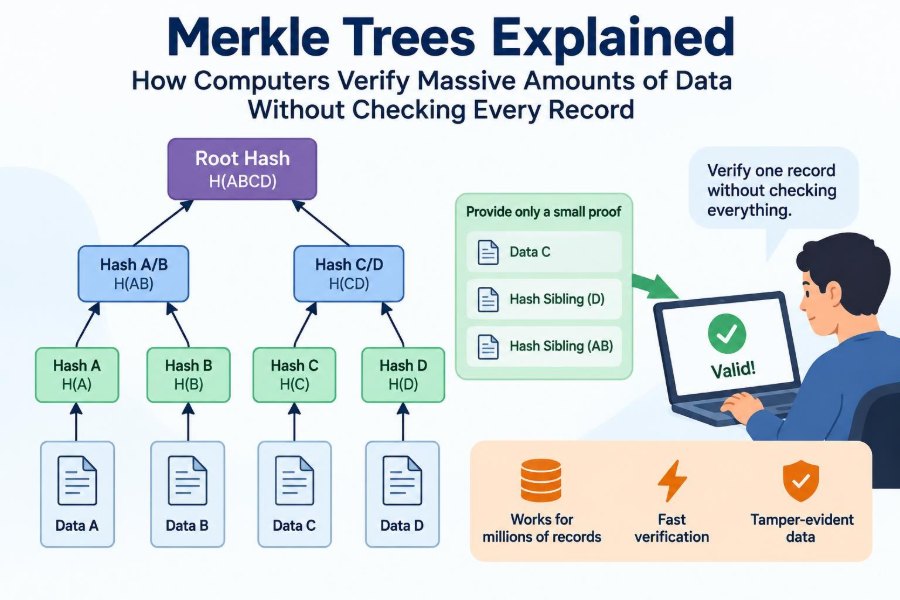
Suppose a collection contains four hypothetical records: A, B, C, and D. The system first computes hashes for each one: H(A), H(B), H(C), and H(D).
What counts as a record must be defined carefully. If one system hashes a record’s text while another hashes a differently formatted version of the same information, their leaf hashes will differ.
🧱 Parent Nodes Combine Their Children
Next, the system joins neighboring hashes in a defined order and hashes that combined value. The parent of A and B is written conceptually as H(H(A) || H(B)), where || means concatenation.
The same happens for C and D. Finally, the two parent hashes are combined and hashed to create the root.
H(A)      H(B)      H(C)      H(D)
  \        /          \        /
  H(AB)               H(CD)
       \               /
          Merkle root
The actual implementation must use unambiguous byte encodings rather than informal text labels such as “AB.” The diagram shows the relationship, not a storage format.
👑 The Merkle Root Is a Dataset Commitment
The Merkle root is a short value that commits to the complete set of leaves and their structure. Change one record, and its leaf hash changes. That change flows upward through every parent on its path to the root.
As a result, a changed dataset normally produces a different root. A root by itself cannot reveal the records inside it, but it lets systems detect whether two carefully defined datasets are identical.
This is why roots can be stored or exchanged efficiently. A system can remember one digest rather than keeping a second full copy solely for comparison.
🪪 Why Order Is Part of the Data
Merkle trees are usually ordered trees. H(A || B) is not generally the same as H(B || A), so moving records around can change the root even when no record content changes.
That is often exactly what a system wants. In a transaction list, position may affect meaning; in a file, block order certainly does. A root proves agreement about both content and the arrangement defined by the protocol.
If order should not matter, the system needs a separate rule, such as sorting items canonically before building the tree. That rule must be shared by every verifier.
🧩 A Small Four-Record Example
Consider a payroll export with four fictional entries. Rather than publishing the entries, an auditor stores the root created from their hashes.
Later, one entry is corrected. The system hashes the changed entry again, rebuilds its parent hash, and then rebuilds the root. It does not need to rehash the untouched entries themselves.
The new root differs from the old one. This tells the auditor that the export is not the same version, though it does not by itself explain which entry changed.
🧭 The Proof That One Record Is Included
A major advantage of Merkle trees is the Merkle proof, also called an authentication path. It proves that one leaf belongs to a tree with a known root.
To prove A is included in the four-record example, a verifier does not need B, C, and D in full. It needs A, the sibling hash H(B), the hash of the other branch H(CD), and information about left-versus-right positions.
The verifier hashes A, combines it with H(B), combines the result with H(CD), and checks whether the computed root matches the trusted root.
📦 What a Merkle Proof Contains
A proof usually includes the hashes needed to reconstruct the route from one leaf to the root. At every level, the verifier needs the neighboring, or sibling, hash.
- The item or its leaf hash
- Sibling hashes along the path
- Position information showing which hash goes on the left or right
- Tree rules, including the hash algorithm and leaf encoding
- The root value the verifier already trusts
Without position information, a verifier may combine hashes in the wrong order. Without agreed encoding rules, two honest implementations can calculate different values.
📏 Why Proofs Stay Small
In a balanced binary tree, each level halves the number of branches. A tree with a very large number of leaves therefore has a height that grows logarithmically, commonly described as O(log n).
That means a membership proof needs one sibling hash per level, rather than every other record. The exact proof size depends on the hash length and tree design, but the growth is far gentler than sending an entire dataset.
This is the practical reason Merkle trees matter: they replace a large comparison with a short chain of hash calculations and a small amount of auxiliary data.
🔎 Finding the Part That Disagrees
Merkle trees can also help systems locate differences. If two roots disagree, the systems compare hashes below the root. When a pair of child hashes match, that whole subtree can be skipped.
They continue descending only into branches that differ. Eventually, they reach the leaves or small groups of leaves that need to be transferred, examined, or repaired.
This technique is useful for synchronization. Instead of moving every object from one replica to another, a system can focus network work on the ranges that are actually different.
🔄 Synchronization Is Not the Same as Proof
A membership proof answers a narrow question: “Is this item included under this root?” Reconciliation answers a broader question: “Where do our collections differ?”
Both use the same hierarchical summaries, but their conversations differ. Reconciliation may exchange hashes at several levels before either side knows which records are missing or changed.
A Merkle tree therefore helps identify what to fetch. It does not automatically define conflict resolution, permissions, merging policy, or which replica should be considered authoritative.
🗂️ File Systems Use Trees of Content
A file can be divided into chunks, with each chunk hashed as a leaf. A root then represents the file’s complete content. If a chunk changes, only the hashes on its route to the root need rebuilding.
Directories can be represented too, often by hashing a structured listing containing names, metadata, and child hashes. This creates a hierarchy that mirrors a file system while allowing fast detection of unchanged subdirectories.
The details matter: a design must state whether permissions, timestamps, names, and file order are included. Different choices answer different integrity questions.
🧑💻 Version Control and Content Addressing
Version-control systems can use hashes to identify content and relationships between objects. A commit can point to a tree of files, while the tree points to blobs containing file content.
This approach makes unchanged content reusable and makes tampering evident when identifiers are checked. It also supports efficient comparison: if two directory-tree hashes match, there is no need to inspect every nested file to establish equality under the system’s rules.
Not every hashed object graph is a simple binary Merkle tree, but the central idea is closely related: hashes connect structured content into verifiable relationships.
⛓️ Blockchains Use Merkle Roots Carefully
Many blockchain designs place a Merkle root for a block’s transactions in the block header. A user can then verify that a particular transaction was included in a particular block using a proof, without downloading every transaction in that block.
This supports lightweight verification, but it does not eliminate every trust question. The verifier must still decide which block headers to trust and must understand the chain’s consensus and validation rules.
A Merkle proof shows inclusion in a committed collection. It does not, on its own, prove that a transaction was valid, final, authorized, or economically irreversible.
📱 Lightweight Clients and Limited Devices
Phones, embedded devices, and browsers may not have the storage or network capacity to retain complete datasets. Merkle proofs let them verify selected pieces against a compact root.
For example, a client could request a specific record and its proof rather than a whole archive. It performs the hash calculations locally and compares the result with a root obtained through an appropriate trust mechanism.
This saves resources, but a lightweight client must still defend against misleading peers, stale roots, and incomplete information. Small proofs reduce data transfer; they do not remove the need for sound protocol design.
🧮 Binary Trees Are Not the Only Shape
Binary Merkle trees combine two children per parent, but a tree may use more children at each node. A wider tree can reduce its height, while each proof step may need more sibling hashes.
The best branching factor depends on the application, proof format, storage pattern, and network costs. There is no universal tree shape that is always superior.
| Design choice | Potential advantage | Trade-off |
|---|---|---|
| Binary tree | Simple, familiar proof paths | More levels for very large sets |
| Wider tree | Fewer levels | More sibling data per level |
| Fixed-size chunks | Simple indexing and rebuilding | Small edits may affect a whole chunk |
| Content-defined chunks | Can preserve boundaries after insertions | More complex chunking logic |
🧷 Handling an Odd Number of Leaves
Real datasets do not always contain a power-of-two number of items. A tree implementation must specify what happens when a level has an unpaired node.
Common approaches include duplicating the final hash, promoting it unchanged, or using a defined empty-node value. These choices produce different roots, so they are protocol rules rather than interchangeable conveniences.
A verifier must use the identical odd-leaf rule as the producer. “Almost the same tree” is not sufficient for cryptographic verification.
🧬 Data Encoding Must Be Canonical
Before hashing, data needs a canonical representation: one exact sequence of bytes for each logical item. Otherwise, harmless-looking differences can prevent matching roots.
For example, extra whitespace, text character encoding, field order in a flexible data format, line-ending conventions, or timezone formatting may alter the bytes. Two records can appear identical to a person but hash differently.
Robust designs define serialization precisely. They also separate fields unambiguously so that different combinations of values cannot be confused after concatenation.
🏷️ Domain Separation Prevents Ambiguity
Well-designed Merkle constructions often use different prefixes or tags when hashing leaves and internal nodes. This practice is called domain separation.
Conceptually, a leaf might be hashed as H(leaf-tag || data), while a parent is H(parent-tag || left-hash || right-hash). The tags make it harder for a byte sequence intended as one type of object to be interpreted as another.
This is a subtle engineering detail, but cryptographic systems often fail at boundaries and representations rather than in the headline algorithm itself.
⚠️ A Root Is Only as Trustworthy as Its Source
Suppose a server gives you both a record and a Merkle root that it invented. You can verify that the record belongs to that root, but you have not learned whether the root represents the genuine dataset.
The root needs to come from a trusted or independently verifiable source: for example, a signed statement, a trusted protocol, an authenticated release channel, or a consensus mechanism appropriate to the system.
This distinction is essential. Merkle trees provide integrity relative to a root; they do not automatically establish trust in that root.
🕳️ Inclusion Does Not Prove Absence
A standard membership proof is excellent for proving that an item is present. Proving that an item is absent is more complicated because the tree’s layout may not make missing positions obvious.
Some systems use sorted trees and provide neighboring entries to show where a missing key would belong. Others use specialized authenticated data structures designed for non-membership proofs.
Do not assume that an inclusion-proof format can answer absence questions. The ability depends on the data model and the tree’s construction rules.
🛡️ Collision Resistance Is a Security Assumption
Merkle tree security relies heavily on the hash function’s collision resistance: attackers should not feasibly find two distinct inputs with the same hash. If they could, they might attempt to substitute data without changing a root.
Security also depends on correct implementation. Weak legacy hash algorithms, ambiguous encoding, missing domain separation, careless truncation, and unauthenticated roots can undermine an otherwise sensible design.
Cryptographic choices should be reviewed against current guidance for the environment. A Merkle tree is a construction pattern, not a magic security label.
🚫 Common Misunderstanding: Hashes Hide Data
Hashes usually do not reveal the original input directly, but that does not mean a root provides privacy. If an attacker can guess likely inputs, they may hash guesses and compare them with known values or exploit exposed leaf hashes.
For a dataset with predictable records, such as a small set of common labels, hashes may be easier to guess than people expect. Salting, access controls, encryption, and careful disclosure policies may be needed depending on the threat model.
Integrity and confidentiality are different goals. Merkle trees primarily address integrity and efficient verification.
📉 Storage and Update Costs Still Exist
A Merkle tree reduces the cost of selected verification and difference discovery, but it is not free. Systems may need to store internal nodes, calculate hashes, manage proofs, and update paths after changes.
For a frequently changing dataset, the update strategy matters. A persistent tree can reuse unchanged branches across versions, while a simple rebuilt tree may be adequate for periodic static snapshots.
If all data fits comfortably on one machine and is checked rarely, a plain full-file hash may be simpler. Merkle trees become compelling when partial verification, synchronization, versioning, or distribution is needed.
🧪 Building a Merkle Tree Safely
A practical implementation starts by writing down the rules before writing code. Treat the format as part of the security boundary.
- Choose a modern, suitable cryptographic hash function.
- Define canonical bytes for every leaf record.
- Specify leaf and internal-node formats, including domain tags.
- Define ordering, chunking, and the odd-leaf rule.
- Store or distribute roots through an authenticated mechanism.
- Test proofs with valid cases, altered records, reordered records, and malformed paths.
Interoperability tests are especially valuable. Independent implementations should produce exactly the same root for the same carefully specified input.
🧰 A Simple Verification Workflow
When verifying a supplied item, a client begins with the item bytes and the agreed leaf-hashing rule. It computes the leaf hash locally rather than trusting a claimed leaf value blindly.
The client then walks upward through the supplied sibling hashes, placing each hash left or right according to the proof. The final computed hash is compared with the expected root.
If the values match, the item is included in the tree represented by that root. If they do not, the proof, item, tree rules, or root is wrong; the mismatch itself does not identify which component failed.
🧠 Merkle Trees Versus a Single File Hash
A single hash of an entire file is excellent when you only need to know whether the whole file matches. It is compact and simple.
A Merkle tree costs more structure, but it can prove one chunk, identify changed regions, and reuse unchanged branches. It is a better fit when data is large, segmented, distributed, or updated incrementally.
Neither choice is inherently more secure in every setting. The right choice follows the verification question you actually need to answer.
🧭 Questions to Ask Before Using One
Before adding a Merkle tree to a system, clarify the problem rather than starting with the data structure.
- Do users need to verify individual items or only complete snapshots?
- Will replicas compare large collections over limited network links?
- What exactly does the root commit to: values, order, metadata, or all of these?
- How will verifiers obtain an authentic and current root?
- Are membership and non-membership proofs both required?
- What happens when records are inserted, deleted, or corrected?
Clear answers prevent the common mistake of using a Merkle tree as a vague “security feature” without defining its guarantees.
🎯 The Core Principle to Remember
A Merkle tree turns many pieces of data into a hierarchy of cryptographic summaries. The root summarizes the whole collection, and a short path of sibling hashes can connect one item back to that root.
That structure lets computers verify a specific record or narrow down a disagreement without repeatedly reading, transmitting, or comparing every record. Its power comes from combining efficient tree structure with carefully defined hashing rules.
Its boundaries matter just as much: it does not encrypt data, decide which source is truthful, validate business rules, or solve every synchronization conflict. Used with a trustworthy root and precise construction rules, it is a focused tool for scalable integrity checking.
Merkle trees make large data collections practical to verify by replacing full-data comparisons with a small, structured proof tied to one trusted root. 🌳🔐💻