
Imagine you are sorting a messy folder of photos. Inside it are smaller folders, and inside those are even more folders. You could inspect every folder manually, but the task has a repeating pattern: for each folder, look at its contents; when you find another folder, do the same thing again.
Many programming problems have this shape. A task contains smaller versions of itself, whether you are searching a family tree, navigating website menus, evaluating a mathematical expression, or exploring nested data from an application.
Recursion is a programming technique built for these situations. A recursive function calls itself with a smaller or simpler version of the original problem, continuing until there is nothing left to solve.
At first, “a function calling itself” can sound circular or even dangerous. Understanding the stopping rule, the changing input, and the computer memory behind each call turns recursion from a mystery into a precise tool.
🪞 What Recursion Means in Programming
Recursion happens when a function solves a problem by invoking itself. Each invocation, called a recursive call, works on a smaller piece of the overall task.
A recursive solution needs more than a self-call. It needs a clear rule for the smallest solvable version of the problem and a reliable way to move toward that version. Without both, the program will not finish.
function countdown(n) {
  if (n === 0) return;
  print(n);
  countdown(n - 1);
}
Here, countdown(3) prints 3, then asks the same function to handle 2, then 1, and finally stops at 0.
🧩 Why Self-Calls Can Be Sensible
Recursion is not a program blindly repeating itself. It is a way to express a repeated structure in the problem itself. If one branch of a tree resembles the full tree, or one subfolder resembles the full folder hierarchy, the same instructions can handle both.
This is often called self-similarity. The whole object and its smaller parts follow the same pattern. Recursive code can mirror that pattern more directly than a loop with many manually managed variables.
The key question is not “Can this function call itself?” It is “Does the problem naturally break into smaller instances of the same problem?”
🛑 The Base Case: The Essential Stop Sign
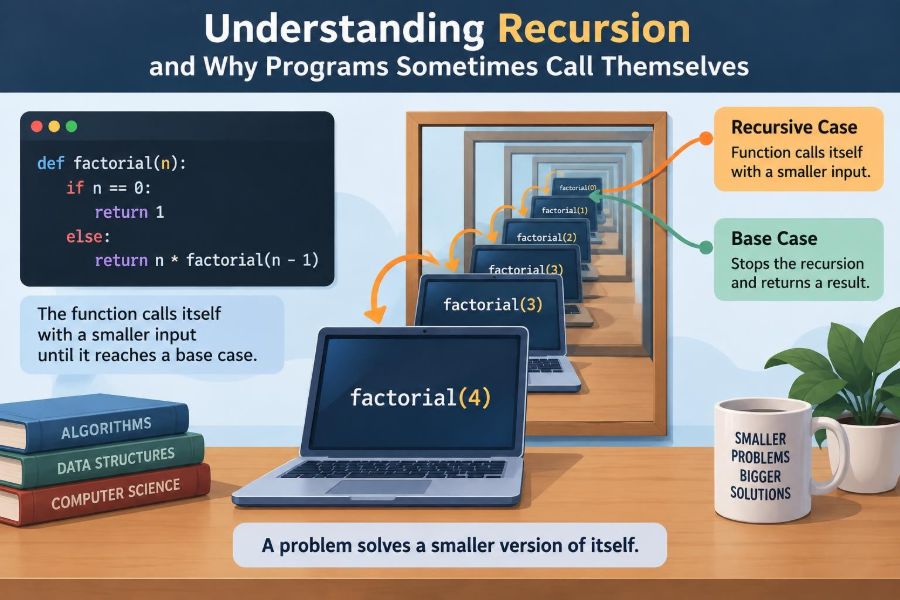
Every recursive function requires at least one base case. A base case is an input simple enough to answer immediately, without another recursive call.
For factorials, the base case is usually 0 or 1. For a folder search, it may be an empty folder. For a tree traversal, it is often a missing branch, represented by a value such as null.
function factorial(n) {
  if (n === 0) return 1;
  return n * factorial(n - 1);
}
When n becomes 0, the function returns 1. That answer allows the earlier calls to complete.
📉 The Recursive Case: Making the Problem Smaller
The recursive case describes what to do when the input is not yet simple enough. It usually performs a small amount of work and calls the function again with a reduced input.
In factorial(n), the reduced input is n - 1. In a string function, it might be the remainder after removing the first character. In a tree algorithm, it could be one child subtree.
A convincing recursive design can answer this question: What changes on every call, and why must it eventually reach a base case? If that cannot be explained, the function may never terminate.
🪜 Following a Call Step by Step
Consider factorial(4). The computer cannot immediately multiply all the values because each call is waiting for the next one to return.
factorial(4)
= 4 * factorial(3)
= 4 * 3 * factorial(2)
= 4 * 3 * 2 * factorial(1)
= 4 * 3 * 2 * 1 * factorial(0)
= 4 * 3 * 2 * 1 * 1
= 24
The calls first move downward toward the base case. Then their results return upward, allowing the postponed multiplications to happen. This two-stage motion is central to many recursive algorithms.
📚 The Call Stack Holds Waiting Work
While a function is running, the computer stores information about that call: its local variables, its position in the code, and where execution should resume afterward. This stored record is often called a stack frame.
Recursive calls create a sequence of stack frames on the call stack. The newest call is handled first. When it returns, the previous call resumes, much like removing the top plate from a stack of plates.
This explains why recursion can remember unfinished work without you explicitly building a separate data structure. The language runtime is holding that work in the call stack.
⚠️ Why Infinite Recursion Crashes
If a recursive function never reaches a base case, it keeps adding stack frames. Memory reserved for the call stack is limited, so eventually the program stops with an error often described as a stack overflow.
function broken(n) {
  return broken(n + 1);
}
This function moves away from any possible stopping point. A subtler failure occurs when a base case exists but the input does not reliably approach it, such as calling broken(n) again with the unchanged value.
A stack overflow is a program failure, not a useful way to detect an answer. Termination should be designed and tested deliberately.
🔢 A Simple Example: Summing Numbers
To add the integers from 1 through n, separate the final number from the smaller total before it. The relationship is sum(n) = n + sum(n - 1).
function sumTo(n) {
  if (n <= 0) return 0;
  return n + sumTo(n - 1);
}
For sumTo(4), the function eventually reaches sumTo(0), which returns 0. The waiting calls then produce 1, 3, 6, and 10.
A loop is often simpler for this particular job, but the example makes the structure of recursion easy to see.
🔤 A String Example: Reversing Characters
Recursion can process one part of a string and delegate the rest. To reverse a word, take its first character, reverse everything after it, and place the first character at the end.
function reverse(text) {
  if (text.length <= 1) return text;
  return reverse(text.slice(1)) + text[0];
}
For the hypothetical input "cat", the calls work with "at", then "t". As calls return, the result becomes "ta" and then "tac".
Real programs should also consider the cost of repeatedly slicing strings, especially for long text.
🌳 Trees Are a Natural Home for Recursion
A tree is a structure made of nodes connected in parent-child relationships. A company reporting chart, a menu with submenus, and a document outline can all be represented as trees.
Each node may have child nodes, and every child is the root of another smaller tree. That recursive definition makes recursive traversal particularly readable.
function printTree(node) {
  if (node === null) return;
  print(node.value);
  printTree(node.left);
  printTree(node.right);
}
The same function visits the current node, then applies itself independently to the left and right branches.
🧭 Traversal Order Changes the Result
When visiting a tree, the location of the “process this node” instruction determines the traversal order. Different orders are useful for different tasks.
| Order | Visit pattern | Typical use |
|---|---|---|
| Preorder | Node, left subtree, right subtree | Copying or displaying a hierarchy from its root |
| Inorder | Left subtree, node, right subtree | Reading values in sorted order from a binary search tree |
| Postorder | Left subtree, right subtree, node | Deleting child items before their parent |
These are not merely different names. The order determines when a parent can use information produced by its children.
📁 Walking Through Nested Folders
A file system provides a familiar recursive scenario. A directory can hold files and more directories. To list all files, inspect each item; if it is a directory, repeat the same process inside it.
function listFiles(folder) {
  for (const item of folder.items) {
    if (item.isFile) print(item.name);
    else listFiles(item);
  }
}
Actual operating systems introduce details such as permissions, symbolic links, errors, and extremely deep paths. Still, the central logic remains recursive because folders can be nested without a fixed maximum number of levels.
🪆 Nested Data Has the Same Shape
Data exchanged by applications often contains nested objects and lists. A comment can have replies, each reply can have further replies, and every reply may have the same fields as the original comment.
Recursive functions can count items, validate fields, render a nested interface, or search for a matching value. The base case occurs when an item has no children; the recursive case processes each child.
This is why recursion appears in web interfaces, configuration readers, language tools, and data-processing programs—not only in textbook exercises.
➗ Divide and Conquer Splits Problems
Some recursive algorithms solve a task by dividing it into independent parts, solving each part, and combining the results. This strategy is called divide and conquer.
Merge sort is a classic example. It splits a list into two halves until each part contains one item, then merges sorted parts back together. Binary search similarly discards half of a sorted range after each comparison.
Recursion is a common way to write divide-and-conquer algorithms, but it is not synonymous with them. A recursive function might follow one path at a time rather than split into multiple subproblems.
🔍 Binary Search Shrinks a Sorted Range
Binary search finds an item in a sorted collection by comparing the target with the middle element. If the target is smaller, only the left half remains possible; if larger, only the right half does.
function binarySearch(items, target, low, high) {
  if (low > high) return -1;
  const middle = Math.floor((low + high) / 2);
  if (items[middle] === target) return middle;
  if (target < items[middle]) return binarySearch(items, target, low, middle - 1);
  return binarySearch(items, target, middle + 1, high);
}
Its prerequisite matters: the data must be sorted according to the same comparison rule. Recursion cannot compensate for an invalid assumption.
🧮 Recursive Math and Its Limits
Mathematics often defines sequences recursively. For example, factorials refer to smaller factorials, and the Fibonacci sequence defines each term using earlier terms.
A direct Fibonacci implementation is elegant but inefficient because it repeatedly recalculates the same values:
function fib(n) {
  if (n <= 1) return n;
  return fib(n - 1) + fib(n - 2);
}
For larger inputs, the branching calls multiply quickly. The definition is correct, but the implementation wastes work. This distinction—correctness versus efficiency—is essential.
🧠 Memoization Avoids Repeated Work
Memoization stores a function’s earlier results so later calls with the same input can reuse them. It is especially valuable when recursive branches overlap, as they do in Fibonacci calculations.
function fib(n, cache = {}) {
  if (n in cache) return cache[n];
  if (n <= 1) return n;
  cache[n] = fib(n - 1, cache) + fib(n - 2, cache);
  return cache[n];
}
Memoization trades some memory for less repeated computation. It is useful only when repeated subproblems occur; adding a cache to every recursive function would add complexity without automatic benefit.
🔁 Recursion and Loops Are Different Tools
Loops repeat instructions within one function call. Recursion creates new calls, each with its own local state and return point. Both can solve many of the same problems.
For counting through a flat list, a loop is commonly clearer and uses less call-stack space. For unknown nesting depth, recursion may communicate the solution more naturally.
- Choose a loop for straightforward repetition over a sequence.
- Consider recursion for trees, nested structures, and naturally defined subproblems.
- Prefer the version your team can test, maintain, and run safely at expected input sizes.
“Recursive” does not mean more advanced, and “iterative” does not mean less elegant.
🔄 Replacing Recursion with an Explicit Stack
Any recursive process that relies on the call stack can often be rewritten using a stack data structure that the programmer manages directly. This is called an iterative approach.
For example, a depth-first tree search can push the root onto a list, repeatedly remove one node, process it, and push its children. The order of pushes controls the traversal order.
This approach can prevent call-stack limits from becoming a problem. It also makes saved state visible, which may help when pausing, resuming, or debugging a long traversal.
🏃 Tail Recursion and Compiler Optimizations
A call is in tail position when it is the final action a function performs. In a tail-recursive design, there is no unfinished calculation after the recursive call returns.
function sumTo(n, total = 0) {
  if (n <= 0) return total;
  return sumTo(n - 1, total + n);
}
Some language implementations can optimize certain tail calls so they do not keep growing the call stack. This is often called tail-call optimization. However, support differs by language and runtime, so code should not assume it will always protect deep recursion.
📏 Time Complexity Counts the Work
To evaluate a recursive algorithm, ask how many calls it makes and what each call does. A countdown makes one call per number, so its work grows roughly in proportion to the input value.
Binary search discards about half the remaining range each time, making far fewer comparison steps for large sorted collections. Naive Fibonacci makes many overlapping calls, so its work grows much faster.
Recursion itself does not determine performance. The call pattern, amount of repeated work, and operations inside each call determine the time cost.
🧱 Space Complexity Includes Stack Frames
Recursive code also uses memory for active calls. A function that descends through n levels before returning may need roughly n stack frames at its deepest point.
This can be acceptable for a shallow organizational chart but risky for a very deeply nested input. Inputs from files, users, or external services can sometimes be deeper than expected.
Consider both explicit memory, such as arrays and caches, and implicit memory on the call stack. A fast algorithm can still fail if it requires more stack depth than the runtime allows.
🪤 Common Mistakes in Recursive Functions
Most recursion bugs fall into a small set of patterns. Recognizing them early makes code review and debugging much easier.
- Missing base case: no input stops the self-calls.
- Wrong base case: the function stops too early or returns an incorrect simple answer.
- No progress: the next call receives unchanged or larger input.
- Forgotten return: a calculated recursive result is not returned to the caller.
- Duplicated work: separate branches solve identical subproblems repeatedly.
- Hidden depth risk: valid but unusually deep input exhausts the call stack.
These are design issues, not just syntax errors. Tracing a few calls by hand often exposes them.
🧪 A Reliable Way to Design Recursive Code
Start by stating the function’s promise in one sentence. For example: “Given a node, return the number of nodes in the subtree rooted there.” A precise promise makes base cases easier to identify.
- Find the smallest valid input and its immediate answer.
- Assume the function can correctly solve a smaller version of the problem.
- Describe how the current call reduces the problem and uses that smaller answer.
- Check that every possible path reaches a base case.
- Test empty, smallest, ordinary, and unusually deep inputs.
This reasoning resembles mathematical induction: trust the smaller case only after defining a valid base and reduction rule.
🐞 Debugging by Tracing Calls
When recursion behaves unexpectedly, print or inspect the input at the start of each call and the value just before each return. Indenting output by depth can reveal the path through a tree or nested object.
function visit(node, depth = 0) {
  print(" ".repeat(depth) + node.value);
  for (const child of node.children) {
    visit(child, depth + 1);
  }
}
Use small examples first. A three-node tree or a two-level folder structure is much easier to reason about than a large real dataset. Then verify what happens at the base case and during unwinding.
🤝 Mutual Recursion: Functions Taking Turns
Recursion does not always mean one function calling itself directly. In mutual recursion, two or more functions call one another.
A simple hypothetical example uses one function to test whether a number is even and another to test whether it is odd. Each reduces the number by one and hands the question to the other function until reaching zero.
This can model alternating states or grammars, but it is harder to follow than direct recursion. Use clear names and make termination conditions especially explicit.
🗺️ Recursion in Parsers and Expression Evaluation
Programming languages and calculators must interpret nested expressions such as (2 + 3) * (4 - 1). Parentheses can contain expressions, which can contain more parentheses, so the structure is recursive.
A parser often builds a tree representing the expression. An evaluator can then recursively calculate child expressions before applying the operator at the parent node.
This does not mean every language tool is written with simple recursion. Production parsers may use iterative techniques or specialized algorithms for speed and error handling. Still, recursive structure is a useful mental model.
🧰 When Recursion Is a Poor Fit
Recursion is not automatically the clearest or safest choice. A simple loop is usually preferable when processing a flat range, reading lines one at a time, or updating a running total.
A recursive solution can also be a poor fit when input depth is uncontrolled, when every call performs costly copying, or when a team will struggle to maintain the logic. In those cases, an explicit stack, queue, or loop may provide clearer control.
Good programming is about selecting a model that fits the problem and the environment, not demonstrating a particular technique.
✅ A Practical Checklist Before Using Recursion
Before committing to a recursive solution, review these questions:
- Does the problem truly contain smaller instances of itself?
- What are the exact base cases?
- Does every recursive path make measurable progress?
- What is the maximum likely nesting depth?
- Will different branches repeat the same work?
- Would a loop or explicit stack be easier to understand and safer to run?
- Have you tested empty, boundary, invalid, and deeply nested inputs where relevant?
If the answers are clear, recursion is likely being used intentionally rather than as a clever-looking shortcut.
🎯 The Core Principle Behind Recursion
Recursion works because a large problem can sometimes be reduced to a smaller version governed by the same rules. The function handles one layer, trusts itself with the smaller layer, and stops at a simple base case.
Its strengths are clarity for nested structures, direct expression of divide-and-conquer logic, and a close match to recursive definitions. Its costs include call-stack memory, possible repeated computation, and bugs that can be difficult to spot without careful tracing.
The durable skill is not memorizing factorial code. It is learning to identify a base case, prove progress toward it, understand what waits on the call stack, and choose iteration when it better serves the problem.
Recursion is a disciplined way of solving self-similar problems: reduce, stop, and combine the returning answers. Once those three actions are visible in your code, programs calling themselves become far less mysterious. 💻🧩🌳