
A phone can improve a photo while you are still framing the next one. A navigation app can redraw a route as traffic changes. A video call can encode your voice, clean up background noise, display other people, and keep the connection alive at the same time.
These experiences feel immediate not because a computer does one task unbelievably fast, but because it can coordinate many pieces of work at once. That ability is called parallel processing, and it has become central to almost every layer of modern computing.
The shift matters to students learning programming and to professionals choosing tools, designing services, or interpreting performance claims. Faster hardware alone no longer explains why systems improve. Often, the real question is whether a problem can be divided, scheduled, and recombined effectively.
Parallelism is not magic, and more processors do not automatically mean faster results. Understanding both its power and its limits explains why modern computers are built the way they are.
🧩 What Parallel Processing Means
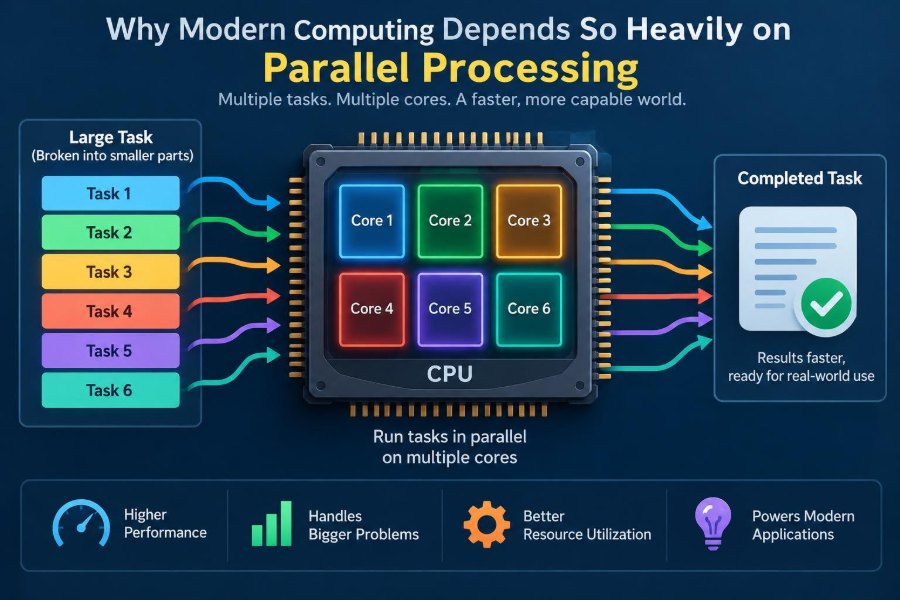
Parallel processing means using multiple processing resources to perform multiple parts of a computation during overlapping periods of time. Those resources may be CPU cores, graphics-processing units (GPUs), machines in a data center, or specialized accelerators.
Imagine sorting a large stack of forms. One person can process them in sequence. Several people can split the stack, process separate groups, and combine the results later. The second arrangement is parallel only if the work can safely be divided and the coordination does not overwhelm the benefit.
⏱️ Parallelism Is Not the Same as Concurrency
Concurrency is about managing several tasks that make progress during the same overall period. A single CPU core can switch rapidly among a browser, a music player, and the operating system, creating a responsive experience without literally executing all instructions at one instant.
Parallelism means tasks actually execute simultaneously on separate hardware resources. Modern systems commonly use both: concurrency keeps many activities organized, while parallel hardware performs some of them at the same time.
📈 Why Faster Clock Speeds Stopped Being Enough
For many years, raising a processor’s clock speed was a major route to better performance. Higher frequencies, however, increase power use and heat, and chips have practical limits on how much heat they can remove.
Manufacturers increasingly improved performance by placing multiple cores on a chip and by adding highly parallel units. This changed the challenge for software: instead of waiting for one ever-faster instruction stream, programs need ways to expose useful independent work.
🔥 The Power and Heat Constraint
Every computation consumes energy, and a portion becomes heat. A device cannot continuously generate more heat than its cooling system can handle without slowing down, becoming unstable, or shortening component life.
Multiple modestly clocked cores can often deliver more total work per unit of energy than one aggressively clocked core. The details vary by chip and workload, but the broad engineering trade-off pushed computing toward parallel designs.
🧠 Multicore CPUs Bring Parallelism to Everyday Devices
A CPU core can independently fetch and execute instructions. A multicore laptop processor might dedicate time to an operating-system service, a browser tab, a video decoder, and a background backup task, reducing the chance that one activity freezes everything else.
More cores do not make every app proportionally faster. They do make it easier for a general-purpose computer to remain responsive while mixed workloads compete for attention.
🧵 Threads Divide a Program’s Work
A process is a running program with its own resources. A thread is an execution path within a process. Programs often create threads so independent activities can run separately, such as receiving network data while updating a user interface.
Threads can share memory, which makes communication convenient but introduces risk. If two threads change the same data at the wrong time, the program may produce an incorrect result that appears only occasionally.
🗓️ The Operating System Schedules the Crowd
The operating system’s scheduler decides which runnable threads get time on available cores. It considers priorities, fairness, responsiveness, power policies, and whether a thread is waiting for input or data.
Scheduling is why a device can appear to do many things at once even when it has fewer cores than active tasks. The scheduler cannot create unlimited processing capacity, but it can allocate scarce capacity so interactive work is not needlessly delayed.
🎮 GPUs Are Built for Many Similar Calculations
GPUs were designed to render graphics, where millions of pixels and vertices often require similar calculations. Rather than optimizing only for one complicated instruction stream, they contain large numbers of simpler execution units that can apply the same style of operation across many data items.
This design is especially effective when tasks have regular structure. Coloring pixels, transforming image data, and applying the same mathematical operation to large arrays are natural GPU workloads.
🖼️ Rendering a Frame Is a Parallel Workload
To display a 3D scene, a system transforms object geometry, determines visible surfaces, applies lighting, and computes colors for many pixels. Much of this work can be distributed because one pixel’s final color often depends primarily on local information.
There are dependencies and shared resources, so graphics pipelines carefully order certain stages. Still, the enormous number of repeated calculations makes graphics a clear example of why parallel hardware is useful.
🤖 AI Relies on Repeated Matrix Operations
Many machine-learning models spend substantial time multiplying matrices and applying related operations over large sets of numbers. These calculations contain many pieces that can be evaluated in parallel, which is why GPUs and AI-oriented accelerators are commonly used for training and inference.
Parallel hardware does not make an AI system inherently accurate or appropriate. It makes particular numerical workloads more practical to run at useful scale and speed.
📷 Media Processing Happens in Several Streams
When a phone records video, it may capture sensor data, stabilize frames, encode video, process audio, save files, and update the preview. Dedicated media hardware and parallel software pipelines help these stages overlap instead of forcing every frame through one long serial path.
The same pattern appears in streaming services: one system may transcode different portions or versions of a video concurrently for different device and bandwidth needs.
🌐 Data Centers Scale Beyond One Machine
Some tasks exceed the memory, storage, or processing capacity of a single computer. Cloud platforms and large online services distribute work among many machines, often called distributed systems.
A search request, for example, can involve separate services for retrieval, ranking, security checks, personalization, and logging. Each service may itself run across multiple servers. Distribution enables scale, but network delays and failures become part of the design problem.
🧱 Divide-and-Conquer Makes Work Shareable
A common strategy is divide and conquer: break a large problem into smaller subproblems, solve them independently where possible, then combine their outputs. Sorting, image tiling, simulations, and batch data analysis often use this pattern.
Good partitions are reasonably balanced. If one worker receives most of the difficult work while others finish early, the whole job still waits for the slowest partition.
🔗 Dependencies Create the Serial Bottleneck
Not every instruction can start immediately. A calculation such as total = price + tax must wait until both values are known. A program may also need one phase to finish before the next phase has meaningful input.
This unavoidable sequential portion limits speedup. Adding workers helps only the parts that are independent, so finding dependencies is as important as finding tasks.
📐 Amdahl’s Law Sets a Reality Check
Amdahl’s law expresses a practical lesson: the serial fraction of a task places a ceiling on the speedup gained from extra processors. If setup, coordination, or a final combining step must happen one at a time, those stages eventually dominate.
The law is not a reason to avoid parallelism. It is a reminder to measure the whole workflow. Optimizing a highly parallel stage may have little user-visible effect when a serial database query or file read remains the longest delay.
📬 Communication Can Cost More Than Computation
Workers must sometimes exchange data, request shared resources, or report results. On one chip, that can mean moving data through memory caches; across machines, it can mean network messages with far greater delay.
A distributed job with tiny tasks may spend more time coordinating than calculating. Effective systems choose task sizes large enough to justify communication, while avoiding chunks so large that load becomes unbalanced.
🧮 Memory Bandwidth Is a Hidden Limit
Processors need a steady supply of instructions and data. Memory bandwidth is the rate at which data can be transferred between memory and processing units. Many cores may sit idle if they all compete for data from the same memory subsystem.
Programs can improve matters by accessing nearby data together, reusing values already in fast cache memory, and avoiding unnecessary copies. In parallel computing, moving data efficiently is often as important as performing arithmetic.
🔒 Shared Data Requires Coordination
When several threads access shared data, programs use mechanisms such as locks, atomic operations, or message passing. A lock allows one thread at a time to enter a critical section, protecting an update that must not be interrupted.
Coordination preserves correctness, but too much of it forces workers to wait. The design goal is not to eliminate synchronization; it is to keep shared mutable state small and make ownership of data clear.
⚠️ Race Conditions Produce Elusive Bugs
A race condition occurs when a program’s outcome depends on the unpredictable order in which concurrent operations occur. Suppose two threads both read an account balance, each subtracts an amount, and both write back a result. One update can overwrite the other.
These bugs may disappear during debugging because timing changes. Testing under load, using well-designed synchronization, and favoring simpler data flow are more reliable defenses than assuming a bug cannot happen.
🚧 Deadlocks Can Stop All Progress
A deadlock occurs when tasks wait indefinitely for resources held by one another. For example, Thread A holds lock one and waits for lock two, while Thread B holds lock two and waits for lock one.
Teams reduce this risk by defining a consistent lock-acquisition order, keeping locked sections short, and using higher-level concurrency tools when possible. A program can have plenty of CPU cores and still make no progress if its workers are blocked.
⚖️ Not Every Task Should Be Parallelized
Small tasks, highly sequential algorithms, and work dominated by input/output may gain little from added threads. Creating tasks, scheduling them, synchronizing access, and merging results all have overhead.
A useful rule is to parallelize where the work is substantial, independent, and measurable. First identify the actual bottleneck with profiling tools; do not assume that a slow program needs more threads.
🧪 Profiling Reveals the Real Bottleneck
Profiling measures where a program spends time, how often functions run, and sometimes how threads wait or contend for resources. It can reveal that an apparent CPU problem is actually slow storage, network latency, inefficient queries, or repeated allocation.
Measure a representative workload before and after a change. Parallel optimizations can shift the bottleneck elsewhere, so a speedup in one function is not enough evidence that the full application improved.
🛠️ Common Parallel Programming Models
Different problems call for different ways of expressing parallel work. The model should match data ownership, task relationships, and the hardware being targeted.
| Model | Core idea | Typical fit |
|---|---|---|
| Threads with shared memory | Workers access common in-process data | Multicore desktop and server software |
| Message passing | Workers exchange explicit messages | Services and distributed systems |
| Data parallelism | Apply one operation across many items | Images, arrays, GPU workloads |
| Task parallelism | Run distinct tasks concurrently | Pipelines and mixed application work |
No model removes trade-offs. Shared memory can be convenient but risky; messages clarify boundaries but add transfer and coordination costs.
🚇 Pipelines Improve Throughput
A pipeline divides work into stages that operate concurrently on different items. In a hypothetical document-processing service, one stage reads files, another extracts text, a third analyzes it, and a fourth stores results.
After the pipeline fills, several documents can be in different stages at once. This improves throughput—the amount completed over time—even if the time for one individual document is not reduced by the same amount.
📊 Latency and Throughput Are Different Goals
Latency is the delay before one result arrives. Throughput is the rate at which a system finishes work. Parallelism can help either, but optimizing for one may hurt the other.
Batching requests may raise throughput because workers handle groups efficiently, while making an individual request wait longer. An interactive app usually prioritizes predictable latency; an overnight analytics job may prioritize total throughput.
🔋 Parallel Hardware Also Affects Battery Life
Using more hardware at once can consume more instantaneous power. Yet finishing a suitable task quickly and allowing components to return to lower-power states can sometimes be energy-efficient.
The outcome depends on the workload, device, and software behavior. Unnecessary background parallel work can drain a battery, while well-targeted hardware acceleration can reduce the energy needed for demanding media or graphics tasks.
🛡️ Reliability Gets Harder Across Many Machines
With enough servers, occasional machine failures, delayed messages, and partial outages are normal operating conditions rather than exceptional events. Distributed systems use replication, retries, health checks, and carefully designed recovery processes to keep services available.
These tools introduce their own complications. A retry can accidentally repeat an operation, and replicas can temporarily disagree. Parallel scale therefore requires explicit thinking about failure, not just faster execution.
👨💻 Practical Habits for Developers
Most programmers do not need to write low-level thread code for every feature. Libraries, runtimes, databases, and cloud platforms often provide safe abstractions for parallel work. The responsibility is to understand what they do and where their limits are.
- Start with a clear correctness test before optimizing.
- Profile representative data rather than a tiny artificial example.
- Choose bounded worker pools instead of creating unlimited threads.
- Keep tasks independent and data ownership explicit where possible.
- Test under load and on hardware closer to the deployment environment.
- Measure end-to-end latency, throughput, memory use, and energy when relevant.
🏢 What Working Professionals Should Recognize
Parallelism influences product decisions well beyond programming. A data-reporting process may finish sooner by running independent jobs together, but it may also increase cloud cost or place pressure on a shared database. A real-time feature may need a low-latency design rather than a high-throughput batch system.
When evaluating a technical proposal, useful questions include: What work is independent? What shared resource will become constrained? How will failures be handled? What user-facing metric should improve? These questions turn “use more compute” into an engineering plan.
🧭 The Core Principle: Coordinate Independent Work Wisely
Modern computing depends heavily on parallel processing because workloads have grown while power, heat, and response-time constraints limit the value of a single faster processor. Multicore CPUs, GPUs, accelerators, and distributed systems provide capacity by working on many pieces at once.
But parallelism succeeds only when work is divisible, communication is controlled, shared state is protected, and the remaining serial path is understood. The best design is rarely the one with the most workers; it is the one that uses the right degree and form of parallelism for a measured problem.
Parallel processing is the discipline of turning independent work into coordinated progress—without letting coordination become the new bottleneck. That principle explains both the speed of modern systems and the care required to build them well. 💻🧩⚡