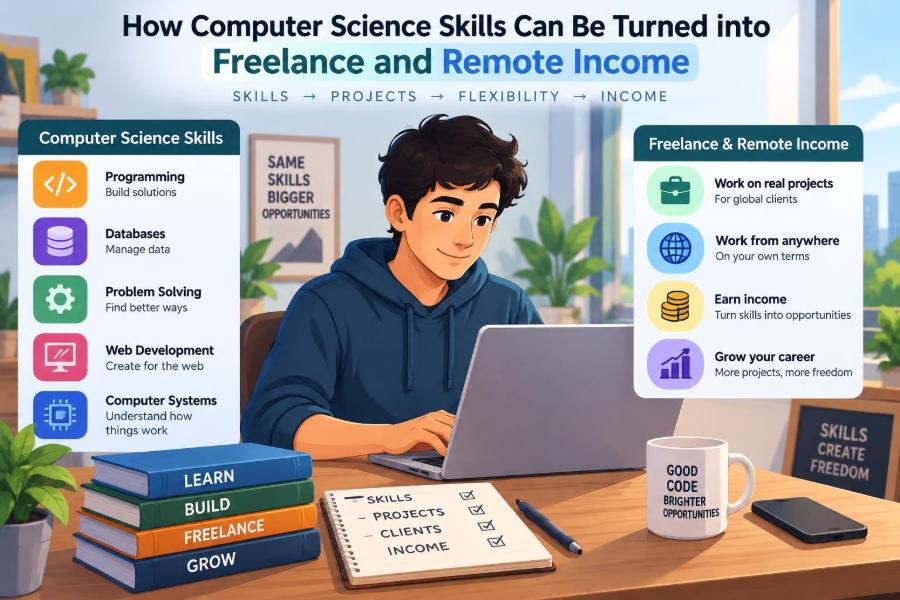

A student may finish a programming assignment and wonder whether that same skill has value outside a classroom. A working professional may automate a repetitive spreadsheet task and realize that many small businesses face similar problems every week.
Computer science skills can create remote and freelance opportunities because software, data, systems, and digital products can often be built, maintained, or explained from anywhere. But turning skills into income is not as simple as opening a profile and waiting for work to appear.
Clients do not usually buy “computer science.” They buy a clearer website, a faster internal process, a reliable app, useful data, safer infrastructure, or help solving a technical bottleneck. Learning to translate technical ability into those outcomes is the central challenge.
This path can be flexible and rewarding, but it also involves uncertainty, communication, contracts, self-management, and continuous learning. A practical approach is more valuable than chasing every remote job trend.
🧭 Start with the Difference Between Skills and Services
A skill is an ability, such as writing Python, designing databases, testing software, or analyzing logs. A service is a defined result that a client can understand and purchase.
For example, “I know JavaScript” is broad. “I build responsive landing pages for local service businesses” describes an outcome, a technology, and a likely customer. The second statement makes it easier for a client to decide whether to contact you.
Freelance work begins when technical knowledge is packaged into a useful offer with a clear boundary.
🎯 Identify Problems Worth Solving
Good opportunities often begin with ordinary frustrations: copied data between systems, slow reports, outdated websites, confusing booking forms, or an application that breaks after a small change.
Listen for repeated manual work. If someone spends hours each week moving information from one spreadsheet to another, a script, integration, or small internal tool may help. The value is not the code itself; it is the time, errors, and frustration the code reduces.
A useful question is: what becomes easier, faster, safer, or more reliable after this work is complete?
🧩 Choose a Practical Starting Niche
You do not need to specialize forever, but a starting niche prevents an unfocused portfolio. It can be based on a technology, a type of problem, or an industry you understand.
- Front-end development for small business websites
- Python automation for operations teams
- Data dashboards for nonprofit organizations
- Quality assurance testing for web applications
- Technical documentation for software products
- WordPress maintenance for organizations without an internal developer
A niche is not a restriction on curiosity. It is a way to make your first offers easier to explain and your early examples easier to compare.
🛠️ Match Computer Science Areas to Real Work
Computer science is broad, and different areas lead to different forms of remote income. Some work is project-based, while other work is ongoing support or employment.
| Area | Possible service | Typical deliverable |
|---|---|---|
| Web development | Build or improve a site | Responsive pages, forms, deployment notes |
| Data | Clean, analyze, or visualize information | Dashboard, report, repeatable data workflow |
| Automation | Reduce repetitive tasks | Script, integration, instructions, error handling |
| Testing | Find defects and improve release confidence | Test plan, bug reports, automated test suite |
| Cloud and systems | Configure, monitor, or maintain infrastructure | Deployment setup, alerts, documented procedures |
| Security | Improve basic security practices | Review findings and prioritized remediation plan |
Security and infrastructure work can carry serious consequences. Only offer services you are qualified to perform, and be explicit about the limits of a review or assessment.
🌱 Build Skills Deeply Enough to Deliver
Clients rarely need someone who has watched a tutorial. They need someone who can work through ambiguity: interpret requirements, handle errors, test changes, and explain trade-offs.
For a web developer, that might mean understanding forms, accessibility, mobile layouts, source control, and deployment—not just copying a component. For a data freelancer, it means checking whether the source data is incomplete or inconsistent before creating attractive charts.
Depth grows through complete small projects. Build, test, document, and revise them as though another person will rely on them.
📚 Turn Coursework into Evidence of Ability
Class projects can become portfolio material when they are presented honestly. A database assignment, scheduling app, compiler exercise, or data analysis project may show valuable reasoning even if it was not built for a paying client.
Remove private material, respect academic rules, and clearly state that the work was educational. Then explain the problem, your role, the technical choices, and what you would improve with more time.
A recruiter or client learns more from a clear project explanation than from a long list of course names.
🧪 Create Portfolio Projects with Realistic Constraints
Personal projects become stronger when they solve a believable problem. A generic to-do list is useful for practice, but it says little about how you handle real constraints.
Try a project such as a booking system prototype, inventory dashboard, expense-import tool, or accessible event page. Include validation, empty states, error messages, basic security considerations, and concise setup instructions.
These details demonstrate professional habits. They show that you think beyond the “happy path,” meaning the one ideal situation where every input and network request works perfectly.
🗂️ Make Each Portfolio Case Study Easy to Scan
A portfolio does not need elaborate design. It needs enough context for a busy reader to understand what you did and why it matters.
- Problem: What user or business need did the project address?
- Approach: What did you build, and which key choices did you make?
- Technology: Which languages, frameworks, tools, or services were involved?
- Evidence: Show screenshots, a short demo, code excerpts, or test results where appropriate.
- Lessons: Explain one challenge and how you addressed it.
Avoid claiming results you cannot verify. If a project is hypothetical, label it as a prototype or demonstration.
🧑💻 Decide Between Freelancing and Remote Employment
Freelancing and remote employment both use similar technical skills, but they organize risk differently. A freelancer finds clients, defines work, invoices, and manages gaps between projects. A remote employee usually has a manager, a continuing role, and a more predictable pay structure.
Some people begin with freelance work while studying or alongside a job. Others seek a remote junior role first, where code review and team processes offer structured learning. Neither route is automatically better.
Your financial needs, available time, appetite for sales work, and desire for mentorship should influence the choice.
🔎 Find Work Where Clients Actually Look
Freelance marketplaces can provide early exposure to real requests, but they are competitive and vary in quality. Professional communities, local businesses, former classmates, open-source communities, and referrals can also lead to work.
For remote employment, company career pages, technical job boards, professional networks, and communities centered on a specific technology can be useful. Tailor your application instead of sending the same generic message everywhere.
Wherever you search, treat a listing as a problem description. Your response should show that you understood that problem.
✉️ Write Proposals That Address the Actual Need
A strong proposal is brief, specific, and realistic. It should not promise a full solution before you have seen the system, data, or requirements.
Start by naming the client’s stated goal. Then mention relevant experience or a similar portfolio example, ask one or two useful questions, and suggest a sensible next step.
For example: “You need to import weekly supplier files and flag missing values. I have built Python-based data-cleaning workflows. Are the files consistently formatted, and should the output be a spreadsheet or a dashboard?” This is more credible than “I can do anything quickly.”
🗣️ Treat Communication as a Technical Skill
Remote work makes communication part of delivery. A client cannot see your progress at a nearby desk, so they need concise updates, documented decisions, and timely questions.
Before beginning, restate the goal in plain language. During work, report progress and blockers without flooding the client with detail. At handoff, explain how to use the result and what maintenance it may need.
Clear writing reduces rework because misunderstandings are found before they become expensive changes.
📝 Define Scope Before Writing Much Code
Scope is the agreed boundary of work: what will be delivered, what will not be delivered, when feedback is needed, and what counts as completion. Vague scope is one of the most common sources of stressful projects.
A simple website request can quietly expand into logo design, copywriting, search optimization, booking integration, analytics, hosting, and ongoing edits. These may all be useful, but they are separate decisions.
Write down the deliverables, assumptions, revision limits, timeline, and acceptance criteria. If the request changes, discuss its effect on cost or schedule before continuing.
💵 Price the Work with More Than Coding Time in Mind
Pricing can be hourly, fixed-price, or based on a continuing monthly arrangement. Each model has trade-offs. Hourly billing fits uncertain tasks, while a fixed price can work when the scope is well understood.
Include time for discovery, meetings, testing, deployment, documentation, revisions, and administration. A task that takes four hours of programming may require additional time to clarify, deliver, and support.
Do not invent certainty where none exists. For unclear work, begin with a paid discovery phase or use an estimate range tied to stated assumptions.
📄 Use Written Agreements and Clear Payment Terms
Even a small project benefits from a written agreement. The exact legal requirements depend on location and circumstances, so seek appropriate local advice for important contracts or tax questions.
At a minimum, document the work scope, payment schedule, ownership of deliverables, confidentiality expectations, revision process, cancellation terms, and responsibilities for third-party accounts or subscriptions.
For larger fixed-price projects, staged payments can reduce risk for both sides. A client receives visible progress, and the freelancer is not doing all work before receiving any payment.
🔐 Protect Accounts, Code, and Sensitive Data
Remote technical work may involve customer records, credentials, production systems, or private source code. Convenience is not a reason to treat these casually.
- Use unique passwords and multi-factor authentication.
- Request only the access needed for the task.
- Do not place secrets such as API keys in public repositories.
- Use approved sharing methods rather than sending credentials in ordinary messages.
- Remove access when the project ends, where appropriate.
If a client asks you to bypass security controls or handle sensitive data without clear authorization, pause and clarify the situation.
✅ Test Deliverables Before the Handoff
Testing is not only for large software companies. A freelancer should verify the core user journey: forms submit correctly, pages work on common screen sizes, data outputs match expectations, and instructions can be followed by someone else.
For automation, test normal inputs and problematic cases such as missing columns or duplicate records. For a website, check broken links, keyboard navigation, and basic loading behavior.
A short handoff checklist prevents avoidable disappointment and signals care.
📦 Deliver More Than a Folder of Files
A useful handoff includes the product and the context needed to operate it. If a client receives a script but cannot run it, or a site but cannot update it, the work is incomplete from their perspective.
Provide concise documentation covering setup, credentials ownership, routine tasks, known limitations, and support boundaries. Record a short walkthrough only if it genuinely helps the client use a complex result.
Good documentation also protects you from repeated questions that were already answered at delivery.
🔁 Build Recurring Income Carefully
One-off projects can lead to recurring work when a client needs maintenance, monitoring, content updates, reporting, or gradual improvements. This can make income less uneven than relying only on new projects.
However, recurring support must be defined. “Available whenever needed” is not a workable service unless response times, included hours, emergency expectations, and extra charges are clear.
A modest maintenance plan can be valuable when it includes specific tasks, such as updates, backups checks, monthly reports, or a defined support window.
🤝 Earn Trust Through Reliability, Not Grand Promises
Technical ability matters, but reliability often determines whether clients return. Meeting an agreed deadline, warning early about a risk, documenting changes, and admitting uncertainty build more trust than overconfident language.
If you discover that a request will take longer than expected, explain why in terms the client can understand. Offer options: reduce the scope, extend the timeline, or approve additional work.
Trust is cumulative. Small, well-managed assignments often create better opportunities than a single dramatic promise.
📈 Ask for Feedback and Use It as Evidence
After completing work, ask whether the deliverable solved the intended problem and whether any part of the process could be improved. This helps you refine your service, not merely collect praise.
With permission, a short testimonial or portfolio note can help future clients understand your reliability. Keep it accurate and avoid editing feedback into claims the client did not make.
You can also turn recurring questions into better onboarding documents, templates, and checklists for future projects.
⏱️ Manage Time Across Delivery and Business Tasks
Freelancers are responsible for work that clients see and work they do not see: proposals, accounting, learning, backups, scheduling, and follow-up. Ignoring the second category can create chaos even when technical work is strong.
Reserve time for administration instead of treating it as an interruption. Use a task system, calendar blocks, and a simple record of project decisions.
Remote employees need similar discipline. Being visible through useful updates and dependable follow-through matters more than appearing constantly online.
🌍 Handle Remote Collaboration Across Time Zones
Distributed teams need agreed communication habits. State your working hours, preferred contact methods, and expected response window. Do not imply that you are available around the clock if you are not.
Asynchronous communication—messages and documents that people can answer later—works well when decisions are written clearly. A short recorded demonstration or a well-structured issue description can save a meeting.
For meetings, confirm time zones and summarize decisions afterward. This simple habit prevents conflicting memories of what was agreed.
🚩 Recognize Risky Clients and Suspicious Offers
Not every opportunity is legitimate or well managed. Warning signs include requests for free “test work” that is actually useful production work, pressure to begin without written terms, unclear payment methods, or requests to use your personal accounts for their business activity.
Be especially cautious with offers that ask you to receive or transfer money, purchase equipment through unusual arrangements, or share identity documents before there is a credible reason. Technical workers can also be targeted by requests to build deceptive, abusive, or unauthorized tools.
Leaving a questionable opportunity is often safer than trying to rescue it through optimism.
⚖️ Avoid Overpromising and Underestimating Complexity
New freelancers often accept work outside their current ability because they fear losing an opportunity. Stretch projects can be healthy, but taking responsibility for systems you cannot safely support can harm both client and freelancer.
Be honest about what you know, what you need to investigate, and where a specialist may be needed. You can offer a smaller, well-defined piece of work rather than claiming ownership of an entire complex system.
This is especially relevant for payment systems, medical information, security-sensitive applications, and production infrastructure.
🧠 Use Open Source and AI Tools Responsibly
Libraries, code examples, and AI-assisted tools can speed up development, but they do not remove responsibility. Review generated code, understand its behavior, test it, and check whether it exposes sensitive information or creates a maintenance problem.
Open-source software has licenses that may affect how code can be used or distributed. Read the relevant license and avoid copying material with unclear origin into client work.
Never paste confidential code, private data, or credentials into tools unless the client has approved that use and the tool’s data handling is appropriate.
🎓 Keep Learning Through Paid Work Without Stagnating
Real projects reveal gaps that tutorials may hide: estimating effort, debugging unfamiliar environments, interpreting vague requests, and supporting other people’s workflows. Capture these lessons after each project.
Choose learning goals that support the direction you want to take. If you want to move from simple websites toward web applications, strengthen databases, authentication concepts, testing, deployment, and application security rather than collecting unrelated certificates.
A learning plan should improve the next service you can responsibly offer.
🪜 A Sensible First 90-Day Approach
A structured beginning reduces the pressure to become an expert in everything at once. The goal is to create evidence, learn from small interactions, and improve your process.
- Choose one service area and identify the kinds of problems it solves.
- Complete two or three portfolio projects with clear case studies.
- Create a simple professional profile and a concise service description.
- Reach out to suitable opportunities with tailored proposals.
- Use written scope, regular updates, and a tested handoff for every project.
- Review what took longer than expected and adjust your process.
The first project may be modest. Its purpose is not to prove that you know everything; it is to prove that you can finish useful work responsibly.
🏁 Turn Technical Ability into Sustainable Value
Computer science skills become freelance or remote income when they are connected to a specific need, demonstrated through credible work, and delivered with professional discipline. Code is only one part of the service.
The durable advantages are often less glamorous: asking good questions, defining scope, protecting data, testing carefully, communicating clearly, and continuing to learn. These practices make technical work dependable for people who may not understand the technology themselves.
Start small enough to deliver well, then let completed work guide your next specialization. A sustainable career is built through repeated evidence that you can solve the right problem—not through a single tool, platform, or impressive-sounding title.
The most reliable route from computer science knowledge to remote income is to combine useful technical skills with clear outcomes, trustworthy delivery, and steady improvement. 💻🌍🚀