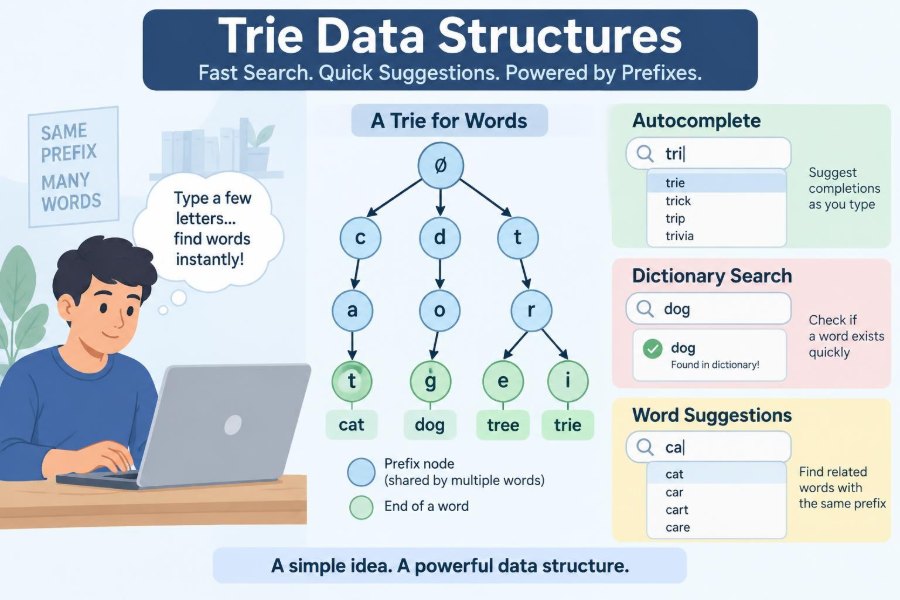

You begin typing a search query: resta… Before you finish, your phone offers “restaurants near me,” “restaurant reservations,” and “restaurant menu.” The response feels immediate, even though the system may be choosing from millions of possible phrases.
A spell checker can tell that a word is unfamiliar. A contacts app can find every person whose name starts with “Sam.” A code editor can suggest functions after a few keystrokes. These features need a fast way to organize text, especially text that shares beginnings.
A trie is one of the classic data structures built for exactly that job. It stores strings by their characters and lets related words share the same path, making prefix-based tasks surprisingly efficient.
Tries are not the right answer for every search problem. But once you understand their structure, many everyday text features become easier to explain—and easier to build.
🌳 What Is a Trie?
A trie, often pronounced “try,” is a tree-shaped data structure for storing strings. Each node represents a character, and a path from the root through several nodes represents a prefix or complete word.
For example, a trie containing cat, car, and dog starts with an empty root node. From there, one branch follows c → a, then divides into t and r. A separate branch follows d → o → g.
The name comes from “retrieval,” reflecting the structure’s original purpose: retrieving stored strings efficiently.
🧩 The Central Idea: Shared Prefixes
The defining feature of a trie is that words with the same beginning reuse the same nodes. The words care, careful, and career all share the path for c → a → r → e.
This differs from storing every word as a completely separate object. Rather than repeating the letters in a common prefix, the trie represents that prefix once and branches only when the words differ.
That shared structure is why tries are naturally suited to questions such as, “What stored words begin with these letters?”
🗂️ Why Ordinary Lists Are Often Too Slow
Suppose a program keeps a dictionary in an unsorted list. To check whether computer exists, it may need to compare the query with many stored words one by one.
Finding all words beginning with comp is even more work. The program must inspect every candidate and test whether its first four characters match the prefix.
A trie instead follows the letters c, o, m, and p directly. If that path does not exist, no stored word has that prefix. If it does exist, all matching words lie below that point.
🔤 Nodes, Edges, and Characters
Like other trees, a trie has nodes and edges. An edge connects one node to another. In a character trie, taking an edge means consuming one character from a string.
There are two common ways to describe the character placement. Some diagrams place a character inside each child node; others put the character on the edge leading to that node. Both describe the same logical structure.
What matters is the path. Walking from the root along c → a → t means that the trie recognizes the sequence cat.
🏁 Why End-of-Word Markers Matter
A path alone does not always mean a complete stored word. If the trie contains car and cart, both paths include c → a → r, but only one continues to t.
Each node therefore usually stores a Boolean flag such as isWord, terminal, or isEnd. The node for r is marked as a word ending for car; the node for t is marked separately for cart.
Without this marker, a program could confuse a prefix with a word and incorrectly report that car is absent or that ca is a stored word.
➕ Inserting a Word Step by Step
To insert a word, begin at the root and process its characters from left to right. For each character, follow the matching child if it exists; otherwise, create a new child node.
Imagine adding can to a trie that already contains cat. The nodes for c and a already exist, so insertion reuses them. The algorithm adds a new n child beneath a and marks it as a word ending.
- Start at the root.
- For each character, find or create the corresponding child.
- Move to that child.
- After the last character, mark the current node as a complete word.
Repeated insertion of the same word should not create duplicates if the implementation simply sets an already-true end marker.
🔎 Exact Word Lookup
Looking up a word uses nearly the same traversal as insertion, except no nodes are created. For table, the algorithm attempts to follow t → a → b → l → e.
If any required child is missing, the word is not present. If the entire path exists, the final node must also have its end-of-word marker set to true.
This final check is essential. A trie containing tables has a path for table, but table itself is present only if its node is marked as a completed word.
🚪 Prefix Lookup Is a Different Question
An exact lookup asks, “Is this full string stored?” A prefix lookup asks, “Does any stored string begin this way?” Those questions produce different answers.
If a trie stores network, the prefix net exists even if net was never inserted as a standalone word. The program only needs to confirm that it can traverse to the node for t.
This small distinction powers autocomplete. The typed text is often incomplete, so an application cares more about whether a prefix leads somewhere than whether it is already a complete entry.
⚡ Time Complexity in Plain Language
For insertion, exact lookup, or prefix lookup, a trie generally performs work proportional to the number of characters in the input. If a query has length L, the traversal is commonly described as O(L).
This does not mean every operation takes identical real-world time. Accessing child nodes, memory layout, character encoding, and cache behavior all matter. Still, the major point is useful: the search follows the query’s characters instead of comparing against every stored word.
With hash tables, lookup is often fast for exact matches too. A trie’s special advantage appears when the application needs prefix navigation, ordered traversal, or character-by-character matching.
🧠 Space Complexity and Its Trade-Off
Tries can save space by sharing prefixes, but they can also consume substantial memory. Each node may need child references, an end marker, counters, and possibly metadata such as word frequency.
A sparse collection of unrelated strings gets little sharing. For example, words beginning with many different characters create many separate early branches. A naïve node with a fixed array for every possible character may waste much more space than the text itself.
Fast prefix operations are often purchased with extra pointer or map overhead. Whether that trade-off is worthwhile depends on the dataset and the features the application needs.
🔡 Choosing a Child Representation
The child nodes of a trie can be stored in several ways. The choice affects speed, memory use, and implementation complexity.
| Representation | Strength | Limitation |
|---|---|---|
| Fixed array | Direct access for a small, known alphabet | Many unused slots can waste memory |
| Hash map | Stores only children that exist | Hashing adds overhead and order is not inherent |
| Sorted map | Supports ordered child traversal | Usually slower than direct indexing |
| Compact edge list | Can be memory-efficient for few children | Finding a child may require scanning or searching |
For a classroom trie limited to lowercase English letters, an array of 26 child references is easy to understand. Production systems often need a more flexible representation because text includes punctuation, accents, symbols, and multiple writing systems.
⌨️ How Autocomplete Uses a Trie
Autocomplete usually begins with a prefix search. After a person types pro, the system finds the trie node reached by that prefix. Every completed word below that node is a possible suggestion.
The application then needs a ranking strategy. It might prefer frequently selected queries, recently used contacts, locally relevant places, or results matching additional context. The trie finds candidates; it does not automatically decide which candidate is best.
For a small dictionary, the system can traverse the subtree and collect words. For a large service, nodes may store extra ranking information so the application can return a few strong suggestions without scanning every descendant.
📱 A Simple Contact Search Example
Consider a contacts app containing Samira, Samuel, Sandra, and Priya. When the user types Sa, the trie reaches the shared prefix node for S → a.
From there, the app explores only the branches beneath that node. It does not need to inspect Priya, because that name lives under a different first-character branch.
Real contact search often adds normalization rules. “Samantha Lee,” “sam lee,” and “SÁM” may be converted into a consistent searchable form while the app preserves the original display spelling.
📚 Dictionary Searches and Spell Checking
A dictionary trie can answer exact membership questions quickly: “Is this sequence stored as a valid dictionary entry?” A spell checker may use that answer as one signal that a word needs review.
However, a simple dictionary lookup is not the entire spell-checking problem. Proper nouns, technical vocabulary, inflected forms, abbreviations, and regional spelling variants can all be valid in context but absent from one dictionary.
For suggestions, the system needs more than an exact trie search. It may search for nearby words based on likely typing mistakes, edits, phonetic similarity, or language-specific rules.
✏️ Word Suggestions Need Ranking
Suppose someone types recieve. Several dictionary words may be close enough to propose, including receive. A trie can help organize the candidate vocabulary, but a suggestion engine still needs a way to measure closeness.
A common concept is edit distance: the number of insertions, deletions, replacements, and sometimes swaps needed to transform one string into another. Searching a trie while tracking possible edits can prune many impossible paths.
The final ordering may combine spelling distance with word popularity, user history, grammar, or the words surrounding the mistake. A technically close word is not always the most useful suggestion.
🧭 Traversing a Trie to List Words
To list every word with a prefix, first traverse to the prefix node. Then perform a depth-first or breadth-first traversal through its descendants, carrying the characters encountered along the way.
Whenever traversal reaches a node marked as a complete word, the accumulated path is emitted as a result. For prefix app, a trie might produce app, apple, apply, and appointment.
Depth-first traversal is convenient for generating all completions. Breadth-first traversal can be useful when shorter completions should be discovered earlier, though real suggestion ranking often requires a separate priority system.
🗑️ Deleting Words Without Breaking Others
Deletion is more delicate than insertion because paths can be shared. If a trie stores bat and batch, deleting bat must not remove the nodes needed for batch.
The safe first step is to clear the end-of-word marker at the final node. Nodes should be physically removed only when they are no longer part of another word and have no children leading to longer entries.
Many implementations use a recursive cleanup process while returning from the final character toward the root. Others keep reference counts or defer cleanup when simplicity matters more than reclaiming every unused node immediately.
🌐 Unicode, Case, and Text Normalization
Characters are more complicated than the 26 lowercase letters used in introductory examples. Modern text can include accents, emoji, combining marks, scripts with large character sets, and characters that look similar but have different underlying representations.
A product must decide what users should be able to find. Should cafe match café? Should uppercase and lowercase be equivalent? Should punctuation in phone numbers or product codes be ignored?
These are product and language decisions, not just implementation details. Normalize input consistently for searching, but retain original text for display when spelling and capitalization matter.
🔐 Sensitive Suggestions Require Care
Autocomplete can expose information unexpectedly. A shared device might reveal recent searches, private contacts, medical terms, or internal project names after only a few typed characters.
Systems handling personal data should consider whether suggestions are local or shared, how long history is retained, who can access it, and whether sensitive entries should be excluded. A technically correct trie can still produce an unsafe user experience if the data policy is careless.
Permissions, account boundaries, encryption at rest, and clear controls for clearing history belong to the broader design. The data structure does not solve these issues on its own.
🧱 Trie Variants for Large Datasets
Basic tries are conceptually simple, but large collections motivate more compact variants. A compressed trie, also called a radix tree or Patricia-style trie in related contexts, combines chains of single-child nodes into one edge label.
Instead of storing separate nodes for i → n → t → e → r, a compressed structure may store inter as one labeled edge until a branch is needed. This reduces node overhead and can improve memory efficiency.
Other specialized structures include ternary search trees, which store character comparisons in a three-way tree, and minimal finite-state structures that merge not only prefixes but sometimes equivalent suffix behavior. These designs bring useful savings at the cost of simpler implementation.
🗜️ Compressed Tries in Practice
Path compression works best when the basic trie contains long stretches with no branching. Consider terms such as international and internet: they share an early prefix, then branch. Before and after branches, several one-child paths may be compacted.
Searching remains conceptually similar, but the algorithm compares multiple characters from an edge label at once. Insertion and deletion become more involved because an edge may need to split when a new word diverges in the middle of its label.
Compressed tries are a reminder that a data structure is not a single fixed object. It is a family of design choices shaped by workload, memory limits, and required operations.
⚖️ Trie vs. Hash Table
A hash table is often an excellent choice for exact word membership. Insertions and lookups are typically very fast on average, and the implementation can be compact when prefixes do not matter.
But hash tables do not naturally group keys by beginning characters. To find all keys beginning with trans, an ordinary hash table generally needs extra indexing or a scan through stored keys.
Choose a trie when prefix search, incremental typing, or lexicographic traversal is central. Choose a hash table when the primary operation is exact lookup and memory or engineering simplicity matters more than prefix-oriented features.
📈 Trie vs. Sorted Arrays and Trees
A sorted array can support binary search for an exact word. It can also locate the range where a prefix would appear, which makes it useful for mostly static dictionaries. Its weakness is insertion: keeping the array sorted may require shifting many items.
Balanced search trees support ordered operations and dynamic updates. They compare whole strings rather than following one character at a time, so their performance depends partly on how far comparisons must scan before finding a difference.
No structure wins universally. The right question is not “Which is fastest?” but “Which operations dominate, how often does the data change, and what resource is scarce?”
🧪 A Small Conceptual Implementation
A minimal trie node needs a collection of children and a terminal marker. The following pseudocode shows the core insertion logic using a map of character-to-node children.
insert(word):
    node = root
    for character in word:
        if character not in node.children:
            node.children[character] = new Node()
        node = node.children[character]
    node.isWord = true
Search uses the same loop but returns false when a child is missing. At the end, it returns node.isWord. A prefix test returns true after the loop if traversal succeeded, regardless of the terminal marker.
This small amount of code captures the main behavior, but robust software also defines normalization, duplicate handling, deletion rules, concurrency behavior, and limits for very large result sets.
🧵 Concurrency and Updating Suggestions
Applications with many users may read a vocabulary constantly while updates arrive in the background. If one thread changes pointers while another traverses the same trie, careless synchronization can cause inconsistent results or failures.
Possible strategies include read-write locks, immutable snapshots, copy-on-write updates, or a separate indexing pipeline that publishes a completed new version. The suitable approach depends on update frequency, latency requirements, and memory budget.
For a personal app with a small local dictionary, this concern may be minor. For a shared search service, safe updates are part of the data structure’s operational design.
🚧 Common Implementation Mistakes
Beginners often write a trie that works for one happy-path example but fails on normal edge cases. Most mistakes come from treating strings as simpler than they are or from overlooking shared paths.
- Forgetting the end-of-word marker and confusing prefixes with full words.
- Deleting shared nodes and accidentally removing longer words.
- Using a fixed alphabet array for input that includes unsupported characters.
- Returning every completion when the interface needs only a small top-ranked set.
- Ignoring case and normalization rules until search results seem inconsistent.
- Assuming trie lookup automatically provides relevance ranking.
Testing should include one word that is a prefix of another, duplicate insertion, absent words, empty input, non-ASCII input where supported, and deletion of shared-prefix entries.
🧰 Practical Design Questions Before Building One
Before selecting a trie, identify what the application actually needs. A useful design starts with queries, not with a favorite data structure.
- Will users need exact lookup, prefix completion, typo tolerance, or all three?
- How large is the vocabulary, and how much prefix sharing does it contain?
- Is the data mostly static or frequently updated?
- What alphabet and language rules must be supported?
- Do results need alphabetical order, popularity ranking, or personalization?
- How many suggestions can the interface display meaningfully?
These answers may lead to a basic trie, a compressed variant, a sorted dictionary, a search index, or a combination. Data structures work best when they match a concrete access pattern.
🧑💻 When a Trie Is the Right Tool
A trie is a strong fit when the program repeatedly processes prefixes. Typical examples include command completion, URL routing, dictionary applications, domain-name matching, product search suggestions, code completion, and IP-prefix-related structures.
It is less compelling for a tiny, rarely searched list or a dataset where only exact membership tests matter. In those cases, the memory and code complexity may not earn their keep.
The best use case is not merely “a collection of words.” It is a collection of sequences where shared beginnings carry useful meaning for the operations you need to perform.
🎯 The Core Takeaway
A trie turns a set of strings into a navigable map of their prefixes. Each character guides the next step, shared beginnings are stored once, and end markers distinguish complete entries from partial paths.
That structure makes exact lookup, prefix detection, and autocomplete candidates natural operations. Yet a complete user-facing search experience also needs ranking, normalization, privacy choices, update handling, and a realistic memory strategy.
Understanding both sides is the real lesson: a trie is powerful not because it is magical, but because its shape directly matches the structure of prefix-based questions.
When software must respond to the first few characters a person types, a trie provides a clear and efficient way to organize the possibilities that follow. 🌳⌨️🔎