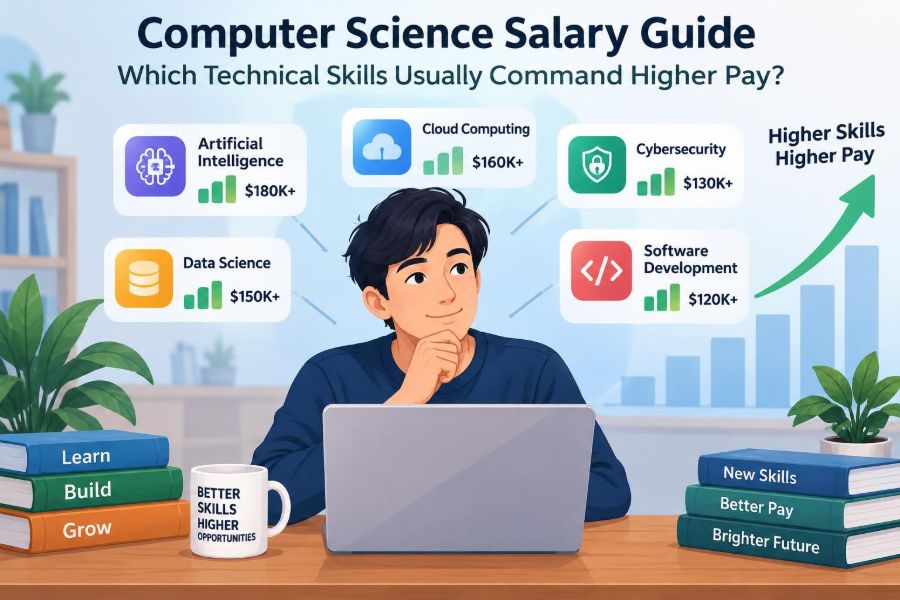

A developer sees a job posting with a salary range far above the roles they have been applying for. The description mentions cloud platforms, distributed systems, security reviews, and an unfamiliar acronym: MLOps. It is tempting to conclude that learning a few fashionable keywords is the entire answer.
Salary differences in computer science are real, but they are rarely a simple reward for knowing one programming language. Employers pay more when a skill helps them manage expensive systems, reduce serious risks, reach scarce expertise, or deliver outcomes that matter to the business.
That makes salary planning more practical than guessing which technology is “hot.” You can look at the problems a skill solves, the depth needed to use it responsibly, and the kind of organization that needs it.
This guide explains which technical skill areas often command higher pay, why they do so, and how to build a career plan without chasing every trend.
🧭 Salary Is a Market Signal, Not a Scorecard
A higher-paying specialty is not automatically more valuable, more enjoyable, or better for every career. Compensation reflects a particular labor market: employer demand, the cost of mistakes, local conditions, company finances, and the supply of people who can do the work.
For example, a team operating a payment platform may pay heavily for reliability expertise because downtime has immediate consequences. A small organization building an internal tool may reasonably value broad generalist development more.
💰 Understand Total Compensation Before Comparing Roles
“Salary” can mean base pay, but an offer may also include a bonus, equity, retirement contributions, insurance, paid leave, training funds, or on-call compensation. Equity can be valuable, uncertain, or worth little depending on the company and its terms.
Compare the whole package alongside workload and risk. A role with a larger number may include frequent emergency coverage, a costly location, or less predictable hours.
📈 Why Some Technical Skills Command Higher Pay
Technical skills tend to command more pay when they sit at the intersection of business impact, scarcity, and responsibility. A skill that is widely taught but easy to apply in routine work has different pricing from one that requires years of production experience.
- It supports revenue-critical products or infrastructure.
- Errors can create security, compliance, availability, or financial risks.
- It requires deep context beyond syntax and tutorials.
- Qualified practitioners are difficult to hire and retain.
- It works with systems that are costly or complex to change.
🏗️ Strong Fundamentals Raise the Ceiling
Data structures, algorithms, networking, operating systems, databases, testing, and software design do not always appear as flashy job-title keywords. Yet they underpin many of the better-compensated specializations.
A developer who understands latency, concurrency, transaction isolation, and failure modes can make sound decisions when an application grows. Fundamentals help you move between tools as the market changes.
☁️ Cloud Architecture and Platform Engineering
Cloud skills often command strong pay because organizations need secure, reliable, cost-aware systems rather than merely virtual machines. Cloud architects and platform engineers design reusable foundations that let product teams deploy and operate software safely.
Useful depth includes identity and access management, networking, infrastructure as code, observability, disaster recovery, and cost controls. Knowing a provider’s console is a start; designing a resilient system with sensible permissions is the higher-value capability.
⚙️ DevOps and Site Reliability Engineering
DevOps is a collaborative approach to software delivery and operations. Site reliability engineering, often called SRE, applies software engineering practices to reliability: service objectives, automation, incident learning, and capacity planning.
These roles can pay well because they influence how quickly teams ship and how safely systems run. They also carry responsibility during incidents, so employers often seek people with calm production judgment, not only tool familiarity.
🔐 Cybersecurity and Secure Engineering
Security work covers many specialties: application security, cloud security, identity, detection and response, penetration testing, governance, and security architecture. Organizations need different mixes depending on their products and risk profile.
Higher pay often follows expertise that prevents or contains consequential failures. Secure engineering is particularly valuable because it integrates threat modeling, code review, authentication design, and safe defaults into normal development rather than treating security as a final checklist.
🧠 Machine Learning Engineering
Machine learning engineers turn models into maintainable product features or decision systems. The job is broader than training a model in a notebook: it may involve data pipelines, evaluation, deployment, monitoring, privacy, and retraining.
Compensation can be strong where machine learning has a clear business use and the organization has quality data. It is not universally high-paying, however. A model without a reliable data source, useful evaluation criteria, or a real product need creates little value.
🤖 AI Systems and MLOps
MLOps is the practice of operating machine learning systems reliably. It adapts ideas from software delivery to models, datasets, experiments, model versions, and performance monitoring.
Generative AI has increased demand for people who can build responsible AI features, but valuable work still depends on fundamentals: data quality, retrieval design, prompt and output evaluation, access controls, latency, cost, and user experience. A demo is not the same as a dependable system.
📊 Data Engineering and Analytics Infrastructure
Data engineers build the pipelines and storage systems that make trustworthy data available. They may work with batch processing, streaming data, data warehouses, orchestration, schema design, data quality checks, and governance.
This work is often well compensated because incomplete, duplicated, or poorly defined data can mislead an entire organization. The highest value lies in creating data systems that are understandable, secure, timely, and usable by others.
🗄️ Database and Data Modeling Expertise
Many applications succeed or fail on data design. Database expertise includes modeling relationships, choosing indexes, understanding query plans, managing replication, and deciding when consistency or availability trade-offs are acceptable.
A developer who can diagnose a slow query and redesign a problematic access pattern may save a system from expensive scaling. This expertise becomes especially valuable in high-volume transactional systems and data-heavy products.
🌐 Distributed Systems and Backend Scale
Distributed systems run across multiple computers that communicate over networks. They introduce difficult realities: messages can be delayed, machines fail independently, data can become temporarily inconsistent, and retries can duplicate work.
Engineers who can design idempotent operations, queues, caching strategies, replication, and graceful failure handling are often valued in organizations operating at scale. The point is not using fashionable architecture; it is choosing enough complexity to solve a genuine reliability or throughput problem.
📱 Mobile Engineering Beyond the Interface
Mobile developers can command higher pay when they combine platform knowledge with product engineering. A polished mobile application must handle offline behavior, device differences, performance limits, secure storage, accessibility, releases, and telemetry.
Native platform expertise can be scarce in some markets, while cross-platform skills may be valuable where teams support several devices with limited resources. Demand varies considerably by industry and local product ecosystem.
🎨 Frontend Performance and Design Systems
Frontend development is sometimes wrongly treated as less technical than backend work. Modern web applications involve rendering performance, accessibility, state management, browser security, testing, build systems, and complex user interactions.
Senior frontend engineers create design systems and application architectures that let many teams build consistent interfaces faster. Skills such as accessibility and performance are valuable because they directly affect whether real people can use the product.
🔌 APIs, Integrations, and Enterprise Systems
Organizations often rely on software that must exchange data with payment providers, customer systems, identity services, vendors, and older internal platforms. Integration engineers work with APIs, event streams, authentication, error handling, mapping, and operational support.
This work can be highly valuable because it connects essential business processes. It also demands patience: the difficult part is frequently clarifying contracts, handling exceptions, and maintaining compatibility rather than writing the first request.
🧮 Low-Level, Embedded, and Systems Programming
Embedded systems engineers work close to hardware in devices such as industrial equipment, vehicles, sensors, and consumer electronics. Systems programmers may focus on operating systems, networking stacks, performance-sensitive services, compilers, or storage.
These areas can command high pay because they require specialized knowledge of memory, timing, hardware constraints, and debugging. Opportunities are more concentrated than general web development, so geography and industry matter greatly.
🧪 Testing, Quality Engineering, and Automation
Quality engineering is not simply clicking through a test script. Strong practitioners design test strategies, automate checks, improve test environments, investigate failures, and help teams prevent defects earlier.
Roles gain influence and compensation when they address release risk across a complex product. Someone who can improve flaky tests, establish meaningful integration coverage, and make failures diagnosable contributes far more than someone measuring activity by test-case counts.
🛡️ Privacy, Compliance, and Regulated Technology
Industries with strict obligations often need engineers who can translate policy requirements into technical controls. This may include audit trails, access boundaries, data retention, encryption, validation, and evidence for reviews.
Technical compliance work pays more in some settings because mistakes can block a sale, create exposure, or prevent a product from operating in its intended market. It is best approached as careful engineering, not as paperwork detached from the system.
🏦 Fintech, Payments, and Financial Systems
Financial software demands correctness under pressure. Payment flows, ledgers, reconciliation, fraud controls, and transaction processing require clear models for money movement, retries, approvals, and records.
Pay can be strong because errors are expensive and trust is central. However, this environment may also involve older systems, regulatory constraints, and deliberate change processes; it is not always the fastest route for someone seeking constant experimentation.
🏥 Health, Public Sector, and Mission-Critical Domains
Some technical roles are shaped more by domain knowledge than by a single programming skill. Health, government, industrial, and infrastructure systems may need engineers who understand privacy, traceability, safety constraints, accessibility, or long product lifecycles.
Compensation patterns vary widely. The key lesson is that domain expertise can compound technical expertise: knowing how a real industry works makes your engineering decisions more useful and harder to replace.
🧑💼 Technical Leadership and System Ownership
Senior, staff, principal, and engineering leadership roles are usually paid more because they widen the scope of impact. They may set architectural direction, reduce coordination problems, mentor engineers, and guide difficult trade-offs.
Leadership does not mean abandoning technical work. Effective technical leaders can explain why a design is appropriate, identify risks early, and help a group make progress when requirements are incomplete.
🗣️ Communication Turns Expertise Into Impact
A technically correct proposal has limited value if nobody can understand its trade-offs or carry it out. Clear writing, design reviews, incident communication, and stakeholder conversations are compensation-relevant skills because they make complex work usable.
For instance, explaining that a faster launch creates a specific security risk—and offering a smaller safe alternative—is more effective than simply saying “no.” Communication is not a substitute for technical depth; it multiplies its reach.
🧩 Breadth Versus Depth: Choose a Useful Shape
Early-career professionals often benefit from broad exposure: version control, testing, databases, web concepts, deployment, and collaboration. Over time, many stronger careers develop a “T” shape: broad understanding across adjacent work plus meaningful depth in one area.
| Career shape | Strength | Best fit |
|---|---|---|
| Broad generalist | Connects product needs across a small team | Startups, internal tools, early career exploration |
| Deep specialist | Solves unusually difficult technical problems | Large-scale, regulated, or specialized systems |
| T-shaped engineer | Combines specialization with collaboration | Most growing teams and senior technical paths |
Neither breadth nor depth is automatically superior. The useful choice depends on the problems you want to solve and the environment you want to work in.
🧱 Experience Beats a Long Tool List
Listing many frameworks can get attention, but employers usually pay for demonstrated judgment. Production experience teaches lessons that short courses cannot fully simulate: diagnosing failures, making safe migrations, estimating uncertainty, and supporting users after release.
When experience is limited, build evidence of judgment through a focused project. Document requirements, trade-offs, tests, deployment choices, monitoring, and what you would improve. A small, finished system says more than several abandoned tutorials.
🧾 Credentials Can Help, but They Are Not a Shortcut
Degrees, certifications, and structured programs can provide foundations and signal commitment. Certifications may be especially useful when an employer needs people familiar with a particular cloud platform or security practice.
They do not replace problem-solving ability. Treat a credential as a learning framework and a conversation starter, then reinforce it with practical work you can explain in detail.
🔎 Read Job Descriptions Like a Researcher
Review roles you might realistically want, not only the highest-paid postings. Look for repeated responsibilities, required versus preferred skills, seniority signals, and the business context behind the technology.
- Do roles ask for building new systems or maintaining critical existing ones?
- Is on-call work expected, and how is it supported?
- Which skills recur across several employers?
- What evidence of experience do they request?
- Does the role’s daily work match your interests?
This approach reveals durable skill clusters better than a single salary headline.
🛠️ Build a Focused Skill Plan
Choose one target direction for the next several months, then identify its foundations, tools, and practical proof. For cloud reliability, for example, that might mean Linux, networking, scripting, infrastructure as code, monitoring, and a deployed service with documented recovery steps.
- Pick a role family and a realistic entry point.
- Learn the concepts underneath the tools.
- Build or improve one complete project.
- Ask for feedback and revise your work.
- Practice explaining technical decisions clearly.
Focused progress is usually more credible than collecting unrelated badges.
⚠️ Avoid Chasing Salary Hype Alone
A skill may be in demand while still being a poor fit for your strengths or preferred working style. Security incident response, for example, can involve urgency and adversarial thinking; data engineering may involve detailed operational work; product frontend work may require frequent user-facing iteration.
Technology markets also change. A durable strategy combines a specialized direction with transferable foundations so that you can adapt when a tool, employer, or hiring cycle changes.
🗺️ Location, Remote Work, and Industry Change the Picture
Compensation differs by region, cost of living, legal employment arrangements, company stage, and industry. Remote work expands some opportunities, but it does not erase differences in tax rules, hiring practices, time zones, or local salary bands.
Compare roles within a relevant context. A lower nominal offer may provide better purchasing power, stability, mentorship, or work-life fit than a higher one elsewhere.
🤝 Negotiate With Evidence and Respect
Negotiation works best when it is grounded in your capabilities and the role’s scope. Discuss the systems you have improved, risks you have reduced, outcomes you have delivered, and responsibilities you are prepared to own.
You do not need to exaggerate. Ask clear questions about level, evaluation, growth path, on-call expectations, and total compensation. A good discussion helps both sides determine whether the role is aligned.
🌱 The Core Principle: Solve Valuable Problems Reliably
The highest-paying technical skills are usually not isolated technologies. They are capabilities for solving consequential problems: keeping systems available, protecting data, turning data into dependable decisions, scaling services, or building products people can actually use.
Build fundamentals first, then develop depth where you can sustain curiosity and responsibility. Pair that depth with communication, domain understanding, and evidence that you can deliver under real constraints.
The most durable route to stronger compensation is becoming trusted to solve difficult, valuable problems—not merely becoming familiar with the newest tool. Choose a direction, practice it deeply, and let useful results make your skills visible. 💻📈🧭