
You type a few words into a search box: a programming error, a restaurant name, or a question about a new skill. In less time than it takes to finish the sentence, a results page appears.
That quick response can make search feel like a simple lookup. But a search engine is not reading the entire web after you press Enter. It has already spent enormous effort discovering pages, understanding their contents, organizing them, and preparing answers in advance.
Search engines are a useful case study in computer science because they combine networks, distributed systems, databases, algorithms, language processing, and security. They also shape how people find information, businesses reach customers, and researchers locate sources.
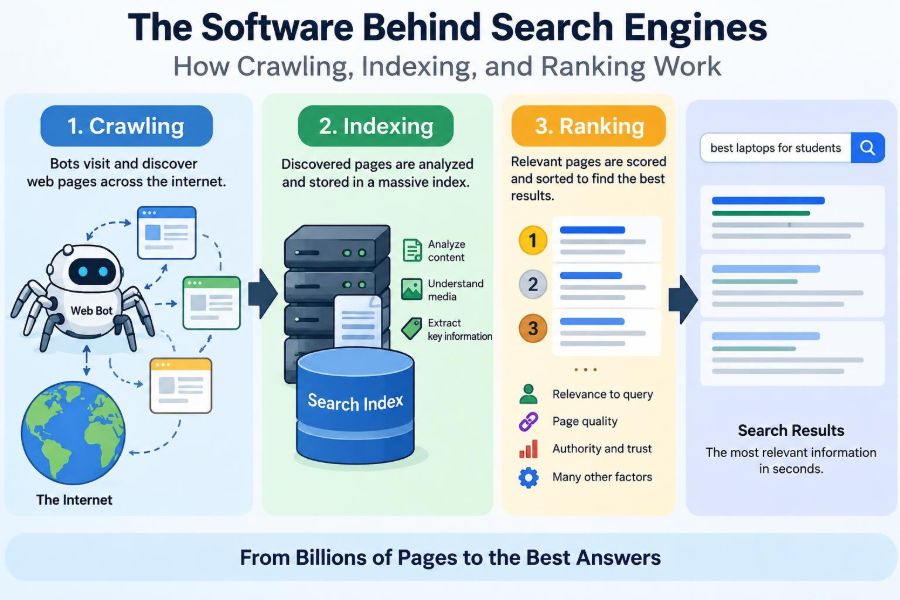
The central process is usually summarized in three words: crawling, indexing, and ranking. Each describes a different software problem, and understanding the differences explains both the power and the limits of search.
🔎 Search Is Retrieval, Not a Live Reading of the Web
At query time, a search engine mainly retrieves information from a prepared collection called an index. Think of a library catalog: it helps locate relevant books without requiring a librarian to read every shelf whenever someone asks a question.
The web is too large, too dynamic, and too slow for an engine to fetch and interpret every possible page for each search. Instead, the engine discovers pages beforehand, processes them, and stores compact representations that can be searched quickly.
🌐 The Web Is a Giant Changing Graph
From a software perspective, the web can be modeled as a graph. Pages are nodes, and hyperlinks are directed edges: a link from Page A to Page B points in one direction, even if B does not link back.
This graph is constantly changing. New pages appear, old pages disappear, URLs redirect, sites alter navigation, and content is edited. A search engine therefore cannot build its view once and consider the job complete.
🤖 What a Web Crawler Does
A web crawler, sometimes called a spider or bot, is software that requests web pages and follows eligible links it finds. It begins with known URLs, often called seeds, then expands outward through discovered links.
Fetching a page resembles what a browser does: the crawler sends an HTTP request and receives a response. Yet a crawler is designed for large-scale, automated collection rather than interactive viewing. It records metadata, handles failures, and places useful new URLs into a future-work queue.
🌱 Seeds Give Crawling a Starting Point
Crawlers need initial addresses because the web has no single master directory. Seeds can come from previously known pages, submitted site maps, public data sources, domain registrations, or URLs encountered during earlier crawls.
Starting from many reliable seeds helps a crawler discover separate regions of the web. Still, no ordinary crawler can guarantee that it will discover every page, especially pages with no inbound links, pages behind logins, or pages generated only after user actions.
📬 The URL Frontier Is a Scheduling Queue
Every discovered URL cannot be fetched immediately. Crawlers maintain a URL frontier: a large scheduling system that decides which address to visit next and when.
The decision is not simply first-in, first-out. Software may prioritize a frequently updated news page over an old archive, avoid repeatedly requesting one host, and delay retries after errors. The frontier is where crawling becomes a resource-allocation problem.
🚦 Politeness Prevents Crawlers From Becoming a Burden
A poorly behaved bot can overload a small website by making too many requests at once. Responsible crawlers limit request rates per host, spread requests over time, and react to server errors or slow responses.
This practice is often called politeness. It protects site infrastructure, but it also creates a trade-off: being more respectful and efficient may mean that some pages are revisited less often.
📜 Robots.txt Communicates Crawl Preferences
Many sites publish a robots.txt file near the root of a domain. It can state which paths particular crawlers should avoid and may identify the location of a sitemap.
Robots.txt is a communication convention, not a security boundary. It does not protect confidential files from someone who knows their address, and malicious software may ignore it. Content requiring protection should use authentication and proper access controls.
🗺️ Sitemaps Offer Helpful URL Hints
A sitemap is a file that lists pages a site wants search engines to know about. It is especially helpful for pages that are difficult to reach through ordinary navigation, such as product records, articles deep in an archive, or pages connected through JavaScript interfaces.
A sitemap is not a command to index every listed URL. A search engine still evaluates whether it can fetch the page, whether the page is useful, and whether another version appears to be the preferred copy.
🔁 Canonical URLs Reduce Duplicate Confusion
The same content can often be reached through several URLs. Tracking parameters, alternative protocols, print versions, sorting controls, and inconsistent capitalization can create many addresses for what users see as one page.
Search systems try to canonicalize these variants: identify the version that should represent the content. Sites can provide hints, but engines also compare redirects, page content, internal links, and other signals. Duplicate handling prevents the index from being crowded with near-identical entries.
📥 Fetching Is More Complicated Than Downloading HTML
A server response has a status code, headers, and usually a body. Crawlers must interpret redirects, missing pages, temporary failures, access restrictions, content types, and character encodings before they can decide what to do next.
For example, a redirect may tell the crawler that a document moved. A server error may lead to a later retry. A response labeled as an image or document requires a different processing path than ordinary HTML.
🧩 JavaScript Creates a Rendering Challenge
Some pages send meaningful HTML directly from the server. Others send a minimal shell and rely on JavaScript to request and display content after the page loads. A basic downloader may see little more than navigation and scripts.
Search engines may use browser-like rendering systems to execute some JavaScript, but rendering costs more computing time than reading static HTML. It can also fail when content depends on user sessions, blocked resources, or unusual client-side behavior.
🧹 Parsing Turns Documents Into Structured Data
After a page is fetched, software parses its document structure. In HTML, elements such as titles, headings, paragraphs, links, image descriptions, and metadata offer clues about both content and relationships.
Parsing also extracts outgoing links for future crawling. The result is not merely a saved page; it is a structured record containing text, fields, links, language clues, timestamps where available, and processing decisions.
🛡️ Crawlers Need Defenses Against Traps
The web includes accidental and deliberate crawler traps. A calendar might generate a different URL for every possible date, a faceted store may create endless filter combinations, or a faulty application may link to an effectively infinite sequence of pages.
Crawlers use rules to detect repetition, limit depth or parameter patterns, and avoid spending their entire budget on one site. They must also treat downloaded material carefully because web content can be malformed or designed to exploit software weaknesses.
📚 Indexing Makes Content Searchable
Indexing converts processed documents into data structures optimized for retrieval. Storing raw pages alone would not support fast search across billions of terms and documents.
During indexing, the system may identify words, normalize text, record fields such as titles and headings, associate terms with documents, and store signals needed later for ranking. The details differ by language and engine design, but the goal remains fast candidate retrieval.
🔤 Tokenization Breaks Text Into Searchable Units
A token is a unit the search system can work with, often a word but not always. Tokenization must handle punctuation, apostrophes, hyphens, numbers, symbols, URLs, and languages that do not separate words with spaces.
For a query such as “error code 404,” keeping both the number and nearby terms may matter. Treating every punctuation mark or character identically would lose useful meaning, so tokenization rules are more nuanced than simply splitting on spaces.
🧠 Normalization Connects Related Forms
Normalization reduces superficial differences. An engine may make case differences irrelevant, interpret accented and unaccented forms sensibly, or use language-aware techniques to connect related grammatical forms.
These techniques help a search for “running” find relevant material containing “run,” but they can also introduce ambiguity. Technical terms, names, and programming identifiers sometimes need more literal treatment than ordinary prose.
🗂️ The Inverted Index Is the Core Lookup Structure
The most famous search data structure is the inverted index. Instead of storing only “document to words,” it stores “word to documents.” For each term, the index keeps a posting list of documents in which that term occurs.
A simplified entry might say that the token crawler appears in documents 12, 48, and 91, often with positions inside each document. Position data supports phrase searches such as “web crawler,” where word order and proximity matter.
| Structure | Question it answers efficiently | Simple example |
|---|---|---|
| Forward document record | What terms and fields are in this page? | Page 48 contains “crawler” in its title. |
| Inverted index | Which pages contain this term? | “crawler” occurs in pages 12, 48, and 91. |
| Link graph | Which pages refer to which others? | Page 12 links to Page 48. |
🧱 Sharding Spreads the Index Across Machines
A web-scale index cannot usually live on one machine. Search systems split, or shard, data across many servers. A query is sent to relevant shards, which each return promising candidates.
A coordinating service merges those candidate lists into one result set. Replication—keeping copies on multiple machines—helps systems continue operating when hardware fails and can distribute heavy query traffic.
⚡ Caching Makes Repeated Work Cheaper
Popular queries and frequently used index data may be cached in fast memory. A cache stores a recently computed result or a frequently accessed data block so the system does not repeat expensive work unnecessarily.
Caches improve speed, but they create a freshness question. If a page changes or an index is updated, cached results may need invalidation or replacement. Search engineering often balances low latency against the cost of perfectly immediate updates.
❓ A Query Begins With Interpretation
When you submit a query, the engine does more than match characters. It identifies tokens, detects likely language, handles spelling variants, and may infer that a phrase, location, recent event, or specific entity is involved.
Interpretation is useful when a query is incomplete. Someone searching “python list” may mean the programming language rather than an animal list. But intent inference is uncertain, so engines need ways to preserve direct matches and allow users to refine searches.
🎯 Candidate Retrieval Narrows a Massive Collection
The index can locate documents containing query terms quickly, but millions of documents may match a common word. The first ranking stage therefore retrieves a manageable set of plausible candidates rather than deeply evaluating every matching page.
Boolean operations help combine terms. An AND-like requirement narrows results to documents containing multiple terms, while phrase and proximity rules can favor terms that occur together in meaningful ways.
📊 Ranking Orders Results by Estimated Usefulness
Ranking sorts candidate documents by an estimate of how well they satisfy a particular query. It is not a single universal measure of “best page.” A useful result for a beginner, a local customer, and a researcher may differ.
Modern ranking commonly combines many signals. The exact weighting is generally proprietary and changes over time, but the broad categories are understandable: relevance to query terms, document quality indicators, freshness, location when appropriate, usability, and relationships in the web graph.
📝 Text Relevance Looks Beyond Simple Word Counts
A page that repeats a word many times is not automatically a good answer. Search systems consider where terms occur, whether the wording aligns with the query, how rare terms are across the collection, and whether terms appear near one another.
Terms in a descriptive title or a clear heading can be more informative than the same terms hidden in unrelated boilerplate. This does not mean page authors should cram keywords into headings; artificial repetition can make content worse for both readers and evaluators.
🔗 Links Act as Discovery Paths and Signals
A link is a navigational choice: one page is pointing readers toward another. Aggregated across many pages, links can offer evidence about a document’s prominence or relationship to a topic.
Link-based analysis has limits. Links can be bought, automatically generated, irrelevant, or manipulated. Good systems therefore treat links as one family of signals rather than an unquestionable vote of truth or quality.
⏰ Freshness Depends on the Query
For a query about a breaking event, a newer page may deserve strong preference. For a question about a stable mathematical concept, a carefully maintained older explanation may be just as useful or better.
Freshness is therefore contextual. The engine must estimate whether recency is likely to matter, while crawlers must decide how often to revisit sources that change at different rates.
📍 Context Can Improve Local and Personal Results
Some queries have an obvious local intent. “Pharmacy open now” is more useful when results reflect the searcher’s approximate location and current time than when it lists distant businesses.
Language settings, device type, and past interactions can also affect results in some systems. This can make search more convenient, but it raises privacy and transparency concerns. Users should understand that two people may not see identical results for the same words.
🧪 Machine Learning Helps Combine Complex Signals
Machine-learning models can help estimate relevance from patterns in queries, documents, and interactions. They are particularly useful for understanding related wording, classifying content, detecting spam patterns, and combining many weak signals that would be difficult to hand-tune.
These models do not eliminate the need for careful engineering. Their outputs depend on data, objectives, testing, and safeguards. A model can misunderstand unusual wording, reflect gaps in training data, or optimize a proxy measure that does not fully represent user satisfaction.
🚫 Spam Attempts to Exploit Ranking Systems
Search spam is content or behavior designed primarily to gain visibility without providing the value implied by the result. Examples include copied pages, keyword stuffing, deceptive redirects, automatically generated nonsense, and artificial link schemes.
Defenses may combine automated classifiers, quality checks, link analysis, manual review processes, and user feedback. The problem is ongoing because ranking rules create incentives for people to reverse-engineer them.
⚖️ Relevance Is Not the Same as Truth
A ranking system estimates relevance and usefulness using available evidence; it cannot guarantee that every high result is accurate, current, safe, or unbiased. A polished page can be wrong, and a reliable source may not use the words a searcher expects.
For health, legal, financial, technical safety, or high-stakes decisions, search results should be a starting point for evaluating sources, not the final authority. Check authorship, dates, primary documentation, and whether claims are supported.
🔒 Search Creates Privacy and Security Responsibilities
Queries can reveal sensitive interests, problems, locations, or plans. Search providers and site owners must consider how logs are retained, secured, and used. Users should also avoid entering passwords, account numbers, or other secrets into search boxes.
Search results can lead to phishing pages or misleading downloads. Before entering information or running downloaded software, inspect the destination, verify the organization independently when needed, and treat urgency or unusual requests with caution.
🧭 Why Search Results Differ Between Engines
Different engines crawl different parts of the web at different times. They also build different indexes, interpret language differently, select distinct ranking signals, and make different decisions about spam, locality, and freshness.
That is why trying a second engine, changing the query wording, adding a domain name, or using quotation marks for an exact phrase can reveal different useful material. Search is an algorithmic judgment process, not a single neutral inventory.
🛠️ Practical Search Techniques for Better Results
A precise query gives the system better evidence about your intent. Add distinctive nouns, an error message, a product model, a programming language, a date range, or the word “documentation” when those details matter.
- Put a short exact phrase in quotation marks when exact wording is essential.
- Add
site:example.orgwhen you want to search within one known domain, if your search engine supports it. - Use minus signs cautiously to exclude an unwanted meaning, such as
jaguar -car. - Read the result title, source, and date before opening; a relevant snippet is not proof that the page answers your question.
These techniques do not replace evaluation, but they reduce ambiguity and help ranking software retrieve a better candidate set.
🧑💻 Practical Guidance for Website Owners
Pages are easiest to discover and interpret when they have stable URLs, descriptive titles, useful visible text, sensible internal links, and a structure that works without requiring fragile client-side behavior.
Do not block important assets or content unintentionally, and use redirects carefully when pages move. A sitemap can help discovery, but the strongest long-term strategy is content that genuinely answers a clear need and a site architecture that makes that content reachable.
🏗️ The End-to-End Pipeline Connects Many Systems
A search engine is not one algorithm. It is a pipeline of specialized services: discovery queues, network fetchers, renderers, parsers, document processors, indexes, distributed query servers, ranking systems, caches, monitoring tools, and abuse defenses.
Failures at one stage affect the next. If a crawler cannot reach a page, there is nothing new to index. If indexing misreads its language, retrieval may miss it. If ranking misjudges intent, a technically matching page may still be unhelpful.
✅ The Core Principle: Prepared Knowledge Enables Fast Answers
Crawling discovers public material and revisits it over time. Indexing transforms that material into structures built for rapid lookup. Ranking then chooses an order based on estimated relevance, quality, context, and freshness.
The essential insight is that search succeeds by doing difficult work before a query arrives, then making carefully constrained decisions in milliseconds. Its results are powerful aids to discovery, but they remain estimates produced from incomplete, changing information.
Search engines work best when we see them as large-scale retrieval systems: they discover, organize, and rank the web, but thoughtful queries and critical readers are still part of the process. 🔎💻🌐