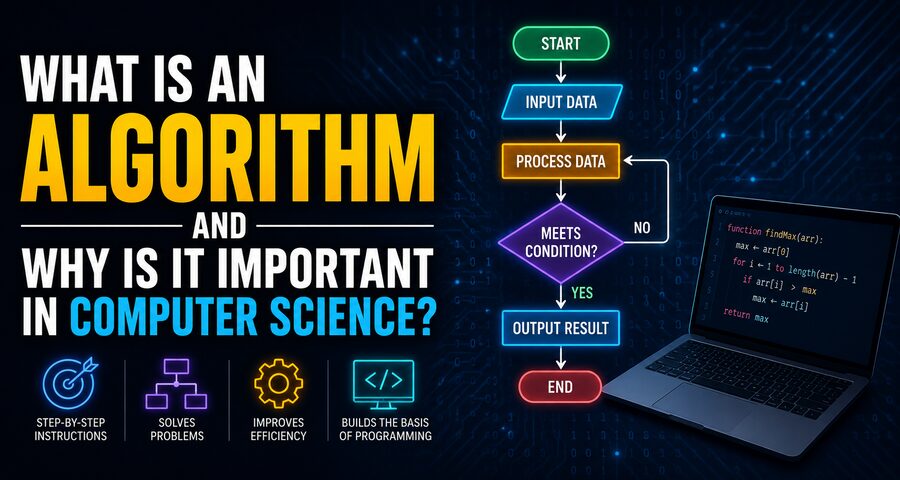

Algorithms are everywhere in modern life. They help search engines decide which websites to show, navigation apps find the fastest route, streaming services recommend movies, banks detect suspicious transactions, and smartphones recognize faces. Yet despite how often the word algorithm appears in conversations about technology, its basic meaning is surprisingly simple.
An algorithm is a finite, ordered set of instructions used to solve a problem or complete a task.
In computer science, algorithms are fundamental because computers do not independently decide how to solve problems. Programmers must define procedures that tell computers what steps to perform, in what order, and under what conditions.
A good algorithm can make software faster, more reliable, and more efficient. A poor algorithm may produce the correct answer but require far more time, memory, or computing power than necessary.
Understanding algorithms is therefore one of the most important foundations of computer science. 🖥️✨
🧠 What Exactly Is an Algorithm?
An algorithm can be thought of as a step-by-step procedure.
Imagine you want to find the largest number in a list:
4, 12, 7, 25, 9
A simple algorithm could be:
- Start with the first number.
- Treat it as the largest number found so far.
- Compare it with the next number.
- If the next number is larger, replace the current largest value.
- Continue until every number has been checked.
- Return the largest number.
The result would be 25.
This procedure is an algorithm because it clearly defines the steps required to reach the solution.
Algorithms do not have to be written in a programming language. They can first be expressed in ordinary language, diagrams, flowcharts, or pseudocode.
Only later does a programmer translate the algorithm into code that a computer can execute. 💻
🍳 Algorithms Exist Outside Computer Science
The idea of an algorithm is much older than modern computers.
A cooking recipe, for example, resembles an algorithm:
- Gather the ingredients.
- Preheat the oven.
- Mix the ingredients.
- Place the mixture in a baking dish.
- Bake for a specified amount of time.
- Remove and serve.
Similarly, instructions for assembling furniture, solving a mathematical equation, or sorting books alphabetically can all be thought of as algorithmic procedures.
What makes algorithms especially important in computing is that computers can execute enormous numbers of carefully defined operations extremely quickly. ⚡
🔑 Important Characteristics of an Algorithm
Although algorithms can take many forms, useful algorithms generally share several important characteristics.
📥 1. Input
An algorithm may receive information to process.
For example, a navigation algorithm might receive:
- Your current location
- Your destination
- Road information
- Traffic conditions
The algorithm then uses those inputs to calculate a route.
📤 2. Output
An algorithm should produce a result.
For a navigation system, the output might be the recommended route and estimated travel time.
For a calculator, the output might be the result of a mathematical operation.
🎯 3. Clear Instructions
Each step should be sufficiently precise.
A computer cannot reliably follow an instruction such as:
“Choose a pretty large number.”
The instruction must instead define exactly what conditions determine the choice.
🏁 4. Finite Execution
A conventional algorithm should eventually stop after completing its task.
If a procedure continues forever without reaching its intended result, it may indicate a problem such as an infinite loop.
✅ 5. Correctness
An algorithm should produce the expected result for the inputs it is designed to handle.
Correctness is one of the most important requirements in software development.
💻 Algorithm vs. Program: What Is the Difference?
Algorithms and computer programs are closely related, but they are not the same thing.
An algorithm describes the logical method used to solve a problem.
A program is an implementation of that algorithm written in a programming language such as Python, Java, C++, or JavaScript.
For example, suppose you design an algorithm for sorting student names alphabetically.
That same algorithm could potentially be implemented in several different programming languages.
The underlying logic remains similar even if the syntax changes.
This distinction is important because computer science is not only about learning programming languages. It is also about understanding the underlying methods used to solve computational problems. 🧩
🗂️ Common Types of Algorithms
Computer scientists have developed many categories of algorithms for different types of problems.
🔍 Search Algorithms
Search algorithms find specific information inside collections of data.
A very simple method is linear search.
Suppose a list contains:
3, 8, 12, 19, 27
If you want to find 19, a linear search checks each item from the beginning until it finds the target.
Another method is binary search, which can be much faster when the data is already sorted.
Binary search repeatedly divides the search area approximately in half.
This ability to eliminate large portions of the data makes it highly efficient for large sorted collections.
🔢 Sorting Algorithms
Sorting algorithms arrange data in a particular order.
Examples include:
- Bubble sort
- Selection sort
- Insertion sort
- Merge sort
- Quick sort
- Heap sort
Some sorting algorithms are relatively easy to understand but inefficient for large datasets.
Others are more sophisticated and can handle millions of items much more effectively.
Sorting is important because organized data can often be searched and processed more efficiently.
🌳 Graph Algorithms
A graph in computer science is a structure consisting of nodes connected by links called edges.
Graphs can represent many real-world systems, including:
- 🗺️ Roads between cities
- 👥 Relationships in social networks
- 🌐 Links between webpages
- 📡 Computer networks
- ✈️ Airline routes
Graph algorithms can answer questions such as:
“What is the shortest path from one city to another?”
Algorithms such as Dijkstra’s algorithm are widely used for shortest-path problems involving weighted graphs.
🔁 Recursive Algorithms
A recursive algorithm solves a problem by breaking it into smaller versions of the same problem.
For example, the mathematical factorial of 5 is:
5 × 4 × 3 × 2 × 1 = 120
A recursive function might calculate factorial by repeatedly calling itself with a smaller number until reaching a base case.
Recursion can provide elegant solutions to certain problems involving trees, mathematical sequences, and divide-and-conquer techniques.
🧩 Divide-and-Conquer Algorithms
Divide-and-conquer algorithms break a large problem into smaller subproblems, solve those subproblems, and then combine their results.
Merge sort is a classic example.
It divides a list into smaller lists, sorts those smaller sections, and merges them back together in order.
This strategy is powerful because solving several smaller problems can sometimes be much easier than solving one large problem directly.
🚀 Why Are Algorithms So Important?
Algorithms matter because the same problem can often be solved in many different ways.
Suppose two programs both correctly sort one million numbers.
One program finishes in less than a second.
The other takes several hours.
Both may be technically correct, but their practical usefulness is clearly very different.
Choosing a better algorithm can dramatically improve:
- ⚡ Processing speed
- 💾 Memory usage
- 🔋 Energy efficiency
- 📈 Scalability
- 💰 Computing cost
In large computing systems, algorithmic efficiency can have enormous consequences.
⏱️ Algorithm Efficiency and Big O Notation
Computer scientists often describe algorithm efficiency using Big O notation.
Big O notation describes how the amount of work performed by an algorithm grows as the size of its input increases.
For example, an algorithm with complexity:
O(n)
generally performs work that grows roughly in proportion to the number of input elements.
An algorithm with:
O(n²)
can become much slower as the input grows because its work may increase approximately with the square of the input size.
Suppose an algorithm processes 100 items.
An O(n) approach might perform roughly 100 operations, while an O(n²) approach could require approximately 10,000 operations, depending on the exact algorithm.
As datasets become enormous, these differences matter tremendously. 📊
💾 Space Complexity
Speed is not the only concern.
Algorithms also consume computer memory.
Space complexity describes how much additional memory an algorithm requires as its input grows.
Sometimes programmers must make trade-offs.
One algorithm may run faster but require more memory.
Another may use less memory but take longer to execute.
Selecting the best approach depends on the problem, hardware, available resources, and performance requirements.
🌐 Algorithms Power the Internet
Many online services depend on sophisticated algorithms.
Search engines use algorithms to:
- Crawl webpages
- Build search indexes
- Interpret search queries
- Rank relevant pages
- Detect spam
Social-media platforms use algorithms to organize enormous streams of posts and recommend content.
Online stores use recommendation algorithms to suggest products.
Email services use algorithms to identify spam and malicious messages.
Without efficient algorithms, processing the enormous amount of information generated online would be extremely difficult.
🗺️ Algorithms Help Us Navigate
Navigation systems provide an excellent example of algorithms in everyday life.
When you request directions, the system may consider:
- Road networks
- Travel distances
- Speed limits
- Current traffic
- Road closures
- Turn restrictions
A route-finding algorithm searches through many possible paths and attempts to find an efficient route.
If traffic changes while you are traveling, the system may run additional calculations and suggest another route. 🚗📍
🤖 Algorithms in Artificial Intelligence
Artificial intelligence also relies heavily on algorithms.
Machine-learning systems use algorithms to identify patterns in data and make predictions.
For example, algorithms can help computers:
- 🖼️ Recognize objects in images
- 🗣️ Process human language
- 📧 Identify spam
- 🩺 Analyze medical data
- 💳 Detect unusual financial activity
- 🎬 Recommend videos
- 🚘 Assist autonomous driving systems
Machine learning differs from traditional programming in important ways because models can learn patterns from data rather than relying entirely on manually specified rules.
However, algorithms are still essential for training models, optimizing parameters, processing data, and producing results.
🔐 Algorithms and Cybersecurity
Cybersecurity depends heavily on algorithms.
Encryption algorithms transform readable information into encoded data that unauthorized people should not be able to understand easily.
Cryptographic algorithms help protect:
- 🔐 Passwords
- 💳 Financial transactions
- 🏦 Banking systems
- 💬 Private communications
- 🌐 Secure websites
Hashing algorithms can also help verify data integrity and securely store certain types of authentication information.
Modern digital security would be impossible without carefully designed cryptographic algorithms.
🏦 Algorithms in Banking and Finance
Banks and financial institutions process enormous numbers of transactions.
Algorithms can help:
- Detect suspicious spending
- Assess financial risk
- Process transactions
- Analyze markets
- Automate certain trading decisions
- Verify account activity
For example, if a credit card is suddenly used thousands of kilometers away from its usual location, fraud-detection systems may analyze that transaction alongside other information and decide whether additional verification is necessary.
🏥 Algorithms in Healthcare
Algorithms are increasingly used to support healthcare systems.
They can help analyze:
- Medical images
- Laboratory results
- Patient records
- Genetic data
- Hospital scheduling
- Treatment patterns
Algorithms may help medical professionals identify patterns that deserve closer examination.
However, medical algorithms must be carefully validated because errors, biased training data, or inappropriate use can have serious consequences.
Human expertise and responsible oversight remain essential. 🩺
⚠️ Algorithms Can Also Make Mistakes
Algorithms are not automatically objective or correct simply because they are mathematical.
They are created by people and depend on assumptions, rules, and data.
An algorithm can produce poor results if:
- The original design is flawed
- The input data contains errors
- Important information is missing
- Training data contains biases
- The algorithm is applied outside its intended purpose
This is particularly important when algorithms influence decisions about employment, loans, healthcare, education, or public services.
Responsible computer science therefore includes not only making algorithms efficient but also examining their fairness, reliability, transparency, security, and consequences. ⚖️
🧑💻 Why Programmers Study Algorithms
Learning algorithms teaches programmers something more important than memorizing specific solutions.
It teaches problem-solving.
When facing a new programming challenge, a developer can ask:
- What information do I have?
- What result do I need?
- Can I divide the problem into smaller pieces?
- What data structure should I use?
- How fast does the solution need to be?
- How much memory can it use?
- What unusual inputs could cause errors?
This type of systematic reasoning is central to computer science.
🏗️ Algorithms and Data Structures Work Together
Algorithms are closely connected to data structures.
A data structure determines how information is organized in memory.
Examples include:
- Arrays
- Linked lists
- Stacks
- Queues
- Hash tables
- Trees
- Graphs
Choosing the correct data structure can make an algorithm significantly faster.
For example, searching for an item in an unsorted list may require checking many entries, while a well-designed hash table can often locate information much more quickly.
Efficient software usually depends on choosing good algorithms and appropriate data structures.
🌟 Final Thoughts
An algorithm is fundamentally a clear sequence of steps for solving a problem or accomplishing a task. Although the concept sounds simple, algorithms form the foundation of almost everything computers do.
Whenever a computer sorts information, searches a database, calculates a route, encrypts a message, recommends a movie, detects fraud, processes an image, or trains an AI model, algorithms are working behind the scenes. 💻⚙️
The importance of algorithms comes from the fact that there is rarely only one possible way to solve a computational problem. Different algorithms can produce dramatically different results in terms of speed, memory usage, reliability, scalability, and cost.
For computer scientists and programmers, understanding algorithms therefore means learning how to transform problems into precise procedures that machines can execute efficiently.
Programming languages may change over time, and new technologies will continue to appear, but the ability to design, analyze, and improve algorithms will remain one of the most valuable skills in computing. 🧠🚀
In that sense, algorithms are more than instructions for computers. They are a structured way of thinking about problems—breaking complicated challenges into logical steps that can be understood, tested, improved, and ultimately solved.